Advent Day 15: The Savior in our midst

TODAY’S READINGS

FROM Zephaniah 3:17-18a (the full passage is Zep 3:14-18a):

   The LORD, your God, is in your midst,
        a mighty savior;
    he will rejoice over you with gladness,
        and renew you in his love,
    he will sing joyfully because of you,
        as one sings at festivals.

From The Word of the Lord (Year C), page 22

“[T]he Lord is described as a bridegroom. The words ‘rejoice over you,’ ‘renew you in his love,’ ‘sing joyfully because of you,’ describe the behavior of a bridegroom. Many Advent/Christmas texts have nuptial themes because the Incarnation of Christ is the ‘wedding’ of two natures, human and divine. God weds his nature to ours in Christ. Furthermore, Jesus is the promised ‘Bridegroom King’ from the line of David, fulfilling many texts which describe the king from the line of David as the ideal spouse.”

FROM Isaiah 12:2 (the full passage is Is 12:2-3, 4, 5-6):

God indeed is my savior;
I am confident and unafraid.
My strength and my courage is the LORD,
and he has been my savior.

From The Word of the Lord (Year C), page 23

“The joyful theme of this doxology fits the mood of this Mass and ties with the First Reading through the motif of God being ‘in [the] midst’ of his people.”

FROM Philippians 4:5b-6 (the full passage is Phil 4:4-7)

The Lord is near.
Have no anxiety at all, but in everything,
by prayer and petition, with thanksgiving,
make your requests known to God

From The Word of the Lord (Year C), page 24

“St. Paul’s advice in this reading is some of his most intensely practical teaching. He gives some keys to lifestyle of rejoicing: (1) not being anxious, through abandonment to God’s providence, (2) showing kindness to everyone, (3) making constant practice of prayer as an antidote to worry, including intercession, supplication, and especially thanksgiving in our prayer. How often we forget to include thanksgiving, and how important it is for the maintenance of joy on both a psychological and spiritual level!”

FROM Luke 3:18 (the full passage is Lk 3:10-18)

Exhorting them in many other ways,
he preached good news to the people.

From The Word of the Lord (Year C), page 26

“We need to keep reminding ourselves that the good news is not a plan for temporal comfort in this life because it is our tendency to revert to thinking that it is And when we look around and see that things are not comfortable, even after two thousand years, we mistakenly think the good news has not worked.
“The good news is about eternal life with God through Jesus Christ, which starts now but won’t be directly seen until the life in the world to come! The good news really is about heaven and what lies beyond the grave.

“The exhortation to rejoice in the first two readings and psalm are not based on some external reality, but on an interior and eternal reality: that Christ has come and taken up residence in our hearts, giving us communion with God even now and in the life to come. This is truly good news!”

MY TAKE

The Lord is near! The Lord is my savior! The first three Scripture passages pound home these themes. How do we know these proclamations to be true? Because, starting with John the Baptist, the Church has “preached good news to the people” — the news of the Savior in our midst: Jesus Christ.

I can’t help but think of the two primary ways Jesus is tangibly present to us today. In the Eucharist and in the Bible. Jesus, the Word, gives us Himself for our digestion, in Sacrament and in Scripture. Both should be consumed ravenously at every opportunity. But unlike food we eat that we assimilate to sustain us physically, the Food that is Jesus is meant to assimilate us into Him. Let us have frequent recourse to the Holy Spirit, the Lord and giver of life, to breathe life into us through consuming the Word.

BP BARRON SERMON

FR MIKE SCHMITZ HOMILY
God bless!
Lent Day 25: ‘O God, be merciful to me a sinner.’

TODAY’S READINGS

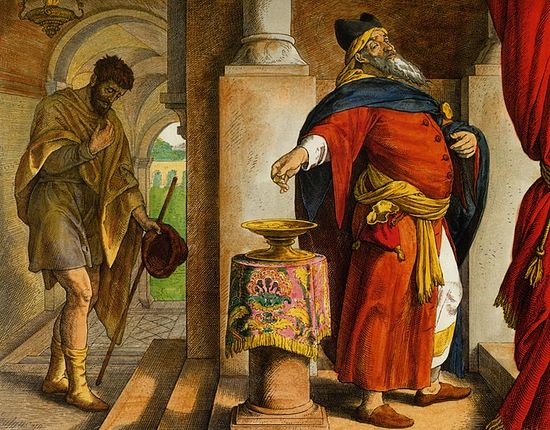
Today’s Gospel (Lk 18:9-14) gives us the Parable of the Pharisee and the Tax Collector. Jesus is making few friends with the former group but is giving hope to the latter. The words of the tax collector in prayer are extolled by Jesus:

“‘O God, be merciful to me a sinner.’” (v. 13b)

“[The tax collector] asked God to ‘be merciful’ (hilaskomai) to him. This verb…occurs only once elsewhere in the New Testament, where it means to ‘expiate’ or make atonement for sin (Heb 2:17). Such ‘sacrificial overtones’ fit the parable’s temple setting, all the more so if the prayer occurs at the time of the daily sacrifice.” (The Gospel of Luke [Catholic Commentary on Sacred Scripture], 304)

“‘Prayer is the raising of one’s mind and heart to God or the requesting of good things from God.’ But when we pray, do we speak from the height of our pride and will, or ‘out of the depths’ of a humble and contrite heart? He who humbles himself will be exalted; humility is the foundation of prayer, Only when we humbly acknowledge that ‘we do not know how to pray as we ought,’ are we ready to receive freely the gift of prayer. ‘Man is a beggar before God.'” (CCC 2559)

“With bold confidence, we began praying to our Father. In begging him that his name be hallowed, we were in fact asking him that we ourselves might be always made more holy. But though we are clothed with the baptismal garment, we do not cease to sin, to turn away from God. Now, in this new petition, we return to him like the prodigal son and, like the tax collector, recognize that we are sinners before him. Our petition begins with a ‘confession’ of our wretchedness and his mercy. Our hope is firm because, in his Son, ‘we have redemption, the forgiveness of sins.’ We find the efficacious and undoubted sign of his forgiveness in the sacraments of his Church.” (CCC 2839)

Humility is the gem-casket of all virtues. We are to put the onus on ourselves for our sins, faults, and shortcomings. It is easy to blame others for paving the way toward our own indiscretions, but keeping it simple is the way to go. Acknowledge we’re sinners and beg for the Almighty’s mercy. We know better and yet we fall so many times.

“What I do, I do not understand. For I do not do what I want, but I do what I hate. Now if I do what I do not want, I concur that the law is good. So now it is no longer I who do it, but sin that dwells in me. For I know that good does not dwell in me, that is, in my flesh. The willing is ready at hand, but doing the good is not. For I do not do the good I want, but I do the evil I do not want. Now if [I] do what I do not want, it is no longer I who do it, but sin that dwells in me.” (Rom 7:15-20)

Paul has the right attitude. While a sinner like all of us, he recognizes sin, its source, and its detrimental effects. Half the battle is acknowledging the wrongdoing we do; then resolve to overcome it (with God’s grace of course). I’m reminded of the AA 12-step program: admit our powerlessness and humbly ask God for help.

It seems to me that the words of the publican are worth incorporating into our daily prayer time. Let’s resolve to do so.

THE LITANY OF REPARATION IN THE BLESSED SACRAMENT

A beautiful prayer that acknowledges sins against the Eucharist and our sorrow for these outrages with a desire to make amends. Thanks to Dr. John Bergsma for sharing this in today’s Exodus & Exile episode.

God bless.

Lent Day 11: Is perfection attainable?

TODAY’S READINGS

Today’s Gospel (Mt 5:43-48), again from the Sermon on the Mount, ends with these challenging (to say the least) words of Jesus:

“So be perfect, just as your heavenly Father is perfect.” (v. 48)

“Strictly speaking, it is quite impossible for a created being to be as perfect as God. What our Lord means here is that God’s own perfection should be the model which every Christian tries to follow, even though he realizes that there is an infinite distance between himself and his Creator. However, this does not reduce the force of this commandment; it sheds more light on it. It is a difficult commandment to live up to, but along with this we must take into account the enormous help grace gives us to go so far as to tend towards divine perfection. Certainly, the perfection which we should imitate does not refer to the power and wisdom of God, which are totally beyond our scope; here the context seems to refer primarily to love and mercy. Along the same lines, St Luke quotes these words of our Lord: “Be merciful. even as your Father is merciful” (Lk 6:36).

“Clearly, the ‘universal call to holiness’ is not a recommendation but a commandment of Jesus Christ.” (The Navarre Bible: St Matthew, 69-70)

“Jesus advocates moral righteousness higher than the Old Covenant—it is a standard of mercy. Just as Israel was to imitate God in being ‘holy’ (Lev 19:2), so Jesus calls the Church to imitate God’s perfect compassion (Lk 6:36). The Father is kind and merciful to the good and evil alike, so his children must extend mercy even to their enemies (5:7; Lk 10:29–37; Jas 2:13). See note on Lk 6:36 (CCC 1968, 2842).” (Ignatius Catholic Study Bible: The Gospel of Matthew, 27)

“There is an insurmountable problem in our Lord’s solemn injunction, which concludes this whole section as its summary, as long as we insist on an abstract, essentialist definition of the term ‘perfect’. The being of man, in this sense, can never be perfect in the same way God’s is, and the Lord seems to be enjoining the impossible. Persons have been known to wreck their psychic, physical, and spiritual lives trying to apply this command in an erroneous way. If we apply the literal Greek meaning of the word for ‘perfect; as noted (τέλειος from τέλος = ‘goal’, ‘end’), we will see that what the command intends is, rather. ‘Guide your actions and attitudes by the same intention, the same finality, as your heavenly Father’s.’ Far from implying a head-braking striving for the unattainable, we should rise from our immersion in the business of self-survival and focus our outlook from the divine point of view. (Fire of Mercy, Heart of the Word, Volume I, 241)

“This ‘as’ is not unique in Jesus’ teaching: ‘You, therefore, must be perfect, as your heavenly Father is perfect’; “Be merciful, even as your Father is merciful’; ‘A new commandment I give to you, that you love one another, even as I have loved you, that you also love one another.’ It is impossible to keep the Lord’s commandment by imitating the divine model from outside; there has to be a vital participation, coming from the depths of the heart, in the holiness and the mercy and the love of our God. Only the Spirit by whom we live can make ‘ours’ the same mind that was in Christ Jesus. Then the unity of forgiveness becomes possible and we find ourselves ‘forgiving one another, as God in Christ forgave’ us.” (CCC 2842)

Feel better? I’m reminded of the famous quote attributed to Mark Twain, “Some people are troubled by the things in the Bible they can’t understand. The things that trouble me are the things I can understand.” Well, if the call to perfection does not trouble the hearer, I’m not sure what else in Scripture would. Any even mildly engaged Christian with an ounce of honest introspection, need only a moment, at most, to realize we all are far from perfect. But this declaration of Jesus should compel us to examine our conscience, pray fervently for help, and then frequent the sacraments to get that help.

Hearkening back to yesterday’s post, “You can pay me now or pay me later.” A person does not get into heaven with any imperfections. Best to clean up our act here, discipline ourselves here, detach ourselves here. It’s easy to understand but very difficult to do.

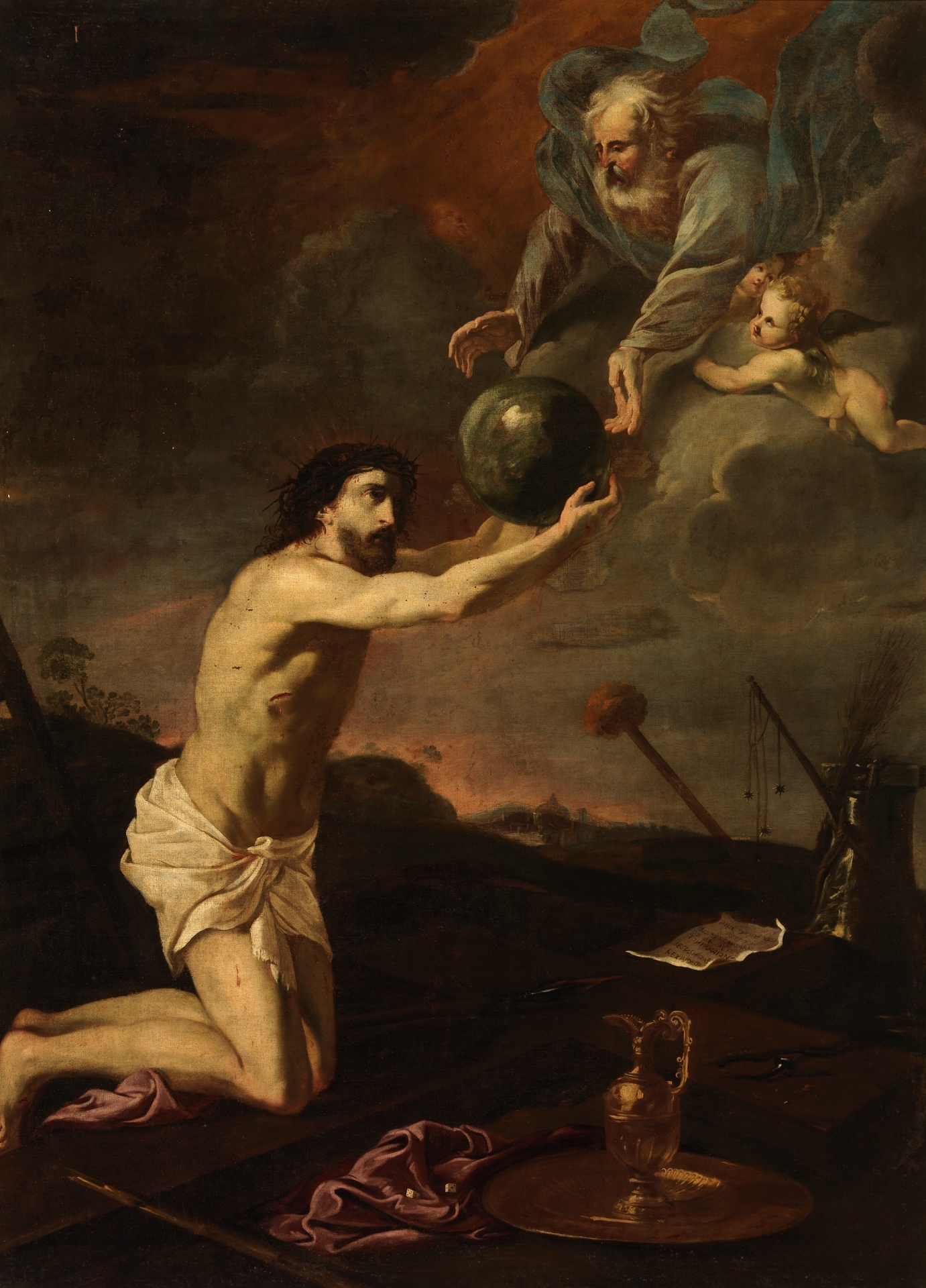
Jesus Receiving the World from God the Father (c. 1657) by Antonio Arnas Fernández

God bless.

Epiphany: Come let us worship

TODAY’S READINGS

In the U.S., Epiphany is celebrated the Sunday that falls from Jan 2-Jan 8, so today is the day. The Gospel reading is from Mt 2:1-12, in which we read the story of the Magi

[O]n entering the house
they saw the child with Mary his mother.
They prostrated themselves and did him homage.
Then they opened their treasures
and offered him gifts of gold, frankincense, and myrrh.
(v. 11)

“Why did the Magi set off from afar to go to Bethlehem? The answer has to do with the mystery of the ‘star’ which they saw ‘in the East’ and which they recognized as the star of the ‘King of the Jews,’ that is to say, the sign of the birth of the Messiah (Mt 2:2). So their journey was inspired by a powerful hope, strengthened and guided by the star, which led them toward the King of the Jews, toward the kingship of God himself. The Magi set out because of a deep desire which prompted them to leave everything and begin a journey. It was as though they had always been waiting for that star. It was as if the journey had always been a part of their destiny, and was finally about to begin. This is the mystery of God’s call, the mystery of vocation. It is part of the life of every Christian … When the Magi came to Bethlehem, ‘going into the house they saw the child with Mary his Mother, and they fell down and worshiped him’ (Mt 2:11). Here at last was the long awaited moment;, their encounter with Jesus. ‘Going into the house’: this house in some sense represents the Church. In order to find the Savior, one has to enter the house, which is the Church … ‘They fell down and worshiped him … and offered him gifts: gold, frankincense, and myrrh’ (Mt 2:11-12). Here is the culmination of the whole journey: encounter becomes adoration; it blossoms into an act of faith and love which acknowledges in Jesus, born of Mary, the Son of God made man … The secret of holiness is friendship with Christ and faithful obedience to his will.” (Benedictus: Day by Day with Pope Benedict XVI, 20)

I ordered the Benedictus book recently on the recommendation of Scott Hahn. It did not take much convincing to pick up 365 daily inspirations from the beloved pope of happy memory. I will be reading these profound one page meditations daily for all of 2024.

I love the connection Benedict makes of the house the Magi enter with the Church. How can one truly find Jesus without entering the “house” He established? And for Catholics, Jesus is truly present in each of the physical houses in the form of the Eucharist. There we should be falling down in worship, offering the gift of our entire lives in every moment in every aspect.

The final sentence is worth pondering for the rest of our lives: “The secret of holiness is friendship with Christ and faithful obedience to his will.” Are we friends of Christ? What does it mean to be friends with Christ? Christ tells us Himself:

You are my friends if you do what I command you. (Jn 15:14)

And how do we know what Jesus commands? Through His word that comes to us through Scripture and Tradition, safeguarded by the teaching authority of the Church. Pray and study! Repent and believe!

BP BARRON SERMON

TWO ARTICLES FOR THIS DAY

CHRISTMAS IS OVER, BUT LENT IS AROUND THE CORNER

Yes, we had a two day extension, but now we get back into the regular grind. But not for long! Ash Wednesday is on Valentine’s Day this year, fortuitously, I think. A great day to begin intensive preparation for Holy Week! What greater gift of love has there ever been than the Second Person of the Trinity coming down to repair the infinite damage our sins do? In addition, because of the date on which Easter falls, we celebrate the Feast of the Annunciation earlier that holiest of weeks — what a tremendous comparison and contrast for our meditation.

God bless.

The Adoration of the Magi (1944-1947) by George Duffie

Advent Day 1: Watch!

Happy Advent! I’m going to give this a shot again this year. High hopes for working through Advent and Christmas with daily blogs quickly petered out in 2022. Pray that I stay the course this time around — I need it.

TODAY’S READINGS

For these upcoming posts, I plan to use Catholic commentaries and other resources generously to bring light to each day’s readings.

The first reading is from Is 63:16b-17, 19b; 64:2-7.

You, LORD, are our father,
our redeemer you are named forever.
(v. 16b)

“God is rarely addressed this way in the OT, although the appellation occurs three times in this prayer alone…The language of divine paternity in the OT is based on the covenant of kinship that the Lord forged with Israel, his first son.” (Ignatius Catholic Study Bible: Isaiah, 105)

Why do you make us wander, LORD, from your ways,
and harden our hearts so that we do not fear you?
(v. 17a)

“Divine hardening is not an action of God that causes people to sin but a form of judgment in which the Lord allows brazen sinners to defy his will without the restraint of his mercy. This response to sin was first revealed at the time of the Exodus, when god hardened the heart of pharaoh (Ex 9:12; 10:1; 11:10; 14:8). Divine hardening is likewise mentioned in the NT as a spiritual condition of unbelieving Israel that will endure until God’s plan of salvation for the Gentiles is accomplished (Rom 11:25-26). Divine hardening remains a mystery because Scripture also insists on human free choice (Sir 15:11-17) as well as God’s universal desire that all people repent of their sins and be save (1 Tim 2:4; 2 Pet 3:9). Within the broader framework of biblical teaching , then, divine hardening does not override human free will or destroy human responsibility for sin; rather, it is a disciplinary measure \that seeks the conversion of the sinner.” (Ignatius Catholic Study Bible: Isaiah, 105-106)

No ear has ever heard, no eye ever seen, any God but you
doing such deeds for those who wait for him.
(v. 4)

“St. Paul quotes from this verse when writing about the wisdom of God, and his love for those who love him, and the gifts he has in store for man…(1 Cor 2:9). because these gifts will not be fully bestowed until the next life, the verse is often quoted in Christian spirituality to describe the happiness enjoyed in heaven.” (Navarre Bible: Major Prophets, 273)

Finally, a certain line jumped out at me as one frequently used by Protestants against the Catholic understanding of the role and necessity of good works in our lives:

…all our good deeds are like polluted rags… (v. 5a)

Catholic Answers is helpful here: “It does not say that all acts of righteousness are as filthy rags to God, but that those being rendered to him in Isaiah‘s day were…This pertains to a particular historical situation, not to a general condition.” (The whole response is worth reading. Also, check out one of my previous posts.)

The Responsorial Psalm is from Ps 80:2-3, 15-16, 18-19.

The St. Louis Jesuits get a lot of flack in some circles, but I like a lot of their stuff (setting aside whether it is appropriate for Mass or simply for worship). Here is a one of my favorites based on this psalm.

The second reading is from 1 Cor 1:3-9.

I give thanks to my God always on your account
for the grace of God bestowed on you in Christ Jesus…
(v. 4)

Corinth was a pagan town known for all manner of sin and debauchery. About five years earlier Paul established a church there and made significant evangelistic inroads. Hearing rumblings of problems in the Church there, he penned this letter until he could return. Considering all that, these words are a wonderful way to start his letter. Would it be that we would begin all our correspondence this way, even with those persons or situations that challenge us, giving thanks to God in all things, even those that are testing us in order to make us saints.

The Gospel reading is from Mk 13:33-37.

Watch, therefore;
you do not know when the lord of the house is coming,
whether in the evening, or at midnight,
or at cockcrow, or in the morning.
May he not come suddenly and find you sleeping.
(vv. 35-36)

“Jesus is speaking of his sudden and unexpected coming at the end of time, when he will judge his disciples for how they have exercised their authority in the Church. But Mark also links this warning to Jesus’ passion by structuring the passion narrative precisely in terms of these four night watches: evening (Mark 14l17), midnight (implied in 14:32-65_, cockcrow (14:72), and morning (15;1). Jesus warns that he may come suddenly and find them sleeping — which is just what will happen during his agony in Gethsemane (14:37-41). To be asleep signifies spiritual torpor and self-indulgence (Rom 11:9; 1 Thess 5:6-8); to be awake is to be alive in faith (Rm 13:11; Eph 5:14). The trial in Gethsemane is the beginning of the trial that will last throughout the whole age of the Church, in which Jesus’ followers are called to be constantly alert and attentive to the presence of the Lord.” (Catholic Commentary on Sacred Scripture: The Gospel of Mark, 273)

For my part, the following words of Jesus have always been sufficient for me:

But of that day and hour no one knows, neither the angels of heaven, nor the Son,* but the Father alone. (Mt 24:36)

As I heard a wise preacher say once: We don’t know when the last day is coming but we know for sure our last day is coming.

BP BARRON’S SUNDAY SERMON

Always worth a listen: You Can’t Save Yourself

THE WORD OF THE LORD

Worth every penny and more: https://stpaulcenter.com/the-word-of-the-lord/

A great way to take a deep dive into the Sunday readings every week — I try to never miss it. And the companion books are a treasure that will stay on my shelf (I’ve already worked through Year A and Solemnities and Feasts and began Year B today — outstanding!).

ADVENT RESOURCES

ADVENT/CHRISTMAS READING

God bless!