
TODAY’S READINGS
Today’s Gospel reading (Jn 12:20-33) has Jesus approached by Gentiles interested in Him. Now Jesus’ hour has come. He ends His short discourse on this matter this way, with an explanation from John:
“And when I am lifted up from the earth,
I will draw everyone to myself.”
He said this indicating the kind of death he would die. (vv. 32-33)
“Like the crowds who are ‘amazed’ at Jesus’ teaching (7:15) and miracles (7:21), the guards are awed at his teaching: there is something unprecedented about Jesus.” (The Gospel of John [Catholic Commentary on Sacred Scripture], 45)
when I am lifted up: Refers primarily to the Crucifixion of Christ, as indicated in the next verse, but also hints at his Resurrection and Ascension (CCC 662). See note on Jn 3:14. ● The expression recalls the opening line of Isaiah’s fourth Servant Song, which runs from Is 52:13 to 53:12. The whole song is a prophetic depiction of the suffering of the Messiah, who will be exalted and lifted up in the sight of the nations, but only after he is cast down by his own people. Isaiah interprets the humiliation and death of this Servant as a redemptive sacrifice for sin. draw all men to myself: Points to the worldwide acceptance of the gospel (Mt 28:18–20; Acts 1:8). ● As Isaiah envisioned the Davidic Messiah as an “ensign” posted for the ingathering of the “nations” and the “outcasts of Israel” (Is 11:10–12), so Jesus sees the world gathering around the “sign” of the Cross (CCC 542). (The Gospel of John [Ignatius Catholic Study Bible], 42)
“‘And I, when I am lifted up from the earth, will draw all men to myself.’ The lifting up of Jesus on the cross signifies and announces his lifting up by his Ascension into heaven, and indeed begins it. Jesus Christ, the one priest of the new and eternal Covenant, ‘entered, not into a sanctuary made by human hands. . . but into heaven itself, now to appear in the presence of God on our behalf.’ There Christ permanently exercises his priesthood, for he ‘always lives to make intercession’ for ‘those who draw near to God through him’. As ‘high priest of the good things to come’ he is the center and the principal actor of the liturgy that honors the Father in heaven. (CCC 662)
Christ stands at the heart of this gathering of men into the ‘family of God’. By his word, through signs that manifest the reign of God, and by sending out his disciples, Jesus calls all people to come together around him. But above all in the great Paschal mystery – his death on the cross and his Resurrection – he would accomplish the coming of his kingdom. ‘And I, when I am lifted up from the earth, will draw all men to myself.’ Into this union with Christ all men are called. (CCC 542)
Knowing how the story ends, or might I rather say, how the story continues, we might think that Jesus is referring to His Ascension when He speaks about being “lifted up.” John quickly disabuses us of this notion. While, as the commentary above says, we can see hints of the Ascension, it is unmistakable that there is no Ascension, no Resurrection, without the Crucifixion. As Jesus says earlier in today’s reading, “it was for this purpose that I came to this hour” (v. 27). He calls us to “hate” our life here so that we “will preserve it for eternal life” (v. 25).
We, too, are called to be drawn to the Cross, that is, to suffering. Not wishing for it — we’re not called to be masochists — but accepting it when it comes (because it always does). I invite you to join me in praying that when pain and suffering come, large and small, that we will have the grace to offer it up for the forgiveness of sins (starting with our own) and the redemption of souls. I will mention, as have before in these posts, the blessing of our faith that informs us of the value of suffering when it is redemptive. For the faithful it is not only a promise, but a requirement:
Then Jesus said to his disciples, “Whoever wishes to come after me must deny himself,* take up his cross, and follow me.
For whoever wishes to save his life will lose it, but whoever loses his life for my sake will find it. (Mt 16:24-25)
The second verse echoes what Jesus says in today’s reading. So we ask ourselves: What wouldn’t you endure in the brief moment we traverse this valley of tears for eternal bliss?
Easy? No. Possible? “[F]or God all things are possible” (Mt 19:26). The Lord puts His stamp on this when speaking to Paul:
“My grace is sufficient for you, for power is made perfect in weakness.” (1 Cor 12:9)
Let us pray, and pray some more, for the grace of perseverance in trials and tribulation.
The painting below represents to me “everyone” coming to Jesus. We especially think of John, the loan apostle to return to Jesus in His moment of torture, as a representative for all of us when Jesus entrusts His mother to him. Ask for Blessed Mary’s intercession frequently, as she knows suffering as well as anyone.
BP BARRON’S SERMON
Check out today’s sermon from the good bishop who takes a deep dive into Jeremiah 31:31 — the promise of a New Covenant which Jesus gives us at the Last Supper. Super important to understand the New Covenant and the Old Covenant(s).
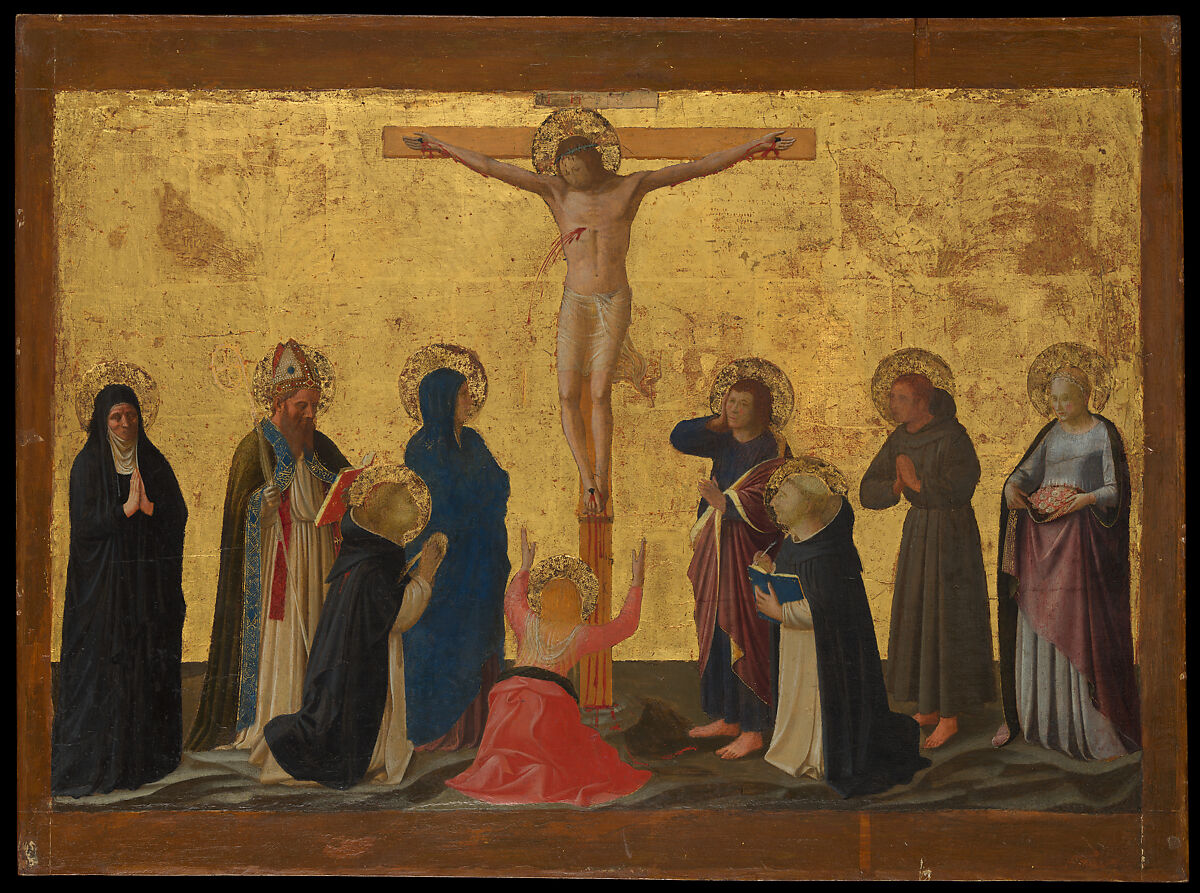
The Crucifixion (c. 1440) by Fra Angelico
God bless.


 Unworthy Servant