
TODAY’S READINGS
The first reading I chose to explore (there are options for each of today’s first two readings and the responsorial psalm) is Gn 15:1-6; 21:1-3, where God’s promise of descendants for Abram and his elderly wife comes to fulfillment.
Abram put his faith in the LORD,
who credited it to him as an act of righteousness. (v. 6)
“In the light of this passage, St. Paul sees Abraham as the model of how a person becomes righteous in God’s eyes — through faith in his word, the definitive word being the announcement that God saves us through the death and resurrection of Jesus. In this way, Abraham not only becomes the father of the Jewish people according to the flesh, but also the father of those who without being Jews have become members of the new people of God through faith in Jesus: ‘We say that faith was reckoned to Abraham as righteousness. How then was it reckoned to him? Was it before or after he had been circumcised? It was not after, but before he was circumcised. He received circumcision as a sign or seal of the righteousness which he had by faith while he was still uncircumcised. The purpose was to make him the father of all who believe without being circumcised and who thus have righteousness reckoned to them, and likewise the father of the circumcised who are not merely circumcised but also follow the example of the faith which our father Abraham had before he was circumcised’ (Rom 4:9-12).
“Abraham’s faith revealed itself in his obedience to God when he left his homeland (cf. 12:4), and later on when he was ready to sacrifice his son (cf. 22:1-4). This is the aspect of Abraham’s obedience which is given special emphasis in the letter of St. James, inviting Christians to prove the genuineness of their faith with obedience to God and good works: ‘Was not Abraham our father justified by works, when he offered his son Isaac upon the altar? You see that faith was active along with his works, and faith was completed by works, and the scripture was fulfilled which says, “Abraham believed God, and it was reckoned to him as righteousness”; and he was called the friend of God.’ (Jas 2:21-23).” (The Navarre Bible: Pentateuch, 95-96)
Sometimes, in discussions regarding righteousness, Protestants will refer to Romans 4 in defense of sola fide (“faith alone”). But James 2 cannot be ignored or reasoned away. And it certainly cannot be pitted against Paul, as some have tried to do. Here comes into play one of the beauties of Catholic teaching that I often fall back on: “serious attention must be given to the content and unity of the whole of Scripture if the meaning of the sacred texts is to be correctly worked out” (Dei verbum, 12). If anyone ever presents biblical authors contradicting each other on matters of faith and morals, run for the hills! Catholic Answers, as usual, is again helpful here.
The second reading I chose is Heb 11:8, 11-12, 17-19. This gives us another aspect of faithfulness from a different episode in Abraham’s life, at least a dozen or more years after Gen 15.
By faith Abraham, when put to the test, offered up Isaac,
and he who had received the promises was ready to offer
his only son,
of whom it was said,
“Through Isaac descendants shall bear your name.”
He reasoned that God was able to raise even from the dead,
and he received Isaac back as a symbol. (vv. 17-19)
“That Abraham was willing to carry out this drastic demand, not knowing why or understanding how it could possibly be compatible with God’s sworn word, is the supreme biblical example of obedient faith. [See the James quote above.]
“Abraham ‘reasoned that God was able to raise even from the dead.’ Although Genesis does not say this directly, Hebrews may see it as implied in Abraham’s words to his servants, ‘The boy and I…will worship and then come back to you’ (Gen 22:5). Having experienced God’s faithfulness in the birth of Isaac, Abraham stretched his faith yet further, trusting that God somehow had a solution to this terrible ordeal. And in the very act of sacrifice, when Abraham had totally given up on his son, God intervened and gave back to him that which he surrendered. So ‘he received Isaac back as a symbol.’ Isaac’s restoration to his father is a figure pointing to Christ, the only-begotten Son who was sacrificed not only in intention but in reality, and who was restored in his resurrection from the dead.” (Hebrews [Catholic Commentary on Sacred Scripture], 242)
I recall some years back, a former classmate of mine posting on social media concerns about the Abraham-Isaac episode involving the sacrificing of the latter. He was struggling greatly with how God could demand such a sacrifice and how Abraham could even entertain it, much less carry it out. I related this passage from Hebrews to him. He seemed to find it helpful, although to what extent, I never learned. One other passage from the biblical incident itself I believe is telling: When asked by his son where the sacrifice is, Abraham answered, “God will provide himself the lamb for a burnt offering, my son.” (Gen 22:8, RSV-CE). When Abraham’s hand is stayed, a ram (not a lamb) is offered in his place. But God did provide Himself as a spotless lamb some two thousand years later when the sacrifice was actually carried out.
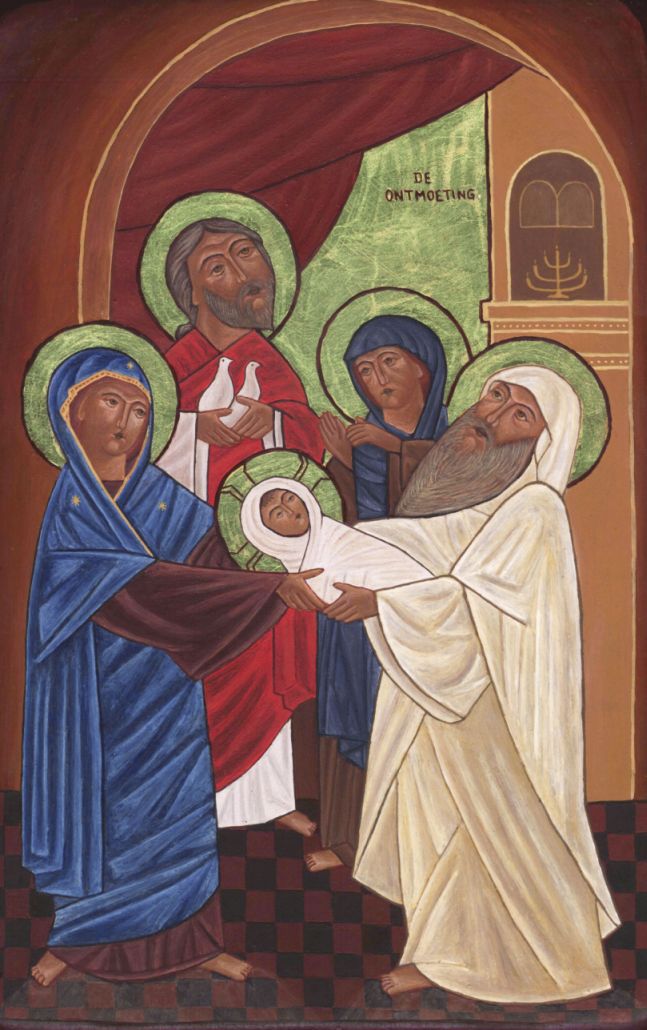
Finally, in the Gospel (Lk 2:22-40), we read of another righteous, trusting man of God:
This man was righteous and devout,
awaiting the consolation of Israel,
and the Holy Spirit was upon him.
It had been revealed to him by the Holy Spirit
that he should not see death
before he had seen the Christ of the Lord.
He came in the Spirit into the temple… (vv. 25-27a)
“Being ‘righteous’ means obeying God’s laws (see 1:6); to be ‘devout’ means to revere God and carefully carry out religious duties. Simeon did what God required of him and he hoped for what God promised: he was ‘awaiting the consolation of Israel.’ Many Jews at the time of Jesus had hopes that God would act to restore his people, freeing them from evil and foreign rule, fulfilling promises made through the prophets. Simeon expresses these hopes as God’s ‘consolation of Israel,’ echoing prophecies of Isaiah that speak of God’s consolation, or comfort, for his people (Isaiah 40:1; 49:13; 51:3, 12; 52:9; 57:18; 66:13). Consolation has a note of intimacy, of God comforting his people ‘as a mother comforts her son’ (Isaiah 66:13). ’And the holy Spirit was upon him’; the Holy Spirit who filled Elizabeth and Zechariah and John (1:15, 41, 67) and overshadowed Mary to conceive Jesus (1:35) rests upon Simeon. The following verses tell how the Holy Spirit inspires and guides Simeon.” (Bringing the Gospel of Luke to Life, 69-70)
Two other men in the Gospels are referred to as “righteous”; Joseph and John the Baptist, both of whom pious tradition tells us never personally sinned. I don’t know if that was true for Simeon, but being righteous has its rewards, as Jesus tells us that these will go off to eternal life (see Mt 25:46).
POPE BENEDICT XVI: RIP
One year on, particularly considering the confusion and lack of clarity exacerbated over the intervening period, this holy man is missed more than ever. I hear his private sermons are being published — always good to get more of Benedict
A good website to bookmark: https://www.benedictusxvi.com/pope-em-benedict-xvi
A JOYFUL (AND FUNNY) BISHOP
This YouTube channel came to my attention recently. Check out this video interview (although it hardly is an interview as this prelate needs no prompting). You will be entertained and moved.
I never heard of this man before, and I know nothing else about him, but from what I see here, we need many more like him. Let us pray.
SCREWTAPE
Today I finished C.S. Lewis’s The Screwtape Letters, finally. I’ve been meaning to read if for years, and finally worked through it. A lot of great tidbits, but not as impressive (to me, at least) as I anticipated. But the concluding section (“Screwtape Proposes a Toast”) is worth the price of the book. Written in 1959, it nails our time like you wouldn’t believe. DEI anticipated. See the pdf for free.
Happy New Year! Let’s redouble our prayers for our Church and our country in what promises to be the most eventful year in some time.
God bless.
 Unworthy Servant