“I did not come to call the righteous but sinners.”

These words, that conclude today’s gospel reading (Mt 9:9-13), come from Jesus and are directed to the Pharisees.  They see Jesus eating at the table of the just-called (former) tax collector, Matthew, and question His eating with “tax collectors and sinners.”

https://thinkingthroughscripture.files.wordpress.com/2015/06/ernst_zimmerman_christ-and-the-pharisees_700.jpg

This episode appears in all three synoptic gospels (also in Mk 2:17 and Lk 5:32 — which gives me plenty more commentaries to consult!), with the others worded nearly exactly as above.  This has always been a somewhat curious statement to me.  I have always taken “righteous” to mean “self-righteous.”  And there is definitely something to that:

Jesus uses the opportunity to reproach the scribes and Pharisees for their pride: they consider themselves just, and their reliance on their apparent virtue prevents them from hearing the call to conversion; they think they can be saved by their own efforts (cf. Jn 6:41).  (The Navarre Bible: St. Mark [Dublin: Four Courts Press, 1988], 80)

But, did not Jesus come to save everyone?  And who really is completely righteous, anyway, aside from the Lord and His mother?

All are sinners.  The only difference is that some admit their lack of righteousness and some do not (see 1 John 1:8-10), thus refusing Jesus’ messianic invitation (see Matt 22:3) and his medicinal grace.  Jesus is recasting the people’s whole understanding of the messiah.  His mission is not to vindicate those who keep the law, and condemn the rest; rather, it is to offer the healing of which all people are in need; healing from the devastation of sin.  Even sins of pride and judgmentalism [as displayed by the Pharisees in this episode] are among the sicknesses he came to heal. (Mary Healy, The Gospel of Mark, Catholic Commentary on Sacred Scripture [Grand Rapids, MI: Baker Academic, 2008], 61)

We should further note that, with this statement, Jesus is indicating that He

did not come to prolong the Old Covenant with the nation of Israel.  This was an imperfect, provisional covenant designed to separate Israel from the Gentiles and their sins (Lev 20:26) while Israel was not ready to love God from the heart (Jer 11:8; Mt 19:8).  Jesus inaugurates the New Covenant to transform the hearts of his people (Jer 31:31-34; Mt 5:8) and so welcomes all into God’s covenant family.  Whereas the Old Covenant quarantined Israel from the world, the New Covenant embraces the world within God’s mercy (Rom 11:32). (Scott Hahn and Curtis Mitch, The Gospel of Mark, Ignatius Catholic Study Bible [San Francisco: Ignatius, 2001], 20)

Let it never be the case that we, like the Pharisees, classify ourselves as righteous, in no need of the Lord’s mercy, because we consider our own works entirely sufficient to put us in right relationship with God.  Rather, we must always acknowledge humbly, in accord with reality, that we are sinners in need of grace to live righteously and to ultimately be saved.


“When Jesus saw their faith, he said to the paralytic, ‘Courage, child, your sins are forgiven.'”

At Mass today, the priest-homilist gave a wonderful reflection on the gospel for this day (Mt 9:1-8), one I never really considered.  In the gospel story, a paralytic is brought in by friends in the hopes that Jesus would heal him.  Jesus tells the man his sins are forgiven.  which gives the onlooking scribes dark thoughts.  Then, to prove His legitimate ability to forgive sins, He physically heals the man, leaving the crowd awestruck.

http://images.nga.gov/?service=asset&action=show_preview&asset=55000Christoph Murer, Swiss, 1558 – 1614, The Paralytic Healed by Christ Picks up His Pallet, woodcut on laid paper
The priest pointed out that Jesus did not base the forgiveness and healing on the disabled man’ s faith, but rather on his friends’.  Maybe he read the man’s heart, saw a skeptical expression on his face, or even heard him complaining or doubting.  Yet, the unfortunate man’s faithful friends were enough to move Jesus.  Do you think that man ever looked at those companions in the same way ever again?

This is a call for us to bring to prayer family, friends, and acquaintances who seem to have little faith or explicitly say they are agnostic or atheist.  Don’t be afraid to tell them you are praying for them or have remembered them at Mass.  If someone is ill, or particularly troubled in any way, drop him a Mass card to let him know you are thinking of him and that he is receiving many — and ongoing — prayers.  Whether or not a healing occurs or the problem is resolved, the prayers and thoughtfulness you engender are bound to have an impact.  This is not something you should pound over the heads of others.  But, by living your faith, and sharing its importance, you may well win over a soul for Christ and have a faith-full friend for life.

I’m quite sure the (former) paralytic went away permanently changed in body and soul.  Through God’s grace so will the skeptics in your life.

“Thereupon the whole town came out to meet Jesus, and when they saw him they begged him to leave their district.”

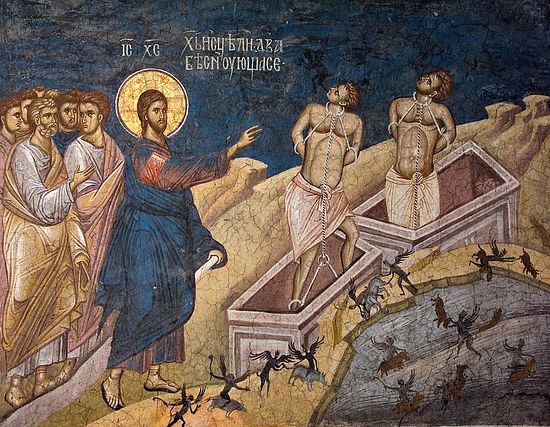
I could not help but thinking of our country, much of our world, really, seeming to react toward Jesus the way the Gadarenes reacted to Him at the end of today’s gospel reading (Mt 8:28-34).  The Lord travels into their territory, encounters two men who terrorized the entire region, expels enough demons from them to fill a whole herd of pigs, and then is promptly asked to leave the area.

https://i0.wp.com/www.pravoslavie.ru/sas/image/101902/190270.p.jpg

With Jesus’ presence demons flee and are gone for good.  Yet as our Savior’s reality is ignored, mocked, and denied, society slips further and further into the clutches of the “prince of this world” (Jn 12:31, 14:30, 16;11).  We are now in a time in which, among growing numbers of persons and groups, good is called “intolerant,” “unjustly discriminatory,” and even “hate speech,” while evil is lauded under the guise of “choice,” “inclusiveness,” and even “love.”

Ah! Those who call evil good, and good evil,
who change darkness to light, and light into darkness,
who change bitter to sweet, and sweet into bitter!
…they have rejected the instruction of the LORD of hosts,
and scorned the word of the Holy One of Israel.
Therefore the wrath of the LORD blazes against his people,
he stretches out his hand to strike them.
                                                                            — Is 5:20, 24b-25a

And if the light in you is darkness, how great will the darkness be.
— Mt 6:23 (see also Lk 11:35)

When Jesus is asked to leave, He does so, honoring our free (if misguided) will.  Is it any wonder that the sheep go astray when the master is no longer the guide?

As happened on the Emmaus road, let us beg the Lord to “stay with us” (Lk 24:29).  Our “light must shine before others” (Mt 5:16), never compromising the truth or failing to share fully the truth.

Finally, and at least as importantly, do not forget what the Lord told His disciples when they failed to drive out a demon from an afflicted person:

This kind can only come out through prayer and through fasting.
–Mk 9:29

So, let us redouble our efforts in these two areas so as to hasten the coming of God’s kingdom.


“Put your finger here and see my hands, and bring your hand and put it into my side.”

Jesus’ words to Thomas (Jn 20:24-29) that we read on this his feast day have given the poor man untold grief this past two millennia.  I, for one, do not think it is deserved.  Considering the cast of characters that were Jesus’ constant companions during His ministry, do you really think any one of them (or us) would have behaved any differently if he were the one to have been absent at Jesus’ first appearance on that glorious Sunday?  Even though Jesus was explicit in speaking of His death and resurrection, shock, grief, fear, inattentiveness, or whatever, made them in no state of mind to process the whole situation.

Yet, Thomas had an extraordinary grace given to him!  The invitation to touch the wounds that healed all of us (see Is 53:5).  The gospels do not record whether Thomas took the Lord up on His offer (I’m betting he didn’t, although Caravaggio [see the painting below] thinks differently), but what an opportunity for him.  I am reminded of the stigmatists, like St. Francis of Assisi, St. Catherine of Siena, and Padre Pio, who in their own way touched the wounds of Jesus — but here Thomas was with the glorified Lord who humbly offers His body to Thomas (as He does to us at each Mass).

https://upload.wikimedia.org/wikipedia/commons/e/e0/Caravaggio_-_The_Incredulity_of_Saint_Thomas.jpg

Caravaggio, The Incredulity of Saint Thomas, 1601/2, oil on canvas

I invite you to read a recent article on this same subject.

St. Thomas, Apostle, pray for us.  And, for you, dear reader, no doubt (hehe), your Tom, Tommy, Thomas, and Thomasina friends would be happy to receive your prayers, through St. Thomas’s intercession, this day.

“Why do you recite my statutes, and profess my covenant with your mouth, Though you hate discipline and cast my words behind you?”

The response for today’s psalm (Ps 50:16bc-17, 18-19, 20-21, 22-23) is what God says to the wicked.  He calls out those who run with thieves, throw in their lot with adulterers, give their mouths free rein for evil, yoke their tongues in deceit, and speak against brother and slander him.  The psalmist concludes with these ominous words from Yahweh:

Now understand this, you who forget God,
lest I start ripping apart and there be no rescuer.

This should serve as a warning to all of us, imperfect as we are.  But I think especially of politicians and celebrities who claim religious faith yet advocate for evil publicly, unashamedly, and obstinately.  I am particularly saddened by Catholics in the public square who claim to be faithful to their religion yet espouse that which is directly opposed to the Faith.  They hate discipline, and those who can enforce it seem, in the main, to hate giving it.  Let no one accompany these scandalous public figures along the wide road that leads to destruction (Mt 7:13-14), but, rather, might they receive correction humbly, then repent and convert.  Our country, our world, needs many more courageous men and women to stand up for the Truth, no matter the cost.


https://abcnews.go.com/images/International/GTY_pope_congress_11_mm_150924.jpg

Some of the most outspoken advocates for abortion in the Senate are Catholics (twenty-four senators profess to be Catholic — 15 Democrats and 9 Republicans).  Over 80% of senators claim Christianity as their faith.  Pray for enlightenment for the misguided so they can be witnesses (mártyres) not scandalizers.

https://en.wikipedia.org/wiki/Religious_affiliation_in_the_United_States_Senate

“God did not make death, nor does he rejoice in the destruction of the living. For he fashioned all things that they might have being.”

The beginning of today’s first reading (Wis 1:13-15; 2:23-34) seems very appropriate for these days as we experience, from certain corners, hysteria over the Supreme Court vacancy.  A most disgusting display by those who seem to believe that the murder of innocents is the most important pillar of American society.  Rightly decried is “babies ripped from their mother’s arms,” but many of that same crowd wish that babies ripped from their mother’s wombs becomes permanently enshrined here and everywhere.  However sad the former is, it is only temporary in this life.

https://static.independent.co.uk/s3fs-public/styles/article_small/public/thumbnails/image/2014/04/16/17/web-sperm-rex.jpg

The Catechism of the Catholic Church:

2271 Since the first century the Church has affirmed the moral evil of every procured abortion. This teaching has not changed and remains unchangeable. Direct abortion, that is to say, abortion willed either as an end or a means, is gravely contrary to the moral law:

You shall not kill the embryo by abortion and shall not cause the newborn to perish. (Didache 2,2:SCh 248,148; cf. Ep. Barnabae 19,5:PG 2 777; Ad Diognetum 5,6:PG 2,1173; Tertullian, Apol. 9:PL 1,319-320.)

God, the Lord of life, has entrusted to men the noble mission of safeguarding life, and men must carry it out in a manner worthy of themselves. Life must be protected with the utmost care from the moment of conception: abortion and infanticide are abominable crimes. (GS 51 § 3.)


If you are on the wrong side of this issue, repent now, and no longer have anything to do with this heinous crime — directly or indirectly.  It is a life and death issue for bodies and souls.


“Do not be afraid; just have faith.”

This quote, from today’s gospel (Mk 5:21-43), is taken from the New American Bible, Revised Edition for use in the Lectionary.  I rather favor the translation from the 1970 NAB: “Fear is useless; what is needed is trust” (v. 36; thanks to Fr. Ruff for the reference), because it brings home the point more forcefully.

And what is the point?  In the reading, Jesus utters the words at top to the synagogue official, Jairus, who earlier approached Him to heal his sick daughter, but now has learned that she has since died.  Undoubtedly devastated by the news, he may well have begun to turn away, with the people from his house, from the Lord.  Why would he be afraid at this moment?  A hint may be in the words of the people who brought the news: “Why trouble the teacher any longer?”  Maybe the official was concerned that he had wasted Jesus’ time.  Also, by seeking, in desperation, this controversial figure, now with nothing to show for it, what repercussions from his peers and other members of the synagogue might be coming his way?  And what about a future without his beloved daughter?  An only daughter, or an only child, possibly?  How would he and his wife go on?

https://i.pinimg.com/originals/d7/9c/74/d79c7440f694c6c8163a0d8574a158ee.jpg

Jesus disregards the people from Jairus’s house in telling Jairus to not be afraid.  Had he not raised the dead before (this story also appears in Luke [8:41-56] after the raising of the son of the widow of Nain [7:11-15])?  Of course, in one of the most beautiful scenes in scripture, Jesus goes to the girl and brings her back to life (I love to envision Jesus kicking out all the mourners who ridiculed Him).

Lessons for us?  Let’s take them one by one from my speculation about Jairus’s experience:

  1. Are we afraid we are troubling God with our problems, wasting His time?  Maybe we feel we don’t deserve any favors?  Maybe fear overcomes trust?  Maybe interior or exterior voices say “don’t bother”?  Do what Jesus did, and ignore these murmurings.
  2. Are we afraid of what other people with think about our appeal to the Lord?  Does appealing to prayer bring ridicule from those who don’t believe or who think physical actions are the only hope?  Do accusations of being a “holy roller” or believing in “superstition” give us pause?  Might we fear straining or losing friendships or uncomfortable future interactions with colleagues and acquaintances?  Or maybe someone (especially ourselves) might intimate that we are not deserving of favors (read Job for an object lesson).  “Put out” the naysayers.
  3. When the news is devastating do we trust unreservedly “that all things work for good for those who love God, who are called according to his purpose” (Rom 8:28)?  Augustine, dealing with the problem of good and evil tells us, “God judged it better to bring good out of evil than to suffer no evil to exist” (Enchirid., xxvii) (see here).  We might not see how this works now, or even in our lifetimes.  But we will know on the last day, when God’s entire plan will be made manifest (see CCC 1040).  Do we unreservedly trust Jesus?

“Fear is useless; what is needed is trust.”  Another challenge from Jesus.  Are we up to it?