“Refer…all things to Me in a particular way, for it is I Who gave you all things. Consider everything as deriving from the sovereign Good, and therefore all must return to Me as to their own origin.” (IC 3,9,1) | “No one can say, ‘Jesus is Lord,’ except by the Holy Spirit … To each individual the manifestation of the Spirit is given for some benefit.” (1 Cor 12:3b,7)

|The Imitation of Christ by Thomas à Kempis, Book III Chapter IX: ”That All Things Should be Referred to God as Our Last End” (second entry)

When we keep ever in front of us that Christ is our true end, we will be mindful to consider Him in all things, eschewing the world and sin, remaining humble in the fact that we only own our own sins and faults. In being faithful in this way, we will have the greatest chance, again with God’s assistance, to be able to offer back to Him thoughts, words, and deeds that show our faithfulness and do Him justice.

|Today’s Second Reading: 1 Cor 12:3b-7, 12-13

Being Pentecost Sunday, it is only right that we should hear from St. Paul regarding the power, gifts, and fruits of the Holy Spirit given to the faithful disciple. We cannot even confess our faith in Jesus without the Spirit! The Spirit gives different gifts, expecting different service, which manifests itself in different workings. But all the baptized are part of the Body of Christ, thus we have different functions within that Body.

|Reflection

Kempis’s Christ tells us to give everything back to God because it is from Him that all the good we have comes and all the good we do is made possible. As we know, we are asked to return to God these gifts with interest, per His instruction (see Mt 25:14-30). So we cooperate with God (only possible and efficacious because of the gift of grace) and then give Him the glory when we make something of the gifts (or, put another way, talents) He has provided. We are given these gifts of the Spirit “for some benefit.” We all have a part to play, a Bodily function to perform. This great feast of Pentecost is a wonderful time to reflect on how well we have used our gifts, manifested their benefits to others (see the fruits here), and given them back to God with interest. And if we don’t know what are our gifts (review them here) or how to use them for the Lord, prayer and a spiritual director are in order (contact your diocese to find the latter). The Spirit wants to work in us — let’s not forego the opportunity!

Jesus breathed on his disciples. A holy infection of grace (With ...

“Out of Me, both little and great, rich and poor, as from a living fountain, draw living water. And they who freely and spontaneously serve Me shall receive grace upon grace.” (IC 3,9,2) | “He received all who came to him, and with complete assurance and without hindrance he proclaimed the Kingdom of God and taught about the Lord Jesus Christ.” (Acts 28:30-31)

|The Imitation of Christ by Thomas à Kempis, Book III Chapter IX: ”That All Things Should be Referred to God as Our Last End” (first entry)

Our spiritual thirst is only slaked by Christ; there is no other fountain, not any “private good” as Kempis says further on, that will satisfy us. By serving God “freely and spontaneously” we continue to be refreshed by this “living water” that sustains us here and sets us up for eternal bliss.

|Today’s First Reading: Acts 28:16-20, 30-31

With Pentecost coming tomorrow, it is appropriate that the Church’s lectionary ends the Easter Season with the closing words of the Acts of the Apostles. We would all love to know more about Paul and his remaining adventures, but hearing that he made it to Rome, the center of the world of his time, to successfully evangelize a few Jews, but mainly the pagan Gentiles, is a great comfort. The closing words, above, are a stirring encouragement that Paul stayed true to his convictions and preached boldly even while a prisoner. No doubt, based on the amazing growth of Christianity that we cull from other historical records, his ministry was extraordinarily fruitful and his disciples, undoubtedly, numerous, quickly spreading throughout the empire.

|Reflection

Did anyone better epitomize a disciple who “freely and spontaneously serve[d Christ]” than St. Paul? “He received all who came to him” and proclaimed the Kingdom and Christ. He knew trouble lay ahead (as it already had behind) because of his dedication to the Gospel. This certainly inspired him to make very good use of the remaining time the Lord allotted him to do the work consigned to him by God. He drank deeply from the “living water” that is Jesus, and was happy to share it by the bucket-full with others.

Jesus stood up and exclaimed, “Let anyone who thirsts come to me and drink.u Whoever believes in me, as scripture says: ‘Rivers of living water will flow from within him.’” He said this in reference to the Spirit that those who came to believe in him were to receive. (Jn 7:37-39a)

The waters of Baptism blessed us with spiritual life. They also gave us a mission, strengthened by Confirmation, to evangelize. We, like Paul, are to “freely and spontaneously serve” Jesus and His Church. We are to proclaim the Kingdom and teach about Jesus “with complete assurance” that the Spirit will help us (giving us “grace upon grace”) and we are to proclaim “without hindrance” the entire truth of the Gospel. God “wills everyone to be saved and to come to knowledge of the truth” (1 Tim 2:4). Do we?

The Arrival of St Paul at Rome, 1920 by Frank William Brangwyn (1867-1956, Belgium) |  | WahooArt.com
The Arrival of St Paul at Rome (1920) Frank William Brangwyn

“Oh, convert us to You, so that we may be thankful, humble, and devout; because you are our salvation, our virtue, and our strength.” (IC 3,8,3) | “Follow me.” (Jn 21:19b)

|The Imitation of Christ by Thomas à Kempis, Book III Chapter VIII: ”Of the Mean Estimation of Oneself in the Eyes of God” (third entry)

Kempis closes this chapter with the three marks of a disciple of Christ: thankfulness, humility, and devotion. Why are these dispositions so important? Because Jesus is “our salvation, our virtue, and our strength.” These gifts inspire us to: thankfulness for the goodness of God toward us, His fallen creatures; humility because on our own without them we would be lost and could do nothing; devotion due to God for who He is and for what He has done for us.

|Today’s Gospel Reading: Jn 21:15-19

We hear proclaimed this day some of the final words recorded of Jesus before ascending to the Father. It provides us the scene in which Jesus invites Peter to affirm his love for his Master three times in front of a charcoal fire just as he denied knowing the Lord three times in front of a different charcoal fire just a short time earlier (see Jn 18:15-18,25-27). John then tells of Jesus’ prediction of Peter’s death many years hence. His last words to Peter are recorded above.

|Reflection

Jesus last words to Peter may well have prompted the latter to be reminded of the same words of Jesus in this interchange they had at the Last Supper:

Simon Peter said to him, “Master, where are you going?” Jesus answered [him], “Where I am going, you cannot follow me now, though you will follow later.” Peter said to him, “Master, why can’t I follow you now? I will lay down my life for you.” Jesus answered, “Will you lay down your life for me? Amen, amen, I say to you, the cock will not crow before you deny me three times.” (Jn 13:36-38)

If it did not come flooding back at that moment, it surely would at Pentecost. Peter was not to follow Jesus to the cross on Good Friday due to cowardice. But because of the salvation Jesus wrought, and the virtue and strength He provided, tradition tells us that Peter did “follow later” the road to crucifixion and glory.

Jesus uses “Follow me!” several times throughout the Gospels to call specific apostles He has chosen, but of course it applies to all of us. Remember this other famous passage:

Then he said to all, “If anyone wishes to come after me, he must deny himself and take up his cross daily and follow me.” (Lk 9:23)

So we note a common them that not only applies to Peter, but also to all disciples of Christ. Following Jesus, by its nature, entails suffering and death. On our own this is a tragic and meaningless circumstance. But, because Christ led the way, we now have the strength He imparts to those of us who ask for it, to follow in His footsteps to the glory of God and eternal beatitude,.

[Jesus said,] “For whoever wishes to save his life will lose it, but whoever loses his life for my sake will save it.” (Lk 9:24)

(By the way, an interesting exposition of this scene, likely different from what you’ve heard before, can be found on The Sacred Page. I encourage you to check it out.)

“You, O most sweet Lord, are bountiful to me above all merit, and more than I would dare hope or ask for.” (IC 3,8,2) | “I made known to them your name and I will make it known, that the love with which you loved me may be in them and I in them.” (Jn 17:26)

|The Imitation of Christ by Thomas à Kempis, Book III Chapter VIII: ”Of the Mean Estimation of Oneself in the Eyes of God” (second entry)

When we realize our nothingness compared to God, and that nothing we can do on our own merits God’s love, we are in a good place. Yet, the Lord loves us gratuitously and completely as if we were His only creation. We owe Him the same love back.for who He is and what He has done for us.

|Today’s Gospel Reading: Jn 17:20-26

Above we read the last words of the Last Supper Discourse and the High Priestly Prayer. What wonderful parting words from Jesus to His closest collaborators, the apostles. Jesus’ arrest is imminent, and He will be going away for awhile, but the love of the Father remains in them, and so does Jesus. They may forget this for a time, but the third Person of the Holy Trinity will remind them of all this in a few short weeks.

|Reflection

This motley group that Jesus called certainly didn’t deserve the love of Jesus based on their own merits, particularly in light on the abandonment of Him that Jesus predicted would happen. Yet, the Lord leaves them with the promise of the love of the Father and the Son and the help of the Holy Spirit (which He spoke of frequently previously in this discourse).

Consider your own calling, brothers. Not many of you were wise by human standards, not many were powerful, not many were of noble birth. Rather, God chose the foolish of the world to shame the wise, and God chose the weak of the world to shame the strong, and God chose the lowly and despised of the world, those who count for nothing, to reduce to nothing those who are something, so that no human being might boast before God. (1 Cor 1:26-29)

Paul is not speaking only to the citizens of Corinth here. He is referring to the apostles and to us as well. Weak, foolish, lowly — put me first on the list. We can only boast of our own sins — and those are nothing of which to be proud. Yet, we are loved with a love undeserved but gratefully accepted and the promise that we will not be abandoned:

I am with you always, until the end of the age. (Mt 28:20b)

These consoling words are the last recorded by Matthew in his Gospel. This is a wonderful takeaway for all Christians. Whatever life brings, Christ promises to be with us (for Catholics and Orthodox this is fulfilled in a special way in His Real Presence in the Eucharist). Only we can drive Him away by serious sin and/or the belief that we cannot be forgiven (commonly held to be the sin against the Holy Spirit). Will we drive Him away or, like the disciples on the Emmaus road, say:

Stay with us (Lk 24:29)

(For an edifying and relatively short read, check out Saint John Paul II’s apostolic letter, his third last, by the same name (Mane nobiscum Domine), in which he introduced the Year of the Eucharist.)

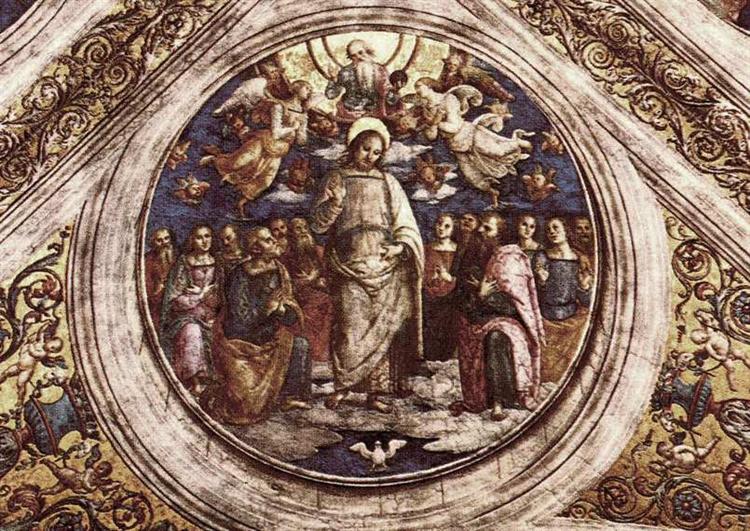
The Holy Trinity and the Apostles, 1507 - 1508 - Pietro Perugino
The Holy Trinity and the Apostles (1507-08) by Pietro Perugino

“It is your love…gratuitously preventing me and assisting me in so many necessities, guarding me also from grave dangers, and (to say the truth), saving me from innumerable evils.” (IC 3,8,2) | “I do not ask that you take them out of the world but that you keep them from the Evil One.” (Jn 17:15)

|The Imitation of Christ by Thomas à Kempis, Book III Chapter VIII: ”Of the Mean Estimation of Oneself in the Eyes of God” (first entry)

Kempis once again extols the virtue of humility. It is the only appropriate disposition we are to have in relation to our Creator. Without God’s grace we can do nothing and are especially susceptible to “grave dangers” and “innumerable evils.”

|Today’s Gospel Reading: Jn 17:11b-19

Today we hear the middle section of Jesus’ High Priestly Prayer that He intones immediately before His arrest. He asks the Father to protect His apostles from Satan and enlighten them to the truth as Jesus sends them out as missionaries to the world just as the Father sent the Son into the world.

|Reflection

Jesus gives the apostles a mission to the world to declare the truth of God. They are to be in the world but not of the world. This is a message meant for all Christians of all times and all places. Kempis recognizes this. This fallen world is full of lies, deceit, evil, and all manner of grave moral dangers. But, like the apostles, the vast majority of Christians (aside from cloistered orders) are deputized, as it were, to engage the world, not flee from it (as tempting as that may be). The danger is that we are dragged down by it as opposed to elevating it. The world is supposed to be changed by us — not us by the world. All we need is the love of God to prevent us from falling and to assist us in our mission.

Let us pray often for the grace to convey to others the truth in love as Christ conveyed to us the truth in love.

Twelve Disciples Painting - Christ with the twelve Apostles by Tissot
Christ with the Twelve Apostles (c.1886-96) by James Jacques Joseph Tissot

“[D]o willingly what depends on you, to the best of your ability and knowledge” (IC 3,7,1) | “I solemnly declare to you this day that I am not responsible for the blood of any of you, for I did not shrink from proclaiming to you the entire plan of God.” (Acts 20:26-27)

|The Imitation of Christ by Thomas à Kempis, Book III Chapter VII: ”How Grace Should Be Hidden Under the Guardianship of Humility” (third entry)

Kempis has Christ telling us that we have a duty, even when feeling arid or anxious and not receiving consolations, to live the Christian message. The Lord doesn’t need us, absolutely speaking, but He has ordained that His message of Good News be carried to the ends of the earth by those who declare faith in Him (see Mk 16:15).

|Today’s Gospel Reading: Acts 20:17-27

Acts tells us of the incessant journeying of Paul as he endeavors with passion and urgency to evangelize as many regions as possible in the time on earth that God had given him. Now he wishes a final farewell before returning to Jerusalem where he knows not what he will find awaiting him. He has been informed by the Holy Spirit that “imprisonment and hardships await” him and he seems certain that he will never again see the Miletans and Ephesians that he is addressing. He leaves with a clear conscience, not holding back, but preaching the whole truth, whatever the consequences. He closes with the words above.

|Reflection

It is not at all hard to imagine the difficulties Paul encountered (which he was not reluctant to express explicitly) and frustrations experienced (that he no doubt felt interiorly) in his ministry. Yet, I don’t recall an instance when these challenges ever deterred him from pressing forward, maybe with even more conviction. We need to be more like Paul. No matter what life throws at us because of our faith, we keep up the fight “do[ing] willingly what depends on [us]” so that we can in good conscience say that we are “not responsible for the blood of any of” those whom we have encountered who looked to us for Christian example by a living out, in word and in deed, of the fullness of truth.

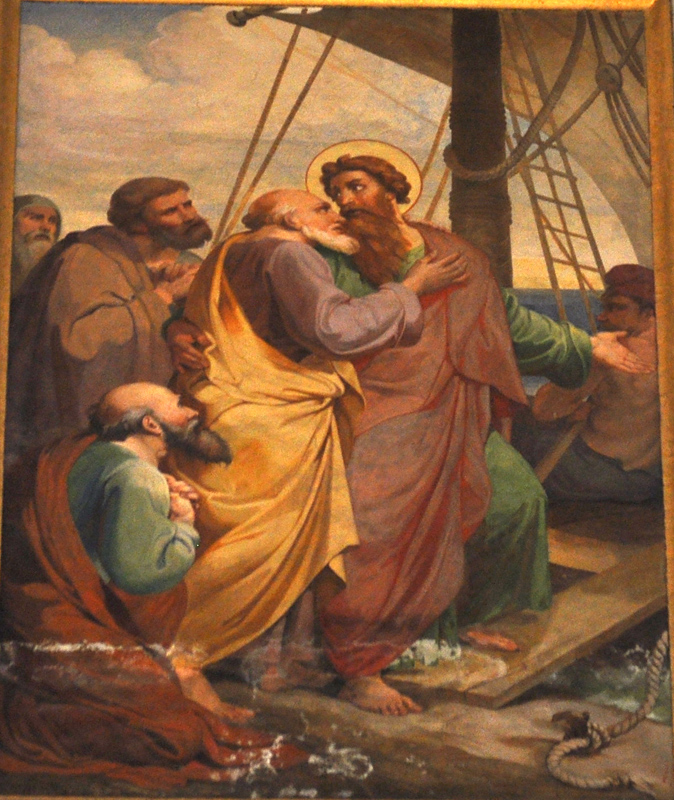
Paul Leaves Miletus (c. 1857-60) in the Basilica of St. Paul Outside the Walls (click the picture for its provenance and other paintings like it)

“He who is too sure in time of peace, will often show himself to be downcast or fearful in time of war.” (IC 3,7,4) | “Jesus answered them, ‘Do you believe now? Behold, the hour is coming and has arrived when each of you will be scattered to his own home and you will leave me alone.'” (Jn 16:31-32)

|The Imitation of Christ by Thomas à Kempis, Book III Chapter VII: ”How Grace Should Be Hidden Under the Guardianship of Humility” (second entry)

Kempis has Christ warning the disciple once again about the dangers of pride and the false confidence that tells us that we’ve got it covered ourselves without the need for God. This attitude of being “too sure” is not so difficult to maintain when things are going well, but when life heads south, then despondency and even fear set in. We are to recall that Jesus provides the light, even if he covers it for awhile, in order to teach us and to help us grow in faith and trust.

|Today’s Gospel Reading: Jn 16:29-33

Today we hear the final words of Jesus’ Last Supper Discourse before He intones the High Priestly Prayer of which the next chapter entirely consists (it will be proclaimed in its entirety over the next three days). The disciples declare an act of faith in Jesus, but Jesus informs them that this will keep them neither unified nor steadfast in their conviction. Yet, their abandonment of Jesus will not leave him without companionship as the Father is always with Him. The peace he promises will come at the Resurrection and the courage He asks them to take will come at Pentecost (that we celebrate Sunday).

|Reflection

It is vitally important that we do not think that any good we have accomplished, or any progress in virtue or in the spiritual life we make, is attributable to us alone. Yes, we must cooperate with grace, but we must remember the Dispenser of that gift. It is tempting, especially after a great struggle to accomplish a good, to pat ourselves on the back. Much better, and infinitely more accurate, is to give glory to the Lord for the good and to own only the bad. May “Praise God!” be peppered throughout our conversations.

https://i0.wp.com/blog.adw.org/wp-content/uploads/2015/04/040115.jpg

“Neither does he show to have much virtue who, in the time of adversity and any affliction whatsoever, gives himself to despair, and thinks and feels less confidence in Me than is convenient for him.” (IC 3,7,3) | “And when they saw him they worshiped him; but some doubted.” (Mt 28:17)

|The Imitation of Christ by Thomas à Kempis, Book III Chapter VII: ”How Grace Should Be Hidden Under the Guardianship of Humility” (first entry)

Kempis comes back to the nearly constant theme of humility in our next chapter. As regards the spiritual life, reveling in heavenly consolation or being disappointed when not quickly receiving consolation is a recipe for disaster. It is best to remember that it is only the gift of grace that allows us to do anything good. The quote in the headline conveys the sentiment that we must always remember the Giver in adversity or affliction and not despair of His love and mercy even if it is not sensibly apparent.

|Today’s Gospel Reading, Mt 28:16-20

For the Solemnity of the Ascension of the Lord, we hear proclaimed the final words of Matthew’s Gospel that gives us Jesus’ Great Commission. This Gospel says nothing about Jesus’ Ascension. In fact, this scene is the only encounter between Jesus and the apostles that the tax collector mentions. Considering what we know from the other Gospels, one wonders why they doubted. Was this the first encounter of Jesus and the apostles after the Resurrection? It would not seem so, considering Jesus’ appearance in the Upper Room (see Jn 20:19-20).

|Reflection

The apostles were daily companions of Jesus for at least three years. They heard Him preach many, many times. They saw miraculous healings and awesome exorcisms. They experienced the first Mass at the Last Supper. They now see Him glorified in His risen body. Yet “some doubted.” What more evidence did they need that Jesus was who He said He was: Lord and Savior?

Instead of rushing to judge these men, we are better served in examining ourselves first (in fact, I would encourage you to do this any time you are tempted to scoff at one or more of the apostles’ reactions to some words or event in Scripture — rather, put yourself in their place and time). If we believe Jesus is Lord and Savior, we certainly worship Jesus (primarily in the Eucharist). But do we also doubt? Consider the circumstances Kempis mentions: when we are tempted to despair of God’s love, or even His existence, in times of difficulty. Let it not be so! We are not fair weather friends of the Lord, are we? His grace is sufficient for us (see 1 Cor 12:9), even if it doesn’t make it easy to navigate troubled waters when storms arise in our lives. Even when Jesus exclaimed in the depths of unimaginable pain in mind, body, and spirit about being forsaken by His Father it was only to point to His ultimate triumph:

For he has not spurned or disdained

the misery of this poor wretch,

Did not turn away from me,

but heard me when I cried out. (Ps 22:25)

As difficult as life’s unexpected challenges can be, let us “poor wretches” never take our eyes off of the prize: eternal beatitude.

Have confidence in God. I would encourage you to get this treasured little book of short meditations on exactly this topic. You will be blessed.

The ideal Holy Bible self-pronouncing, self-interpreting, self-explanatory.. (1908) (14781699461).jpg
Source: The Ideal Holy Bible (1908)

“Keep your resolution firm, and fix your right intention in God.” (IC 3,6,3) | “He vigorously refuted the Jews in public, establishing from the Scriptures that the Christ is Jesus.” (Acts 18:28)

|The Imitation of Christ by Thomas à Kempis, Book III Chapter VI: ”The Proof of a True Lover” (third entry)

This chapter has Christ speaking much about the wiles of the devil and what a true disciple needs to do to combat the machinations of the evil one. A firm resolution to do the good is a gift of the Holy Spirit called fortitude. Whether reactive to temptation or proactive toward evangelization, we must be mindful of our duty toward God and neighbor.

|Today’s First Reading, Acts 18:23-28

Today’s first reading offers a little side note to Paul’s ministry. An Alexandrian Jew named Apollos is “speak[ing] boldly in the synagogue” about Jesus in Ephesus. Paul has already left, but apparently his companions, spouses Priscilla and Aquila, have remained behind there. They fill in some gaps for Apollos by “tak[ing] him aside and explain[ing] to him the Way (of God) more accurately.” He must have been grateful for this instruction as he immediately wishes to share the entirety of the Good News in Achaia which encompassed Athens and Corinth. There he contested with the Jewish religious class while preaching to the public “establishing from the scriptures that the Christ is Jesus.”

|Reflection

Apollos was not going to let the push back he was receiving from the Jews dim in the slightest his resolution to preach the fullness of truth he had just received from Paul’s companions. One can imagine the Jews trolling (as we say these days) this newcomer as he attempts to catechize and evangelize this populace. He knew the people well as he also was a Greek. Undoubtedly the more persuasive he was, the more the professional religious crowd grew irritated and demonstrative. The devil certainly had reason to be concerned about the wild success this new movement was having. Thus, the attacks on Apollos, just as Peter, Paul, and the other apostles had experienced, are no surprise. Fortitude in the face of the temptation to be uncharitable or to quit were needed then as now. Where does the power to combat this lie? In the Word. The Christ is Jesus. All of Scripture speaks of the coming of the Messiah (remember the apostolic Christians only had the Hebrew Scriptures, our Old Testament). We, too, should have recourse to Scripture and Tradition (the entirely of divine revelation, which is the Word, that is, Jesus) to stand firm in the truth and refute those who would lead others astray. Know it well!

All scripture is inspired by God and is useful for teaching, for refutation, for correction, and for training in righteousness, so that one who belongs to God may be competent, equipped for every good work. (2 Tim 3:16)

“If a camp is pitched against me, my heart shall not fear. The Lord is my helper and my Redeemer.” (IC 3,6,4) | “Do not be afraid. Go on speaking, and do not be silent, for I am with you.” (Acts 18:9-10a)

|The Imitation of Christ by Thomas à Kempis, Book III Chapter VI: ”The Proof of a True Lover” (second entry)

In the excerpt above, Kempis concludes a section on the temptations of the devil who constantly attempts to pull us away from God through pride, acedia, and evil thoughts. Why fear when “Jesus will be with me, as a strong warrior”? Death is preferable to sin for Kempis (and for Christ — see below).

|Today’s First Reading, Acts 18:9-18

Paul, likely feeling discouraged and more than a bit upset by his likely quick rejection at the Corinthian synagogue, is bolstered by Jesus Himself in a vision, who begins speaking to the man from Tarsus with the words above. Paul is to go on preaching, now to the Gentiles (thus, he is the “Apostle to the Gentiles”). As we read, he stays there another eighteen months, teaching the people. During this time, the Jewish leaders try to stir up trouble for Paul with the Roman officials. Unlike Pilate with Jesus, Gallio will have none of it, and leaves the Jews to their own dispute. Paul stays on “quite some time” before deciding to continue his missionary journey in Syria.

|Reflection

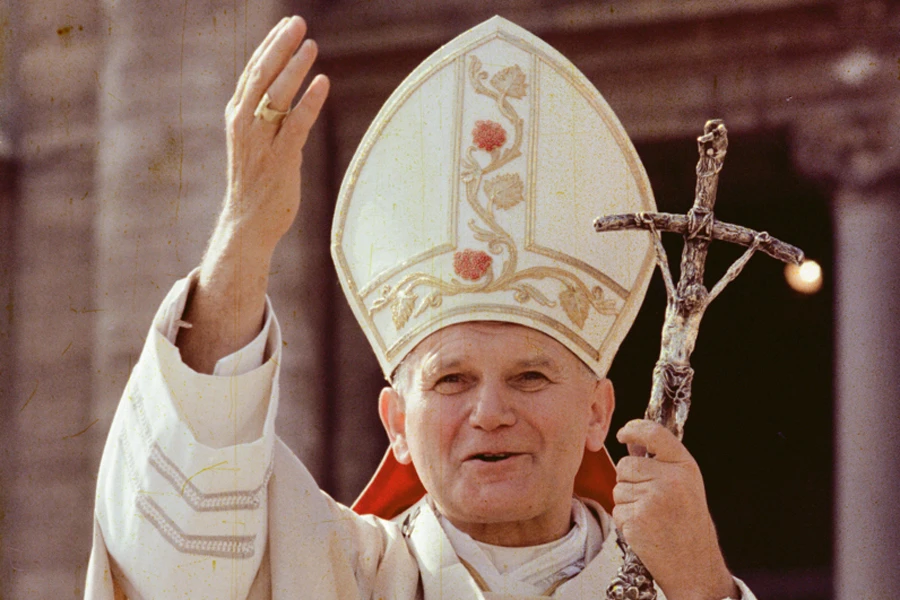
Especially as we mark the 100th anniversary of Pope St. John Paul II’s birth, I am reminded of the theme of his first homily as Holy Father: “Be not afraid!” His whole pontificate is marked by this exclamation in his teaching, outreach, and personal witness. If Christ is for us, who can be against us? (see Rom 8:31) Complete trust in the Lord is needed, then fear is overcome (see Lk 8:50, Mk 5:36).

Kempis writes of the temptation to sin. Luke writes of the temptation to give up evangelizing. Both come from the devil. In these few short years we have on earth, we need to develop an unfailing trust in God. Ultimately (that is, regarding our eternal destiny), the only legitimate fear is offending the Almigjhty. Witness Scripture:

I shall show you whom to fear. Be afraid of the one who after killing has the power to cast into Gehenna; yes, I tell you, be afraid of that one. Are not five sparrows sold for two small coins? Yet not one of them has escaped the notice of God. Even the hairs of your head have all been counted. Do not be afraid. You are worth more than many sparrows. (Lk 12:5-7)

This is easier said than done, of course. Turning to prayer and the Word are necessary for strength. The words of the psalmist below (and mentioned in Kempis) are a wonderful remedy for trepidation. Let us have frequent recourse to them and to the entire psalm.

The LORD is my light and my salvation;

whom should I fear?

The LORD is my life’s refuge;

of whom should I be afraid? (Ps 27:1)

Finally, we should pay special attention to what Jesus says to Paul immediately after the sentence in the headline: “No one will attack and harm you, for I have many people in this city.” We are not alone in this fight! The Lord has nurtured many good Christians with whom we have common cause. Let us work together to drive out fear and build up the Kingdom, praying, with Jesus, “that they may all be one, as you, Father, are in me and I in you, that they also may be in us, that the world may believe that you sent me” (Jn 17:21).

How St. John Paul II began his papacy, 40 years ago