“Do not believe him, do not pay attention to him, even though he often has laid his snares to trap you.” (IC 3,6,4) | “Amen, amen, I say to you, you will weep and mourn, while the world rejoices” (Jn 16:20)

|The Imitation of Christ by Thomas à Kempis, Book III Chapter VI: ”The Proof of a True Lover” (first entry)

What is the proof of a true lover of God? He “remains firm in the midst of temptations,” loves the giver more than the gift, keeps firm in his resolutions, and is steadfast in “continuous humility.” As is noted above, the devil hates all of these qualities and does not tire of attempting to draw us away from these noble dispositions.

|Today’s Gospel Reading, Jn 16:16-20

Jesus’ Last Supper Discourse continues with His mysterious words to the apostles that they would soon not see Him for a little while but then a short time later they would see Him. They don’t understand what He means. The close of this reading (above) is Jesus’ response to their questioning; He answers indirectly by telling them what their reaction will be to His departure versus how the worldly will react. This will be made manifest the next day upon Jesus’ death and burial.

|Reflection

A sinful world did not want to hear Jesus’ convict it with the truth during His time on earth and it wants even less to be convicted in our time. There is much rejoicing among the worldly when Christianity is pushed out of the public square and all strains of moral evil are given exalted praise and free rein. And even when the Faith is relegated to obscurity, that is not enough for the wicked — it must compromise its values or be eliminated entirely. This is the work of the devil, the one whom Kempis has Christ speaking of in the passage in the headline. The fallen world pays keen attention to the “old adversary,” as Kempis calls him in this chapter, and rejoices with him when the Church takes blows and loses power, influence, and authority. Meanwhile, those who remain faithful grow increasingly downcast at the state of our culture.

Yet, those who mourn now but remain faithful to the end will receive their reward:

Blessed is the man who perseveres in temptation, for when he has been proved he will receive the crown of life that he promised to those who love him. (Jas 1:12)

Those who laugh now in their immorality should pay close attention to the following words of Scripture:

Do you not know that the unjust will not inherit the kingdom of God? Do not be deceived; neither fornicators nor idolaters nor adulterers nor boy prostitutes nor sodomites nor thieves nor the greedy nor drunkards nor slanderers nor robbers will inherit the kingdom of God. (1 Cor 6:9-10)

Then mourning will turn to joy, and joy to mourning:

Blessed are they who mourn, for they will be comforted. (Mt 5:4)

Woe to you who laugh now, for you will grieve and weep. (Lk 6:25b)
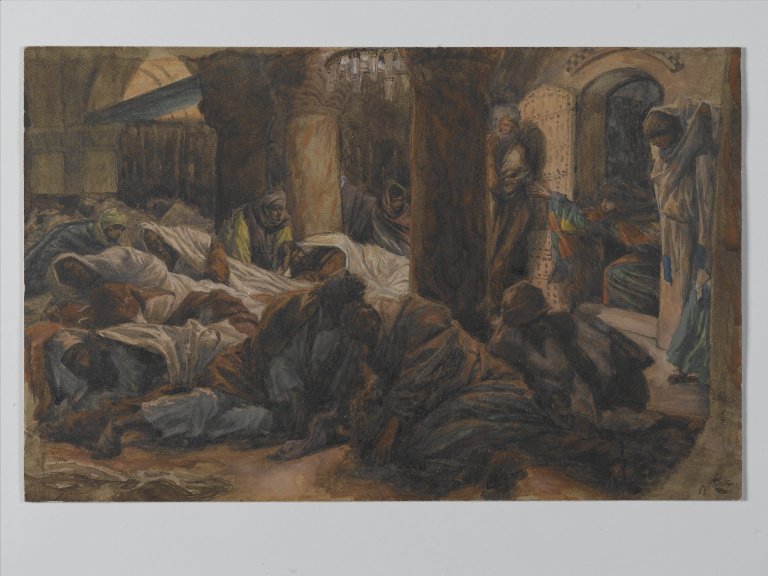
File:Brooklyn Museum - The Madgalene Runs to the Cenacle to Tell the Apostles that the Body of Jesus is No Longer in the Tomb - James Tissot.jpg
The Madgalene Runs to the Cenacle to Tell the Apostles that the Body of Jesus is No Longer in the Tomb (between 1886 and 1894) by James Tissot

“The noble love of Jesus spurs us on to do great things and stimulates us always to desire that which is the most perfect.” (IC 3,5,3) | “I even discovered an altar inscribed, ‘To an Unknown God.’ What therefore you unknowingly worship, I proclaim to you.” (Acts 17:23)

|The Imitation of Christ by Thomas à Kempis, Book III Chapter V: ”The Wonderful Effects of God’s Love” (third entry)

Jesus loves us.  God created all things out of love — not out of necessity but to share His love.  We are made for greatness, to share in the divine life here on earth and to contemplate the Blessed Trinity for all eternity in heaven.  We know of our innate drive for perfection based on our earthly desires.  This is a hint of the divine perfection for which we ultimately long and that can only be fulfilled by the Divine Author.

|Today’s First Reading, Acts 17:15, 22—18:1

In this passage, we are given Paul’s full speech to those present in the Areopagus in Athens.  After several days of preaching and debating, he is asked by some of the Greek philosophers to explain further “this new teaching is that you speak of[.]  For you bring some strange notions to our ears; we should like to know what these things mean” (vv. 19-20).  Paul, who, when exploring the city, had grown “exasperated at the sight of the city full of idols” (v. 16), now seizes on one particular temple hoping to move his listeners hearts.  He goes on to preach a beautiful discourse on the one true God, creator of all, who does not dwell in temples or has need of our services, but rather provides everything to us.  Now the time of ignorance of God is over, and that the time for repentance has come.  He concludes by speaking of a day of justice now established through “a man [God] has appointed” whom He has raised from the dead.

Some of those present scoff at the notion of resurrection, others brush him off with, essentially, “come back some other time,” and a few actually join his ministry as he departs.

|Reflection

So be perfect, just as your heavenly Father is perfect. (Mt 5:48)

We strive for perfection here to better prepare for our eternal goal: eternal beatitude with the Lord.  It is by emulating the love of God, only possible through the impetus of His love, expressed by Him to us as grace, that we can even approach this state.  While not even the greatest saints would ever have the temerity to think they had reached perfection in this life, their heroically virtuous behavior is what we are called to emulate.  The saints wished to do “great things” stimulated by love of God and neighbor.  And so Paul, due to his missionary zeal and the urgency of the need to pull peoples from ignorance to repentance, brings the Good News to Athens.

Does love of God and desire to do “great things” stimulate us to a zeal to break others free from the ignorance of not knowing the fullness of divine revelation?  Are we willing and able to proclaim the truth to seekers who do not know God or who have rejected Him?  Let us learn our faith well, pray for grace often, and ask for heroic virtue to bring the love of God to all whom we encounter.

Saint Paul delivering the Areopagus Sermon in Athens (1515) by Raphael

“O Lord God! my holy Lover! when You shall come into my heart all that is within me will exult.” (IC 3,5,1) | “He … with his household rejoiced at having come to faith in God.” (Acts 16:34)

|The Imitation of Christ by Thomas à Kempis, Book III Chapter V: ”The Wonderful Effects of God’s Love” (second entry)

Kempis gives us the words — directed to Christ — of the disciple who recognizes his own unworthiness and his “weak[ness] in love and imperfect[ness] in virtue.”  Christ responds by extolling the virtues and the power of love.

|Today’s First Reading, Acts 16:22-34

Due to Paul’s exorcising of an “oracular” demon in Philippi, the minders of the now freed girl, who had made a profit off of her fortune-telling, stirred up the people against Paul and his companion Silas, reporting them to the authorities who in turn beat them and had them imprisoned.  A miraculous earthquake opened the doors of the jail and broke their chains, but they did not use this opportunity to escape; rather they were inspired to bring the jailer and his household to God.  The words above reflect the jailer’s family’s sentiments after hearing the Word preached and receiving baptism.

|Reflection

The jailer’s family members exulted upon receiving the life of God within them.  Earlier, the head of the family, “trembling with fear,” at what the earthquake wrought, asked Paul and Silas: “Sirs, what must I do to be saved?”  Well, he needed Jesus!  Inviting the two men into his home, the jailer heard the Word proclaimed, that is, what the Christian message and life entailed, then submitted himself and his entire family to baptism, so that the grace of the Lord would come into their hearts.

Some Christians advocate the so-called Sinner’s Prayer that, in part, invites Jesus “to come into my heart,” in order to be saved.  The impetus to call Christ into our hearts is a good one.  But, like the disciple in Kempis, we should do this often, not just once.  As fallen human beings we continually need the grace of God to live authentically Christian lives.  Have you been saved?  Here’s the Catholic answer:

[W]e believe that we were saved, as Paul says in Rom 8:24; that we are being saved, as Paul says in 1 Cor 1:18; and that we will be saved, as Paul says in Rom 5:9-10, provided we persevere and keep our eyes on the prize. (Catholics Come Home; also see Catholic Answers)

How can a person not exult when Jesus is securely in his heart?  And how could he ever be tempted do anything to push Him out once He is there?  We are justified by grace through faith working in love.  And love is the impetus of Kempis’s entire chapter and Jesus’ entire mission.

Are you saved?"--Just went through this with my children this week ...

“He who loves must willingly embrace all that is hard and bitter, for the sake of his Beloved, and never separate himself from Him for accidental oppositions.” (IC 3,5,8) | “[T]he hour is coming when everyone who kills you will think he is offering worship to God.” (Jn 16:2b)

|The Imitation of Christ by Thomas à Kempis, Book III Chapter V: ”The Wonderful Effects of God’s Love” (first entry)

We begin this chapter that expounds on the virtue of love by turning to the last sentence.  As beautiful and essential as love is, it also entails bearing hardship heroically for God’s sake and for our sake.  Adversities (“accidental oppositions”) will come, but they must not serve as impetus to distance ourselves from the Lord.

|Today’s Gospel, John 15:26-6:4a

Jesus again speaks to the apostles of the Holy Spirit as the Last Supper discourse continues.  The Spirit will impart truth to them and allow them to testify to the truth to others.  But proclaiming the fullness of the Good News will entail persecution and, for all but one of the apostles, red martyrdom.  These men must be prepared for this eventuality and the Spirit will help them to endure these trials.

|Reflection

Kempis’s words remind me of these verses from Scripture:

What will separate us from the love of Christ? Will anguish, or distress, or persecution, or famine, or nakedness, or peril, or the sword? As it is written:

“For your sake we are being slain all the day; we are looked upon as sheep to be slaughtered.”

No, in all these things we conquer overwhelmingly through him who loved us. For I am convinced that neither death, nor life, nor angels, nor principalities, nor present things, nor future things, nor powers, nor height, nor depth, nor any other creature will be able to separate us from the love of God in Christ Jesus our Lord.

— Rom 8:35-39

Paul lived the challenges of being a zealous proclaimer of Christ.  He was very familiar with the persecutions that come with the territory.  He would eventually pay with his life.  For love of God and neighbor, we, also, are asked to be forthright in living an authentically Christian life in thought, word, and deed.  Always in love, but never compromising the truth.  It will be difficult.  There will be persecution.  We will likely suffer loss.  But what we ultimately gain, through loving perseverance, is immeasurable.

Blessed is the man who endures trial, for when he has stood the test he will receive the crown of life which God has promised to those who love him. (Jas 1:12)

The Beheading of St. Paul (1648) by Simon de Vos

“[T]he Spirit teaches…to despise earthly things and to love heavenly things; to despise the world, and day and night to desire Heaven.” (IC 3,4,5) | “I will ask the Father, and he will give you another Advocate to be with you always, the Spirit of truth, whom the world cannot accept, because it neither sees nor knows him.” (Jn 14:16-17)

We close the fourth chapter of Book Three with the comforting final words of that chapter.  We invoke the Holy Spirit to live in truth and humility, to reject the base things of the world and to focus on eternal life with God.

The promise of Jesus to send the Holy Spirit comes in today’s Gospel (Jn 14:15-21) the first of five times during the Last Supper Discourse.  The Lord knows the apostles will need this great gift in order to preach boldly the Word of God to an unbelieving world hostile toward the truth, with many denying there is such a thing as truth altogether (see Jn 18:38).  But they must keep the commandments if they truly love the Lord (Jesus repeats this twice in this short passage to emphasize its importance).

We must “despise earthly things” in order to keep the commandments.  Inordinate affection for material goods leads us away from God.  If an offense in this area is particularly serious we are in danger of cutting ourselves off from the life of God in us (see CCC 1854-1861).  So, if we want to discern clearly the truth of God, we must regularly examine ourselves, repent of sins, confess them to God and His priest, and firmly resolve to not commit these offenses again.  In order to see clearly the truth we cannot lose the Spirit through our own wickedness.  How will we convey the truth to, at best, a skeptical culture when we ourselves have exchanged the truth for a lie (see Rom 1:25) for the sake of some temporary pleasure that defies God’s law?  What sort of example do we set when we don’t walk the talk?  Do we wish to be responsible for driving persons away from the one true Faith?

Let us not be slaves to sin but rather always remember that, as Jesus said, “If you remain in my word, you will truly be my disciples, and you will know the truth, and the truth will set you free” (Jn 8:31-32) — free “to love heavenly things” and to invite our neighbor to join us in doing so.

10 Great Verses on the Holy Spirit to Fire You Up!

“He who walks before Me in the truth, shall be defended from the assaults of evil, and the Truth will deliver him from deceivers and from the detractions of the wicked.” (IC 3,4,1) | “If you belonged to the world, the world would love its own; but because you do not belong to the world, and I have chosen you out of the world, the world hates you.” (Jn 15:19)

Kempis, in emphasizing that we need to live in truth, has Christ telling us that doing so will lead to assaults by deceivers and detractions from the wicked (3,4).  Christ goes on to tell the disciple (that is, us) that He will teach him the truth but he must give up sin and recognize his own nothingness without Him.

Jesus, in today’s Gospel, continuing His Last Supper Discourse, warns the apostles of the resistance they will meet from a fallen, sinful world (Jn 15:18-21).  They persecuted Jesus, so why should they think they will fare better when preaching in His name?  The Lord is preparing them well for that which they will be dealing very soon.

Can anything worse be said of a Christian today than that he is “worldly.”  A culture in chaos, where truth and falsehood have reversed poles (see Rom 1:25 and read the whole section — Paul describes the world to a T), must not affect our equilibrium.  Our true north is Christ who is the Truth (see Jn 14:6).  We keep our eyes on Him and we do well.  A momentary glance away, being more concerned with self than God, and we begin to sink into the abyss (see Mt 14:29-31).  This is why we must be on guard always to embrace and proclaim the unvarnished truth, with no compromise to evil.  We will be hated for holding fast to our Faith, especially with the hot button issues of the day related to life and sexuality.  We must not be wishy-washy (see Rev 3:15-16 for a graphic example of what the Lord thinks of such folks).  We must be bold.  We must be Catholic.

Let us pray intensely for the gifts of the Holy Spirit (see Is 11:2-3) to guide us and give us a well-trained tongue (see Is 50:4).  He will not let us down (see Lk 12:10-12).

See the source image

“I, Who am the Truth, will teach you those things which are right and pleasing in my sight.” (IC 3,4,3) | “You are my friends, if you do what I command you.” (Jn 15:14)

Chapter IV of Book III of Thomas à Kempis’s The Imitation of Christ: “How We Should Live in God’s Presence in Truth and Humility.”  In this chapter, Kempis continues two prevalent themes in this work: veritas and humilitas.  Seek truth from God and not the world and remember your own wretchedness and the need for grace to do anything good.  Above, Kempis has Christ respond in this way to the disciple who asks to be taught, guarded, and kept in this life so that he can attain eternal life.

Today’s Gospel (Jn 15:12-17) repeats the last six verses of yesterday’s reading in which Jesus commands (and then reiterates to) His disciples to love one another if they wish to remain in his friendship.

In human relationships, we would not expect to remain in good standing with friends if we constantly betrayed and scorned them.  We would likely think something was wrong with them if they continued to accept this sort of behavior from us.  Why, then, would we think that, with Almighty God, anything goes?  It is true, of course, that the Lord awaits our return, no matter how egregious our behavior toward Him or our fellow mortals.  But He will not save us against our will.  Now, He has been very generous to us in giving us Divine Revelation safeguarded by the Church as the fountain of truth to rightly satiate our thirsty consciences.  But, if we do not listen, if we wish to sever those ties with God, we have only ourselves to blame — we condemn ourselves.

So let us always strive for the Truth, that is, Jesus because, as He said:

If you remain in my word, you will truly be my disciples, and you will know the truth, and the truth will set you free. (Jn 8:31-32)

Jesus saying farewell to his eleven remaining disciples (1308-1311) by Duccio

“O Lord, teach me to do Your will, teach me to stand worthily and humbly in Your presence, because you are my Wisdom, Who truly know me, and did know me before the world was made, and before I was born to the world.” (IC 3,3,7) | “It was not you who chose me, but I who chose you and appointed you to go and bear fruit that will remain, so that whatever you ask the Father in my name he may give you.” (Jn 15:16)

Kempis closes out this chapter (3,3) with the proper attitude of a servant toward his Master: do God’s will, be worthy of the name Christian, be humble realizing that I am nothing and God is everything, and all wisdom comes from God.  The Lord knows us better than we know ourselves and has conceived of us before we were a hint in our parents’ minds (see Jer 1:5).

Jesus uses the word love eight times in the nine verses included in today’s Gospel reading (Jn 15:9-17).  How do we prove our love?  Jesus says, “keep my commandments.”  This is how a person’s joy is made complete, so that he may remain in God’s love.  Jesus goes on to say: “love one another as I love you.”  This is how we stay friends with Christ.  The words in the headline lead to His conclusion where He again issues the command to “love one another.”

Kempis and Jesus are on the same page (a good page to be on): God knew us and chose us from all eternity.  He comes to us — we have no power on our own to go to Him.  We recognize this in all humility.  We also acknowledge the Messiah’s mission for us: to do His will.  This is made perfect in love.  The Ten Commandments are our guideposts for this task (see Ex 20:1-17).  The first three commandments pertain to love of God; the concluding seven have to do with love of neighbor.  This is true wisdom: to love God above all things and, in turn, to view others as God views them.  This is, it hardly needs to be said, truly difficult, as well.  But with God’s grace all things are possible (see Mt 19:26).  Let us ask for this gift unceasingly.  In a world in which divisiveness, hate, and despair seem to have the upper hand, let us do our part to bring the unity, love, and joy of God.

“Lord, save us from gloomy saints,” has been attributed to the great mystic and master of the spiritual life, St. Teresa of Avila.  What a beautiful sentiment.  Being in right relationship with the Lord should be thrilling!  Bearing fruit, as appointed by Jesus for us to do, should render us ecstatic!  Spreading the Good News should be a joy (see here)!

To the One who gave us everything what else must we do but give it all back in spades.

After a long time the master of those servants came back and settled accounts with them. The one who had received five talents came forward bringing the additional five. He said, ‘Master, you gave me five talents. See, I have made five more.’ His master said to him, ‘Well done, my good and faithful servant. Since you were faithful in small matters, I will give you great responsibilities. Come, share your master’s joy.’

For to everyone who has, more will be given and he will grow rich; but from the one who has not, even what he has will be taken away. (Mt 25:19-21,29)

That is some great reward.

Willem de Poorter's 'Parable of the Talents' in the Narodni Galerie, PragueParable of the Talents by Willem de Poorter (1608-1668)

“What I have promised, I will give; what I have said, I will fulfill; provided a man remains faithful in loving me until the end.” (IC 3,3,4) | “Whoever remains in me and I in him will bear much fruit, because without me you can do nothing. Anyone who does not remain in me will be thrown out like a branch and wither … they will be burned.” (Jn 15:5-6)

Kempis puts the words above on Christ’s lips (3,3).  In this rather lengthy monologue, the Lord bemoans the fact that so many listen to the world and the flesh, even in small matters, than they listen to Him.  It will not turn out for these unfaithful ones.

Jesus’ lengthy Last Supper Discourse continues with the famous analogy of the vine and the branches (Jn 15:1-8).  Remain attached to Jesus (the vine), feeding from Him (as branches do), accepting the pruning of the Father (the vine grower), and one bears much fruit.  Those who do not desire the life giving nourishment of the Lord wither, die, and are tossed into the fire.

How do we bear fruit?  By having “[Christ’s] words remain in [us].”  In these posts, I never tire of tying belief in Jesus with living an authentically Christian life. Those who claim that belief and salvation only entail a verbal acknowledgement of Jesus as Lord and Savior, without concern for behavior, scandalize Christians and non-Christians alike.  We are called to interiorize the Gospel then exteriorize it in word and deed.  Jesus today, and repeatedly in the Gospels, speaks of the necessity of good works to attain heavenly glory (never forgetting the gift of grace necessary to do such deeds).  Meanwhile, this disposition also allows us to bear much fruit here: the Lord closes this passage by saying that doing so is the mark of a disciple.  Will their be pain involved?  Guaranteed.  It hurts to be pruned of our worldly affections and disordered inclinations.  But the gain is eternal life for us and for those whom Christ brings along by working through us.

pruning grapes

“I am the Remunerator of all good men, and I severely try all the devout.” (IC 3,3,4) | “They stoned Paul and dragged him out of the city, supposing that he was dead. But when the disciples gathered around him, he got up and entered the city.” (Acts 14:19-20)

Chapter III of Book III of The Imitation of Christ deals with listening to the Word with humility while recognizing that so many persons take Scripture lightly.  The voice of the world is powerful but ultimately leads to one’s downfall.  The faithful, though, will be tried and tested, as we read above.  In the end, Jesus rewards, but not before the most challenging trials are met by those deeply devoted to Him.

In today’s first reading (Acts 14:19-28), we hear of the stoning of Paul before he and Barnabas travel to a number of Gentile cities, sharing the Good News with success, before returning to Antioch to spend time with other disciples.

How things can turn on a dime, can’t they?  When we left off yesterday, we heard that Paul and Barnabas were considered gods by the pagans of Lystra because of a miraculous healing performed in the midst of the people.  Today, picking up with the verses immediately following this event, we discover that Jewish agitators from other regions come to rile up the selfsame crowd to kill Paul.

Now, I don’t believe Paul was faking his death to stop the onslaught of rocks; rather; he was likely unconscious and severely battered.  I can imagine the horror and sadness of those disciples who thought him dead.  It seems to me quite significant that Luke (the evangelist author of Acts) mentions that “the disciples gathered around” the apparently lifeless Paul.  The prayers and supplications of his friends that Paul be allowed to continue his powerful ministry must have been fervent.  Imagine their great joy when, prayers answered, he pops up and boldly heads back into the city.

Saul was zealous in his persecution of Christians.  His dramatic conversion turned that zeal around without diminishing it — in fact it was likely stronger since he was now part of the minority.  Desiring his eternal reward (Phil 1:20-26), nevertheless he was steadfast in preaching the whole truth regardless of consequences.  He had personal struggles and public disappointments.  A more devout person to Christ might never be known, yet he was severely tried.  This stoning we heard proclaimed today was certainly one of the harshest events recorded about Paul in Scripture but by no means the only one (2 Cor 11:23-28)

We should expect to be tried; even more so as our devotion deepens.  Let it never hinder our desire to evangelize as we anticipate the divine remuneration that awaits those who persevere till the end.

The Stoning of St Paul and St Barnabas at Lystra by Barent Fabritius (1624-1673)