
The first reading is from Rv 11:19a; 12:1-6a, 10ab . We will focus here on the first two verses of chapter 12. But the Church gets it right by starting this reading with the last verse of chapter 11 (remember, chapter and verse designations came much later in history and they don’t always get it right).
A great sign appeared in the sky, a woman clothed with the sun,
with the moon under her feet,
and on her head a crown of twelve stars.
She was with child and wailed aloud in pain as she labored to give birth. (vv. 1-2)
“The woman of Revelation 12 is both an individual person and a collective symbol. She is Mary, the Mother of the Messiah and the spiritual mother of his disciples (Jn 19:26–27). But she also represents the faithful of Israel, crying out for the Messiah (Rev 12:2), as well as the Church, attacked by the devil for witnessing to Jesus (12:17) (CCC 501, 507, 1138). ● The depiction of the woman is rich in biblical symbolism. (1) Antagonism between the woman and the dragon, the “ancient serpent” (12:9), recalls Gen 3:15, the first prophecy in Scripture to foretell the demise of the devil through the offspring (Messiah) of a woman (a new Eve). (2) Images of the sun, moon, and stars call to mind Gen 37:9–10, where they symbolize the family of Israel, namely, Jacob, his wife, and his twelve sons. (3) The pangs and anguish of childbirth recall Isaiah’s description of Daughter Zion, a maternal figure that represents the holy remnant of Israel groaning for redemption (Is 26:17; Mic 4:9–10). (4) Because the woman is a queen who wears a crown and a mother who bears a royal male child, she is also the Queen Mother of the Davidic kingdom reestablished by Jesus, the Davidic male child (1 Kings 2:19–20; Jer 13:18) (CCC 489). See essay: Queen Mother at 1 Kings 2. ● The woman is clearly the Church, endowed with the Word of the Father, whose brightness outshines the sun. Like the moon she is adorned with heavenly glory, and her crown of twelve stars points to the twelve apostles who founded the Church (St. Hippolytus, On the Antichrist 61). The vision speaks of the Mother of our Savior, depicting her in heaven, not on earth, as pure in body and soul, as equal to an angel, as one of heaven’s citizens, as one who brought about the Incarnation of God. She has nothing in common with this world and its evils but is exalted and worthy of heaven, despite her descent from our mortal nature (The Ignatius Catholic Study Bible: The New Testament. [2010]. [pp. 506–507]. San Francisco: Ignatius Press.)
Now, is the “woman” Mary or a symbol of the Church? Catholics easily see Mary, assumed and now queen of heaven. Protestants often reject the Marian aspect. As is often the case, Catholics do not pick an either/or but rather take a both/and approach. As usual, Trent Horn takes a balanced look in his article “Is Mary the Woman in Revelation 12?“
And, if this woman experiencing birth pangs bothers you (because many believe due to Mary’s Immaculate Conception, with private revelations affirming, that Jesus’ mother would not have experienced the pain of childbirth), Catholic Answers comes through again: “The Woman in Revelation and the ‘Pangs of Childbirth.'”
Finally, because we have this reading due to today’s celebration of the Feast of Our Lady of Guadalupe, what connections can we find between the woman on the tilma who appeared to Juan Diego, and the woman of Revelation. See here.
Our dear mother changed the hearts of millions within a decade of her appearance and message to Juan Diego. May we invoke her daily and allow her to continue to effect conversion today in a world so need of a mother’s love.
God bless.
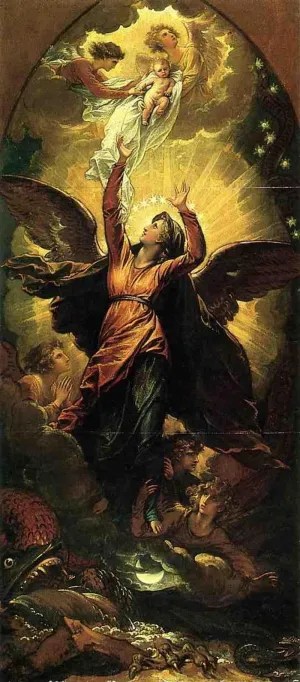
The Woman Clothed with the Sun Fleeth from the Persecution of the Dragon
by Benjamin West (c.1797)
 Unworthy Servant