“Alas! what kind of life is this, where there is nothing but afflictions and miseries; where all is full of snares and of enemies.” (IC 3,20,3) | “The days will come when the bridegroom is taken away from them, and then they will fast.” (Mt 9:15b)

|The Imitation of Christ by Thomas à Kempis, Book III Chapter XX: ”The Confession of Our Own Weakness, and the Miseries of this Life” (second entry)

Kempis’s disciple tells Christ in this chapter how difficult it is to resist the temptations of this life and their associated trials. This leads him to exclaim the words above. He really wants to be detached from the world, not to love the world for its illicit pleasures.

|Today’s Gospel reading: Mt 9:14-17

This reading is Jesus’ response to John the Baptist’s disciples who wonder why Jesus’ disciples do not fast as they do. Jesus, calling Himself the Bridegroom, says they are not to fast while He is with them, but the time will come when He no longer is with them and then they will have cause to fast. He ends with the comparison to pouring old wine (the Old Covenant) into new wine-skins (the New Covenant); the promise of the Old has been fulfilled in Jesus — the outmoded rituals of the past no longer apply.

|Reflection

Surely, this life has plenty of “afflictions and miseries” and is “full of snares and of enemies.” But what match are these to the power of the Lord when He is on our side? If and when we take Jesus out of the picture, such troubles are insurmountable. If it is the case that we no longer have the Lord in our lives, then fasting is certainly a good way to begin inviting Him back into our lives. And if the Lord simply is not sensibly present and no consolations are forthcoming, fasting is a beautiful way to honor Him. Fasting is an expectation of the Christian, in any case (“When you fast…” — Mt 6:16-17). A detachment from earthly goods helps to keep this life in proper perspective by keeping us focused on God and others so that we keep the Great Commandments (see Mt 22:36-40) now in the blessed hope of entering eternal beatitude later..
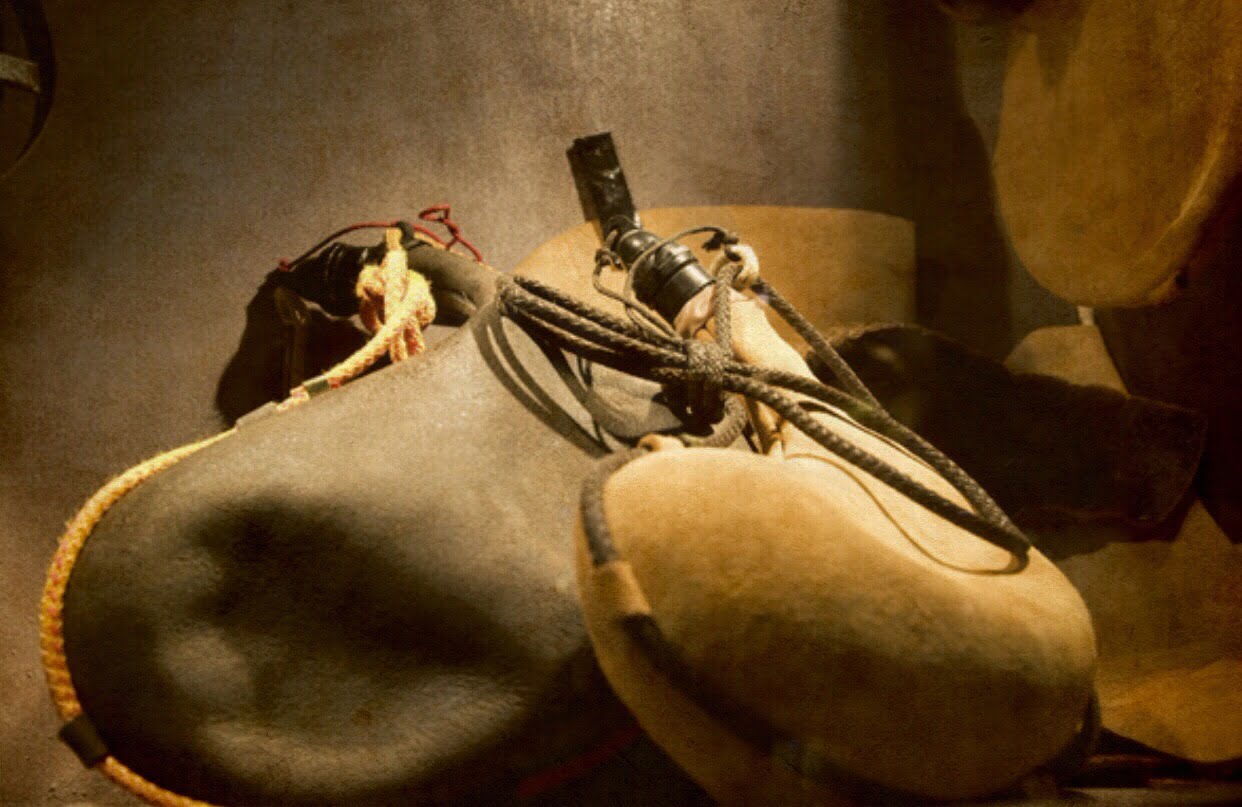
What does Jesus mean by 'new wineskins'? | Psephizo

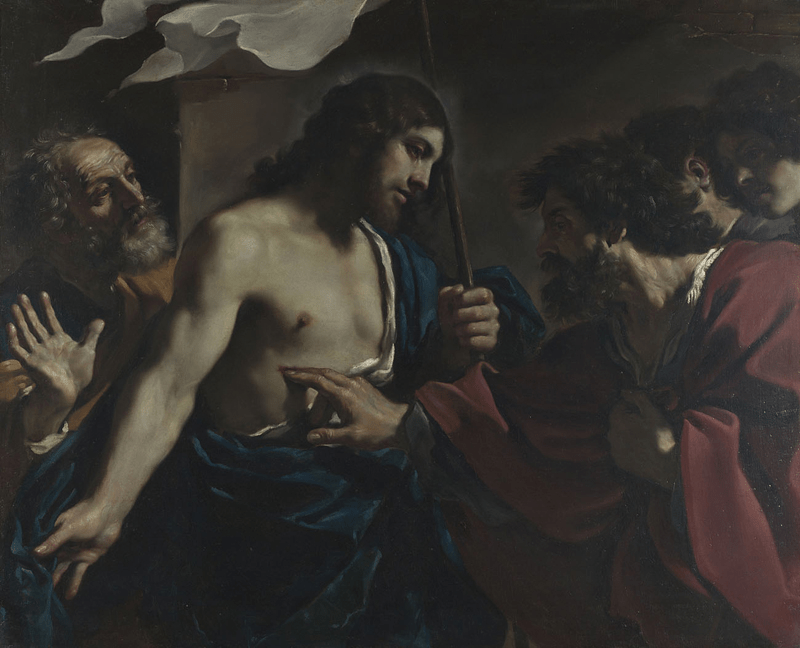
“Behold…O Lord, my littleness and my frailty, clearly shown to you on every side.” (IC 3,20,2) | “Then [Jesus] said to Thomas, ‘Put your finger here and see my hands, and bring your hand and put it into my side, and do not be unbelieving, but believe.'” (Jn 20:27)

|The Imitation of Christ by Thomas à Kempis, Book III Chapter XX: ”The Confession of Our Own Weakness, and the Miseries of this Life” (first entry)

In this chapter, Kempis bemoans the difficulty we have in controlling our passions due to our weakness that comes from concupiscence. Only God’s help along with our own discipline can find us overcoming our inordinate desire for the “mire” of earthly pleasures.

|Today’s Gospel reading: Jn 20:24-29

On today’s Feast of St. Thomas, Apostle, we again hear the story of “doubting Thomas” for which this great saint goes down in infamy. Thomas was not present on Resurrection Sunday and expressed serious doubts about the veracity of the apostles’ insistence that Jesus had visited them in the flesh that evening. The following Sunday is when the Lord appears to Thomas and invites him to probe His wounds. Upon this event, Thomas makes an awesome profession of faith prompting Jesus to bless all those in the future who will believe in the Resurrection without having seen the Lord in His glory.

|Reflection

When we clearly recognize and humbly acknowledge our “littleness” and “frailty” we are far ahead of the game. Without grace we have no chance. When we trust in the Lord and cooperate with the grace He so wishes to pour out upon us we can move mountains. Thomas must have recognized in an instant his own weakness and faithlessness — despite the depictions of this apostle literally probing Jesus’ wounds upon His invitation, I really don’t believe it ever got to that point (Scripture certainly does not explicitly state that he did so). Instead of thinking poorly of Thomas for his doubt, we should thank him for his witness and be grateful to his compatriot, John, for relating this scene. Not only does it reinforce the truth of the Resurrection, it gives us Jesus’ heartening closing sentiment, “Blessed are those who have not seen and have believed.” The Lord took on human littleness and frailty. He understands our weakness and temptations. Believe that only He can help us overcome our challenges if only we ask.

Ask and it will be given to you; seek and you will find; knock and the door will be opened to you. For everyone who asks, receives; and the one who seeks, finds; and to the one who knocks, the door will be opened. (Mt 7:7-8)

The Incredulity of Saint Thomas (1621) by Guercino

“Do not say: ‘I cannot tolerate these things from such a man; nor should I suffer things of this kind because he has done me great harm, and he has reproached me for things I never thought of; but I will suffer willingly from another, and in the manner which I shall judge better.'” (IC 3,19,2) | “At that, some of the scribes said to themselves, ‘This man is blaspheming.’ Jesus knew what they were thinking, and said, ‘Why do you harbor evil thoughts?'” (Mt 9:3-4)

|The Imitation of Christ by Thomas à Kempis, Book III Chapter XIX: ”On Supporting Injuries; and Who Shows Himself to be Truly Patient” (first entry)

To achieve patience in suffering it helps to look to our Lord for the perfect example. In whatever form His difficulties took, Jesus did not complain or express undue frustration. Rather, He kept after the mission on which He was sent by His Father. Any reproach of Jesus was unjust. When it came from the religious leaders, which it most often did, the insult was particularly egregious. Jesus was certainly accused of things He never did or said (just consider His trial) yet He ultimately went like a lamb to slaughter. Here, Kempis has Jesus saying that patience like unto His own is key to enduring those who treat us wrongly. He goes on to say that our overriding consideration should be the one who will ultimately “crown” the patience we show in adversity.

|Today’s Gospel reading: Mt 9:1-8

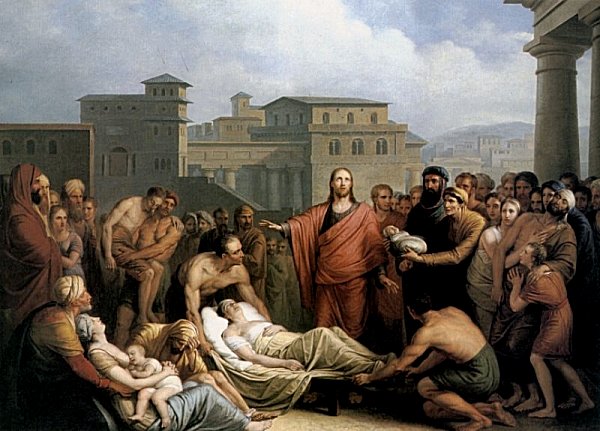
In today’s Gospel, Jesus is fresh off His rejection in Gadara, stepping off the boat in His home town, when He is immediately brought a paralyzed man on a stretcher. Jesus declares his sins forgiven which causes a mental outcry of blasphemy from the lurking scribes (see the headline). Jesus, being wise to them, rebukes them for their “evil thoughts” and then proves His provenance by completely healing the unfortunate prostrate man. The onlookers “were struck with awe and glorified God.”

|Reflection

Patience is difficult enough in the minor annoyances of day to day living: a slow driver blocking our way, sporadic internet service, a throbbing headache, noisy neighbors. But what about the big stuff? False accusations, verbal or written attacks on us or our family and friends, disparaging of our faith, off-handed questioning of our sincerity. Jesus had to endure all these things. Yet these never disturbed His inner peace nor did they deter Him in the slightest in His mission. When He did respond, He did so in a manner that was completely justified and always entirely truthful. So this is a lesson for us: may we have the patience of Christ who could never be justly criticized yet was often taken to task. Everything He said, everything He did, was out of love, inviting all He encountered to be part of the Kingdom. Whatever happens to us, we must have the same attitude and drive to bring others to the Lord, regardless of how they treat us.

Christ Heals the Paralytic by Mathieu Ignace van Bree (1773-1839)

“Behold we are still tepid, after having heard of your miracles and your teachings!” (IC 3,18,2) | “[T]he whole town came out to meet Jesus, and when they saw him they begged him to leave their district.” (Mt 8:34)

|The Imitation of Christ by Thomas à Kempis, Book III Chapter XVIII: ”How Temporal Miseries are to be Borne with Patience Imitating the Example of Jesus Christ” (fourth entry)

One last time in this chapter highlights the closing paragraph. Despite all we know of Jesus’ life and works, it still can be difficult to become excited about our faith and the great things the Lord has done for us, even when things are going well — never mind when “temporal miseries” come along.

|Today’s Gospel reading: Mt 8:28-34

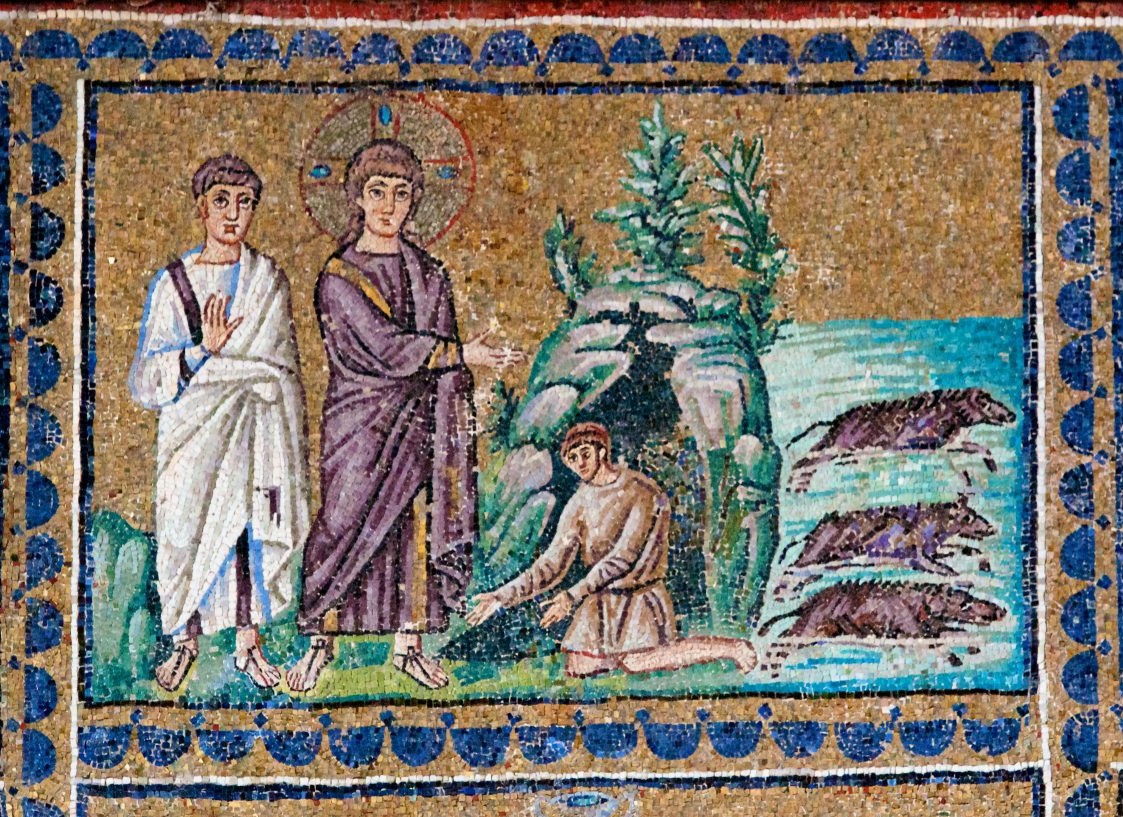
The last words of today’s Gospel say much about the townsfolk Jesus encountered. Having gone into Gentile territory and encountering two dangerous men possessed by demons, Jesus exorcises the evil spirits into a herd of pigs per their request with just two words. The pigs run into the sea and drown, the swineherds tell the people of these astonishing events, and all come out to beg Jesus to leave.

|Reflection

I suppose one could say that the reaction of the Gadarenes was more than tepid — more like outright hostile. Maybe they didn’t like that Jesus was imperiling their livelihood considering the destruction of the pigs (consider: when is the Lord “inconvenient” to our desire for earthly goods”); or could it be that He frightened them with this great power (consider: what causes us to shrink from the awesome power of God causing us to ask Him to leave our “district”?); or what if they were just not ready to receive the Almighty in their midst (consider: are we like the young Augustine, regardless of our age, in saying, “Lord, make me pure, but not yet!”). In any case, we have much less excuse than these poor Gentiles for pushing away Jesus. They likely had never seen or heard of this Man before. We have the wealth of His miracles and teachings in Scripture, reinforced by nearly two thousand years of Church teaching and scholarship, to guide and inspire us. How can we remain “tepid”? As it says in Jeremiah, “Is not my word like fire” (23:29)? How is it possible to be indifferent knowing what we know, and having the Spirit as we do? Let us not suffer the fate of the Laodicaens in the book of Revelation:

[B]ecause thou art lukewarm, and neither cold, not hot, I will begin to vomit thee out of my mouth. (3:6)

Exorcism of the Gerasene demoniac - Wikipedia
Mosaic of the exorcism of the Gerasene demoniac from the Basilica of Sant’Apollinare Nuovo in Ravenna, dating to the sixth century AD

“Son, I came down from heaven to save you.” (IC 3,18,1) | “Lord, save us! We are perishing!” (Mt 8:25)

|The Imitation of Christ by Thomas à Kempis, Book III Chapter XVIII: ”How Temporal Miseries are to be Borne with Patience Imitating the Example of Jesus Christ” (third entry)

We close this chapter with the opening words of it, placed into Christ’s mouth by the author. Nine words that neatly sum up the reason for the Incarnation of the Second Person of the Most Blessed Trinity. The Lord goes on to say that His life was one of constant suffering so that from Him we can learn patience in our trials and tribulations.

|Today’s Gospel reading: Mt 8:23-27

The Gospel relates the familiar story of Jesus and some of the disciples caught in a storm on the sea. Jesus is asleep (much needed, assuredly, as His day was filled with healings and exorcisms). The disciples are in a panic as the weather turns nasty, overwhelming even for the experienced sailors that were surely on the boat. They wake up the Lord (really tired, to be sure, but trusting in His Father more so) asking to be saved as they were sure their demise was imminent. Disappointed in their lack of faith, Jesus, with a word, calms the sea. His companions are astonished and wondered aloud about who He was.

|Reflection

Give the disciples credit, even though they called upon the Lord in desperation. They just witnessed this man performing miracle upon miracle, exorcism upon exorcism. Why not call out to Him for help? It couldn’t hurt and they had nowhere else to turn. Interesting that before calming the storm, Jesus rebukes his shipmates: “Why are you terrified, O you of little faith?”

It is always beneficial, when Jesus asks a question in the Gospels, to attempt to answer it ourselves. We know Jesus came to save us because without Him we would perish. No longer, though. Despite the storms in life, sometimes overwhelming, Jesus is right there with us. Is our faith so small that we believe the Messiah cannot help us in our terror? Can we ask Jesus to calm our storms, to “save us”? Of course! But if He wills that we are to ride them out, He does so for our benefit (difficult as it may be to understand or accept) at the time. He understands suffering, anxiety (see Lk 22: 39-46; Jn 12:27; Jn 13:21), even terror (see Jer 20:10). He is our exemplar and He is with us the entire way, to save us for eternal life.

“For Your life is our way; and by means of a holy patience we walk to You, Who are our crown.” (IC 3,18,2) | “The Lord will rescue me from every evil threat and will bring me safe to his heavenly Kingdom.” (2 Tim 4:18)

|The Imitation of Christ by Thomas à Kempis, Book III Chapter XVIII: ”How Temporal Miseries are to be Borne with Patience Imitating the Example of Jesus Christ” (second entry)

The Way, spoken about, even in the Acts of the Apostles, is the path of the disciple faithfully following Jesus, imitating Him and doing His will. We need His help to maintain “a holy patience” since the challenges of this life and the desire to receive our eternal reward can make us manifestly impatient.

|Today’s second reading: 2 Tm 4:6-8, 17-18

Maybe the last letter he wrote before his death, Paul speaks closing words of finishing the race, preaching to the Gentiles, praising the Lord for protecting him and strengthening him, then expresses full confidence that he will soon be receiving “the crown or righteousness,” that is, a heavenly reward for his extraordinary earthly labors..

|Reflection

While Paul had expressed a longing for his eternal reward, he knew he had work to do on the Lord’s behalf before being granted eternal rest (see Phil 1:22-24). He exhibited a “holy patience” through disappointment, rejection, suffering, and, ultimately, martyrdom. He awaited his glorious crown and was confident he would achieve it by faithfully living the mission the Lord had imparted to him. He knew that no outside evils could deter him if he wouldn’t let them:

What will separate us from the love of Christ? Will anguish, or distress, or persecution, or famine, or nakedness, or peril, or the sword? No, in all these things we conquer overwhelmingly through him who loved us. For I am convinced that neither death, nor life, nor angels, nor principalities, nor present things, nor future things, nor powers, nor height, nor depth, nor any other creature will be able to separate us from the love of God in Christ Jesus our Lord. (Rom 8:35, 37-39)

This should be for us a comforting thought. God is love — He cannot not love us. Only we can permit our separation from this love if we act wrongly in the trials and temptations that are sure to come. So let us patiently stay on the Way so as to, like Paul, achieve the crown as we are led “safe to his heavenly kingdom.” Please “Lord…rescue me from every evil threat.”

“For although this present life be burdensome, yet it has now become, through Your grace, very meritorious and, by following Your example and in the footsteps of Your saints, it seems more clear and more bearable to the weak.” (IC 3,18,2) | “[W]hoever does not take up his cross and follow after me is not worthy of me.” (Mt 10:38)

|The Imitation of Christ by Thomas à Kempis, Book III Chapter XVIII: ”How Temporal Miseries are to be Borne with Patience Imitating the Example of Jesus Christ” (first entry)

This book is rightly called The Imitation of Christ. The disciple here is responding to Christ’s bearing witness to His “temporal miseries” and an entire earthly existence in which He “was never without suffering” so that we “would learn patience” in our trials.

|Today’s Gospel reading: Mt 10:37-42

Here Jesus famously speaks of the necessity of His faithful followers to take up their crosses as He was bound to. The Lord demands our love before any thing or any person, including those closest to us, even if it means forfeiting this life for His sake. This then naturally flows to care and appreciation for others in the spiritual realm (the prophet) as well as those in the physical realm (the thirsty disciple).

|Reflection

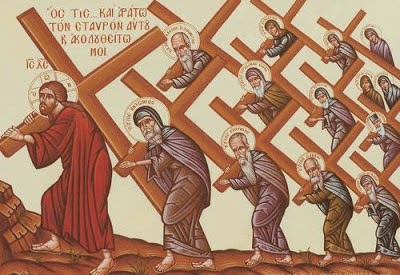
The icon below portrays well the combination of quotes in the headline. There is not a canonized (or otherwise) saint who did not ultimately and definitively take up his or her cross and follow Jesus in the end. It is a requirement and a privilege for us to follow in their footsteps. Note that Jesus implies that the cross of suffering is a necessity, not an option. We are not “worthy” of Jesus in any case, but He deigned to come down to lift us up. Remember, Jesus said this:

And when I am lifted up from the earth, I will draw everyone to myself. (Jn 12:32)

Not only does He draw us to the cross, He lifts us up on the cross. He led the way and supports us in our own mini-crucifixions (“mini” because we cannot fathom the complete immolation that Jesus suffered physically and spiritually carrying the burden of all sin of all time). Our example of faithfulness and patience in suffering may well bring others to Jesus as well. In any case, as Kempis’s disciple says, our suffering is meritorious due to divine grace. Thus, we can say with Paul:

Now I rejoice in my sufferings for your sake, and in my flesh I am filling up what is lacking in the afflictions of Christ on behalf of his body, which is the church (Col 1:24)

Nothing is “lacking” from Christ’s sacrifice except what He deigns is required willingly of us. What a privilege it is to unite our sufferings with Christ for the forgiveness of sins and the redemption of souls. May this conviction strengthen us in our most grievous trials.

“As long as You do not cast me off forever, nor blot me out of the Book of Life; all the tribulations that will befall me will not harm me.” (IC 3,17,4) | “Look to your covenant, for the hiding places in the land and the plains are full of violence. May the humble not retire in confusion; may the afflicted and the poor praise your name.” (Ps 74:20-21)

|The Imitation of Christ by Thomas à Kempis, Book III Chapter XVII: ”We Should Place All Our Solicitude in God” (third entry)

The closing words to this chapter appear above. A fitting summation: whatever difficulties we encounter in this life, may we not let it jeopardize our eternal fate in the next life..

|Today’s Responsorial Psalm: Ps 74:1b-2, 3-5, 6-7, 20-21

A psalm that starts out as a lament of devastation at an enemy’s hand, concludes with the glorification of God’s might while imploring Him to “defend your cause.” Praise of God is in order for the afflicted, the poor, and the oppressed (another reading of “humble”) as they place their trust in He who has shown His might to the Chosen People and their enemies throughout the ages.

|Reflection

In our brief time in this mortal coil, we will endure trials, tribulations, hardships, and suffering. How we bear these gives a good indication of our eternal destiny. Do we persevere as did Christ:

My Father, if it is possible, let this cup pass from me; yet, not as I will, but as you will. (Mt 26:39)

and Paul:

I consider that the sufferings of this present time are as nothing compared with the glory to be revealed for us. (Rom 8:18)

or do we “kick against the goad,” that is, resist, uselessly and to our own detriment, God’s will (Acts 26:14)?

Like the Psalmist, we are to trust in the Father, praising Him always, even in the most dire circumstances. We certainly can lament these painful circumstances, crying out to the Lord in supplication, but regardless of the outcome, the only proper disposition to the Almighty is praise for who He is and what He ordains. What a tragedy if the Lord were to “blot me out of the Book of Life” due to our failings in times of trouble.

Kicking Against the Pricks – Old Paths Baptist Church

“Son, let me do with you what I will; I know what is best for you.” (IC 3,17,1) | “Lord, if you wish, you can make me clean.” (Mt 8:2)

|The Imitation of Christ by Thomas à Kempis, Book III Chapter XVII: ”We Should Place All Our Solicitude in God” (second entry)

The first sentence in this chapter has the Christ of Kempis imparting the words above to the disciple. An appropriate opening for a chapter dedicated to the idea that we need to place our cares in God’s hands. Trust in God and let Him guide the way.

|Today’s Gospel reading: Mt 8:1-4

Coming off the Sermon on the Mount, Jesus’ first action is to heal a leper who boldly asks to be rid of his debilitating death sentence of a disease. Jesus gives a touch and says the word and immediately the man is made clean. He is then instructed to show himself cleansed to the priest as was the usual way for healed lepers to be reintegrated into society.

|Reflection

The Lord does know what’s best for us. He desires to make us clean. Note that Jesus touched the leper in today’s Gospel. Aside from the possibility of contracting the disease, this act made a person ritually unclean. But contact with Jesus does not diminish Him, it raises up us. He lowers Himself to lift up the person sick in body or spirit. Now, whether or not Jesus wills any specific thing for us is not for us to debate. We are to let Him do with us what He wills for our own good and to advance His kingdom. With the right disposition, in which we open wide of the doors for Christ, we know we will find healing in spirit, even if not in the flesh..

“Lord as long as my will remains right and firm in You, do with me whatever shall please You.” (IC 3,17,2) | “Not every one who says to me, `Lord, Lord,’ shall enter the kingdom of heaven, but he who does the will of my Father who is in heaven.” (Mt 7:22)

|The Imitation of Christ by Thomas à Kempis, Book III Chapter XVII: ”We Should Place All Our Solicitude in God” (first entry)

The thrust of this chapter is that whatever God ordains or permits to happen to us, it is for the best. Consolation or desolation, rejoicing or suffering, it is all to be accepted willingly, even joyfully. Only sin can harm us and move us away from God — it alone we ask to be preserved from.

|Today’s Gospel reading: Mt 7:21-29

This day we get the conclusion of the Sermon on the Mount. After Jesus has provided this extended teaching (covering three chapters), He emphasizes the absolute necessity of listening to (that is, not just hearing, but processing) all He says and acting on it. This is the solid foundation of faith and discipleship. Simply calling out the name of the Lord while in turn ignoring or defying His teachings risks the danger of eternal damnation.

|Reflection

The first line of today’s Gospel, found in the headline, is one of my “go to” verses when defending the Catholic Faith against those who believe in “once saved, always saved.” Jesus spent His entire earthly ministry instructing His followers on appropriate actions and often warning of the dire consequences of not doing so; it is incredible that anyone could possibly think that a simple one-time affirmation of Jesus as Lord and Savior is sufficient without a lifestyle that corresponds to His directives. So, like the disciple in Kempis, we individually are to desire that “my will remains right and firm in You.” Through prayer, study (especially of Scripture and the Catechism), and spiritual direction (if possible), we strive to know God’s will and faithfully follow it with the help of the Sacraments.

I never knew you | Matthew 7:21-23 | Jesus´ sermon on the mount