“He who is too sure in time of peace, will often show himself to be downcast or fearful in time of war.” (IC 3,7,4) | “Jesus answered them, ‘Do you believe now? Behold, the hour is coming and has arrived when each of you will be scattered to his own home and you will leave me alone.'” (Jn 16:31-32)

|The Imitation of Christ by Thomas à Kempis, Book III Chapter VII: ”How Grace Should Be Hidden Under the Guardianship of Humility” (second entry)

Kempis has Christ warning the disciple once again about the dangers of pride and the false confidence that tells us that we’ve got it covered ourselves without the need for God. This attitude of being “too sure” is not so difficult to maintain when things are going well, but when life heads south, then despondency and even fear set in. We are to recall that Jesus provides the light, even if he covers it for awhile, in order to teach us and to help us grow in faith and trust.

|Today’s Gospel Reading: Jn 16:29-33

Today we hear the final words of Jesus’ Last Supper Discourse before He intones the High Priestly Prayer of which the next chapter entirely consists (it will be proclaimed in its entirety over the next three days). The disciples declare an act of faith in Jesus, but Jesus informs them that this will keep them neither unified nor steadfast in their conviction. Yet, their abandonment of Jesus will not leave him without companionship as the Father is always with Him. The peace he promises will come at the Resurrection and the courage He asks them to take will come at Pentecost (that we celebrate Sunday).

|Reflection

It is vitally important that we do not think that any good we have accomplished, or any progress in virtue or in the spiritual life we make, is attributable to us alone. Yes, we must cooperate with grace, but we must remember the Dispenser of that gift. It is tempting, especially after a great struggle to accomplish a good, to pat ourselves on the back. Much better, and infinitely more accurate, is to give glory to the Lord for the good and to own only the bad. May “Praise God!” be peppered throughout our conversations.

https://i0.wp.com/blog.adw.org/wp-content/uploads/2015/04/040115.jpg

“Neither does he show to have much virtue who, in the time of adversity and any affliction whatsoever, gives himself to despair, and thinks and feels less confidence in Me than is convenient for him.” (IC 3,7,3) | “And when they saw him they worshiped him; but some doubted.” (Mt 28:17)

|The Imitation of Christ by Thomas à Kempis, Book III Chapter VII: ”How Grace Should Be Hidden Under the Guardianship of Humility” (first entry)

Kempis comes back to the nearly constant theme of humility in our next chapter. As regards the spiritual life, reveling in heavenly consolation or being disappointed when not quickly receiving consolation is a recipe for disaster. It is best to remember that it is only the gift of grace that allows us to do anything good. The quote in the headline conveys the sentiment that we must always remember the Giver in adversity or affliction and not despair of His love and mercy even if it is not sensibly apparent.

|Today’s Gospel Reading, Mt 28:16-20

For the Solemnity of the Ascension of the Lord, we hear proclaimed the final words of Matthew’s Gospel that gives us Jesus’ Great Commission. This Gospel says nothing about Jesus’ Ascension. In fact, this scene is the only encounter between Jesus and the apostles that the tax collector mentions. Considering what we know from the other Gospels, one wonders why they doubted. Was this the first encounter of Jesus and the apostles after the Resurrection? It would not seem so, considering Jesus’ appearance in the Upper Room (see Jn 20:19-20).

|Reflection

The apostles were daily companions of Jesus for at least three years. They heard Him preach many, many times. They saw miraculous healings and awesome exorcisms. They experienced the first Mass at the Last Supper. They now see Him glorified in His risen body. Yet “some doubted.” What more evidence did they need that Jesus was who He said He was: Lord and Savior?

Instead of rushing to judge these men, we are better served in examining ourselves first (in fact, I would encourage you to do this any time you are tempted to scoff at one or more of the apostles’ reactions to some words or event in Scripture — rather, put yourself in their place and time). If we believe Jesus is Lord and Savior, we certainly worship Jesus (primarily in the Eucharist). But do we also doubt? Consider the circumstances Kempis mentions: when we are tempted to despair of God’s love, or even His existence, in times of difficulty. Let it not be so! We are not fair weather friends of the Lord, are we? His grace is sufficient for us (see 1 Cor 12:9), even if it doesn’t make it easy to navigate troubled waters when storms arise in our lives. Even when Jesus exclaimed in the depths of unimaginable pain in mind, body, and spirit about being forsaken by His Father it was only to point to His ultimate triumph:

For he has not spurned or disdained

the misery of this poor wretch,

Did not turn away from me,

but heard me when I cried out. (Ps 22:25)

As difficult as life’s unexpected challenges can be, let us “poor wretches” never take our eyes off of the prize: eternal beatitude.

Have confidence in God. I would encourage you to get this treasured little book of short meditations on exactly this topic. You will be blessed.

The ideal Holy Bible self-pronouncing, self-interpreting, self-explanatory.. (1908) (14781699461).jpg
Source: The Ideal Holy Bible (1908)

“Keep your resolution firm, and fix your right intention in God.” (IC 3,6,3) | “He vigorously refuted the Jews in public, establishing from the Scriptures that the Christ is Jesus.” (Acts 18:28)

|The Imitation of Christ by Thomas à Kempis, Book III Chapter VI: ”The Proof of a True Lover” (third entry)

This chapter has Christ speaking much about the wiles of the devil and what a true disciple needs to do to combat the machinations of the evil one. A firm resolution to do the good is a gift of the Holy Spirit called fortitude. Whether reactive to temptation or proactive toward evangelization, we must be mindful of our duty toward God and neighbor.

|Today’s First Reading, Acts 18:23-28

Today’s first reading offers a little side note to Paul’s ministry. An Alexandrian Jew named Apollos is “speak[ing] boldly in the synagogue” about Jesus in Ephesus. Paul has already left, but apparently his companions, spouses Priscilla and Aquila, have remained behind there. They fill in some gaps for Apollos by “tak[ing] him aside and explain[ing] to him the Way (of God) more accurately.” He must have been grateful for this instruction as he immediately wishes to share the entirety of the Good News in Achaia which encompassed Athens and Corinth. There he contested with the Jewish religious class while preaching to the public “establishing from the scriptures that the Christ is Jesus.”

|Reflection

Apollos was not going to let the push back he was receiving from the Jews dim in the slightest his resolution to preach the fullness of truth he had just received from Paul’s companions. One can imagine the Jews trolling (as we say these days) this newcomer as he attempts to catechize and evangelize this populace. He knew the people well as he also was a Greek. Undoubtedly the more persuasive he was, the more the professional religious crowd grew irritated and demonstrative. The devil certainly had reason to be concerned about the wild success this new movement was having. Thus, the attacks on Apollos, just as Peter, Paul, and the other apostles had experienced, are no surprise. Fortitude in the face of the temptation to be uncharitable or to quit were needed then as now. Where does the power to combat this lie? In the Word. The Christ is Jesus. All of Scripture speaks of the coming of the Messiah (remember the apostolic Christians only had the Hebrew Scriptures, our Old Testament). We, too, should have recourse to Scripture and Tradition (the entirely of divine revelation, which is the Word, that is, Jesus) to stand firm in the truth and refute those who would lead others astray. Know it well!

All scripture is inspired by God and is useful for teaching, for refutation, for correction, and for training in righteousness, so that one who belongs to God may be competent, equipped for every good work. (2 Tim 3:16)

“If a camp is pitched against me, my heart shall not fear. The Lord is my helper and my Redeemer.” (IC 3,6,4) | “Do not be afraid. Go on speaking, and do not be silent, for I am with you.” (Acts 18:9-10a)

|The Imitation of Christ by Thomas à Kempis, Book III Chapter VI: ”The Proof of a True Lover” (second entry)

In the excerpt above, Kempis concludes a section on the temptations of the devil who constantly attempts to pull us away from God through pride, acedia, and evil thoughts. Why fear when “Jesus will be with me, as a strong warrior”? Death is preferable to sin for Kempis (and for Christ — see below).

|Today’s First Reading, Acts 18:9-18

Paul, likely feeling discouraged and more than a bit upset by his likely quick rejection at the Corinthian synagogue, is bolstered by Jesus Himself in a vision, who begins speaking to the man from Tarsus with the words above. Paul is to go on preaching, now to the Gentiles (thus, he is the “Apostle to the Gentiles”). As we read, he stays there another eighteen months, teaching the people. During this time, the Jewish leaders try to stir up trouble for Paul with the Roman officials. Unlike Pilate with Jesus, Gallio will have none of it, and leaves the Jews to their own dispute. Paul stays on “quite some time” before deciding to continue his missionary journey in Syria.

|Reflection

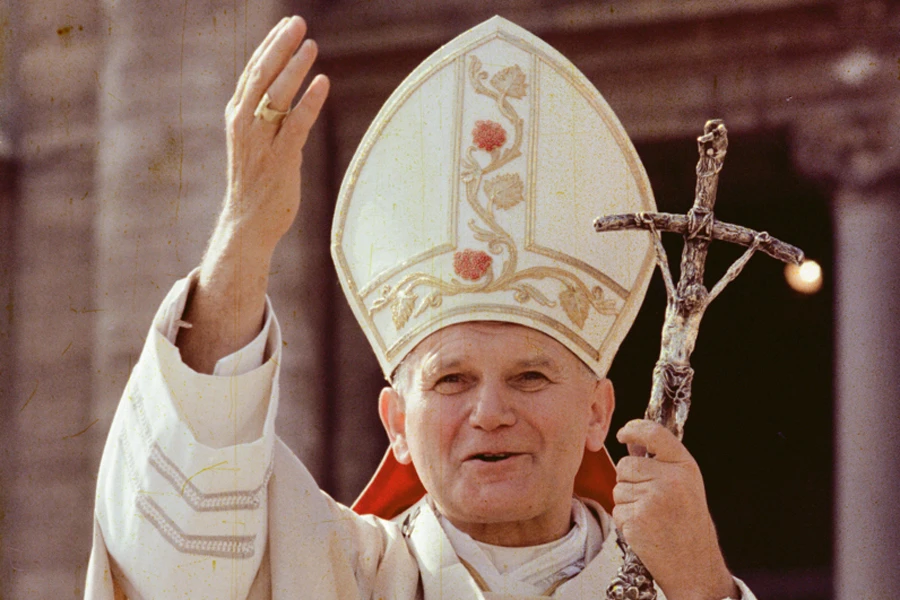
Especially as we mark the 100th anniversary of Pope St. John Paul II’s birth, I am reminded of the theme of his first homily as Holy Father: “Be not afraid!” His whole pontificate is marked by this exclamation in his teaching, outreach, and personal witness. If Christ is for us, who can be against us? (see Rom 8:31) Complete trust in the Lord is needed, then fear is overcome (see Lk 8:50, Mk 5:36).

Kempis writes of the temptation to sin. Luke writes of the temptation to give up evangelizing. Both come from the devil. In these few short years we have on earth, we need to develop an unfailing trust in God. Ultimately (that is, regarding our eternal destiny), the only legitimate fear is offending the Almigjhty. Witness Scripture:

I shall show you whom to fear. Be afraid of the one who after killing has the power to cast into Gehenna; yes, I tell you, be afraid of that one. Are not five sparrows sold for two small coins? Yet not one of them has escaped the notice of God. Even the hairs of your head have all been counted. Do not be afraid. You are worth more than many sparrows. (Lk 12:5-7)

This is easier said than done, of course. Turning to prayer and the Word are necessary for strength. The words of the psalmist below (and mentioned in Kempis) are a wonderful remedy for trepidation. Let us have frequent recourse to them and to the entire psalm.

The LORD is my light and my salvation;

whom should I fear?

The LORD is my life’s refuge;

of whom should I be afraid? (Ps 27:1)

Finally, we should pay special attention to what Jesus says to Paul immediately after the sentence in the headline: “No one will attack and harm you, for I have many people in this city.” We are not alone in this fight! The Lord has nurtured many good Christians with whom we have common cause. Let us work together to drive out fear and build up the Kingdom, praying, with Jesus, “that they may all be one, as you, Father, are in me and I in you, that they also may be in us, that the world may believe that you sent me” (Jn 17:21).

How St. John Paul II began his papacy, 40 years ago

“Do not believe him, do not pay attention to him, even though he often has laid his snares to trap you.” (IC 3,6,4) | “Amen, amen, I say to you, you will weep and mourn, while the world rejoices” (Jn 16:20)

|The Imitation of Christ by Thomas à Kempis, Book III Chapter VI: ”The Proof of a True Lover” (first entry)

What is the proof of a true lover of God? He “remains firm in the midst of temptations,” loves the giver more than the gift, keeps firm in his resolutions, and is steadfast in “continuous humility.” As is noted above, the devil hates all of these qualities and does not tire of attempting to draw us away from these noble dispositions.

|Today’s Gospel Reading, Jn 16:16-20

Jesus’ Last Supper Discourse continues with His mysterious words to the apostles that they would soon not see Him for a little while but then a short time later they would see Him. They don’t understand what He means. The close of this reading (above) is Jesus’ response to their questioning; He answers indirectly by telling them what their reaction will be to His departure versus how the worldly will react. This will be made manifest the next day upon Jesus’ death and burial.

|Reflection

A sinful world did not want to hear Jesus’ convict it with the truth during His time on earth and it wants even less to be convicted in our time. There is much rejoicing among the worldly when Christianity is pushed out of the public square and all strains of moral evil are given exalted praise and free rein. And even when the Faith is relegated to obscurity, that is not enough for the wicked — it must compromise its values or be eliminated entirely. This is the work of the devil, the one whom Kempis has Christ speaking of in the passage in the headline. The fallen world pays keen attention to the “old adversary,” as Kempis calls him in this chapter, and rejoices with him when the Church takes blows and loses power, influence, and authority. Meanwhile, those who remain faithful grow increasingly downcast at the state of our culture.

Yet, those who mourn now but remain faithful to the end will receive their reward:

Blessed is the man who perseveres in temptation, for when he has been proved he will receive the crown of life that he promised to those who love him. (Jas 1:12)

Those who laugh now in their immorality should pay close attention to the following words of Scripture:

Do you not know that the unjust will not inherit the kingdom of God? Do not be deceived; neither fornicators nor idolaters nor adulterers nor boy prostitutes nor sodomites nor thieves nor the greedy nor drunkards nor slanderers nor robbers will inherit the kingdom of God. (1 Cor 6:9-10)

Then mourning will turn to joy, and joy to mourning:

Blessed are they who mourn, for they will be comforted. (Mt 5:4)

Woe to you who laugh now, for you will grieve and weep. (Lk 6:25b)

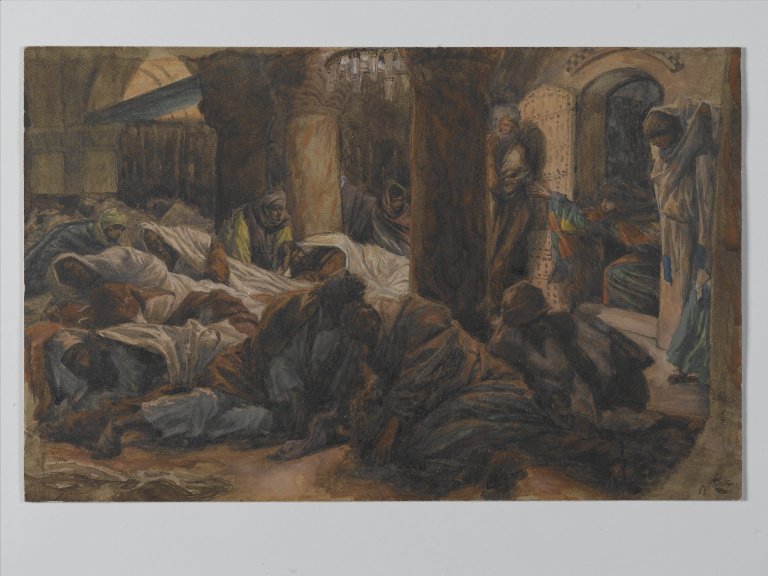
File:Brooklyn Museum - The Madgalene Runs to the Cenacle to Tell the Apostles that the Body of Jesus is No Longer in the Tomb - James Tissot.jpg
The Madgalene Runs to the Cenacle to Tell the Apostles that the Body of Jesus is No Longer in the Tomb (between 1886 and 1894) by James Tissot

“The noble love of Jesus spurs us on to do great things and stimulates us always to desire that which is the most perfect.” (IC 3,5,3) | “I even discovered an altar inscribed, ‘To an Unknown God.’ What therefore you unknowingly worship, I proclaim to you.” (Acts 17:23)

|The Imitation of Christ by Thomas à Kempis, Book III Chapter V: ”The Wonderful Effects of God’s Love” (third entry)

Jesus loves us.  God created all things out of love — not out of necessity but to share His love.  We are made for greatness, to share in the divine life here on earth and to contemplate the Blessed Trinity for all eternity in heaven.  We know of our innate drive for perfection based on our earthly desires.  This is a hint of the divine perfection for which we ultimately long and that can only be fulfilled by the Divine Author.

|Today’s First Reading, Acts 17:15, 22—18:1

In this passage, we are given Paul’s full speech to those present in the Areopagus in Athens.  After several days of preaching and debating, he is asked by some of the Greek philosophers to explain further “this new teaching is that you speak of[.]  For you bring some strange notions to our ears; we should like to know what these things mean” (vv. 19-20).  Paul, who, when exploring the city, had grown “exasperated at the sight of the city full of idols” (v. 16), now seizes on one particular temple hoping to move his listeners hearts.  He goes on to preach a beautiful discourse on the one true God, creator of all, who does not dwell in temples or has need of our services, but rather provides everything to us.  Now the time of ignorance of God is over, and that the time for repentance has come.  He concludes by speaking of a day of justice now established through “a man [God] has appointed” whom He has raised from the dead.

Some of those present scoff at the notion of resurrection, others brush him off with, essentially, “come back some other time,” and a few actually join his ministry as he departs.

|Reflection

So be perfect, just as your heavenly Father is perfect. (Mt 5:48)

We strive for perfection here to better prepare for our eternal goal: eternal beatitude with the Lord.  It is by emulating the love of God, only possible through the impetus of His love, expressed by Him to us as grace, that we can even approach this state.  While not even the greatest saints would ever have the temerity to think they had reached perfection in this life, their heroically virtuous behavior is what we are called to emulate.  The saints wished to do “great things” stimulated by love of God and neighbor.  And so Paul, due to his missionary zeal and the urgency of the need to pull peoples from ignorance to repentance, brings the Good News to Athens.

Does love of God and desire to do “great things” stimulate us to a zeal to break others free from the ignorance of not knowing the fullness of divine revelation?  Are we willing and able to proclaim the truth to seekers who do not know God or who have rejected Him?  Let us learn our faith well, pray for grace often, and ask for heroic virtue to bring the love of God to all whom we encounter.

Saint Paul delivering the Areopagus Sermon in Athens (1515) by Raphael

“O Lord God! my holy Lover! when You shall come into my heart all that is within me will exult.” (IC 3,5,1) | “He … with his household rejoiced at having come to faith in God.” (Acts 16:34)

|The Imitation of Christ by Thomas à Kempis, Book III Chapter V: ”The Wonderful Effects of God’s Love” (second entry)

Kempis gives us the words — directed to Christ — of the disciple who recognizes his own unworthiness and his “weak[ness] in love and imperfect[ness] in virtue.”  Christ responds by extolling the virtues and the power of love.

|Today’s First Reading, Acts 16:22-34

Due to Paul’s exorcising of an “oracular” demon in Philippi, the minders of the now freed girl, who had made a profit off of her fortune-telling, stirred up the people against Paul and his companion Silas, reporting them to the authorities who in turn beat them and had them imprisoned.  A miraculous earthquake opened the doors of the jail and broke their chains, but they did not use this opportunity to escape; rather they were inspired to bring the jailer and his household to God.  The words above reflect the jailer’s family’s sentiments after hearing the Word preached and receiving baptism.

|Reflection

The jailer’s family members exulted upon receiving the life of God within them.  Earlier, the head of the family, “trembling with fear,” at what the earthquake wrought, asked Paul and Silas: “Sirs, what must I do to be saved?”  Well, he needed Jesus!  Inviting the two men into his home, the jailer heard the Word proclaimed, that is, what the Christian message and life entailed, then submitted himself and his entire family to baptism, so that the grace of the Lord would come into their hearts.

Some Christians advocate the so-called Sinner’s Prayer that, in part, invites Jesus “to come into my heart,” in order to be saved.  The impetus to call Christ into our hearts is a good one.  But, like the disciple in Kempis, we should do this often, not just once.  As fallen human beings we continually need the grace of God to live authentically Christian lives.  Have you been saved?  Here’s the Catholic answer:

[W]e believe that we were saved, as Paul says in Rom 8:24; that we are being saved, as Paul says in 1 Cor 1:18; and that we will be saved, as Paul says in Rom 5:9-10, provided we persevere and keep our eyes on the prize. (Catholics Come Home; also see Catholic Answers)

How can a person not exult when Jesus is securely in his heart?  And how could he ever be tempted do anything to push Him out once He is there?  We are justified by grace through faith working in love.  And love is the impetus of Kempis’s entire chapter and Jesus’ entire mission.

Are you saved?"--Just went through this with my children this week ...

“He who loves must willingly embrace all that is hard and bitter, for the sake of his Beloved, and never separate himself from Him for accidental oppositions.” (IC 3,5,8) | “[T]he hour is coming when everyone who kills you will think he is offering worship to God.” (Jn 16:2b)

|The Imitation of Christ by Thomas à Kempis, Book III Chapter V: ”The Wonderful Effects of God’s Love” (first entry)

We begin this chapter that expounds on the virtue of love by turning to the last sentence.  As beautiful and essential as love is, it also entails bearing hardship heroically for God’s sake and for our sake.  Adversities (“accidental oppositions”) will come, but they must not serve as impetus to distance ourselves from the Lord.

|Today’s Gospel, John 15:26-6:4a

Jesus again speaks to the apostles of the Holy Spirit as the Last Supper discourse continues.  The Spirit will impart truth to them and allow them to testify to the truth to others.  But proclaiming the fullness of the Good News will entail persecution and, for all but one of the apostles, red martyrdom.  These men must be prepared for this eventuality and the Spirit will help them to endure these trials.

|Reflection

Kempis’s words remind me of these verses from Scripture:

What will separate us from the love of Christ? Will anguish, or distress, or persecution, or famine, or nakedness, or peril, or the sword? As it is written:

“For your sake we are being slain all the day; we are looked upon as sheep to be slaughtered.”

No, in all these things we conquer overwhelmingly through him who loved us. For I am convinced that neither death, nor life, nor angels, nor principalities, nor present things, nor future things, nor powers, nor height, nor depth, nor any other creature will be able to separate us from the love of God in Christ Jesus our Lord.

— Rom 8:35-39

Paul lived the challenges of being a zealous proclaimer of Christ.  He was very familiar with the persecutions that come with the territory.  He would eventually pay with his life.  For love of God and neighbor, we, also, are asked to be forthright in living an authentically Christian life in thought, word, and deed.  Always in love, but never compromising the truth.  It will be difficult.  There will be persecution.  We will likely suffer loss.  But what we ultimately gain, through loving perseverance, is immeasurable.

Blessed is the man who endures trial, for when he has stood the test he will receive the crown of life which God has promised to those who love him. (Jas 1:12)

The Beheading of St. Paul (1648) by Simon de Vos

“[T]he Spirit teaches…to despise earthly things and to love heavenly things; to despise the world, and day and night to desire Heaven.” (IC 3,4,5) | “I will ask the Father, and he will give you another Advocate to be with you always, the Spirit of truth, whom the world cannot accept, because it neither sees nor knows him.” (Jn 14:16-17)

We close the fourth chapter of Book Three with the comforting final words of that chapter.  We invoke the Holy Spirit to live in truth and humility, to reject the base things of the world and to focus on eternal life with God.

The promise of Jesus to send the Holy Spirit comes in today’s Gospel (Jn 14:15-21) the first of five times during the Last Supper Discourse.  The Lord knows the apostles will need this great gift in order to preach boldly the Word of God to an unbelieving world hostile toward the truth, with many denying there is such a thing as truth altogether (see Jn 18:38).  But they must keep the commandments if they truly love the Lord (Jesus repeats this twice in this short passage to emphasize its importance).

We must “despise earthly things” in order to keep the commandments.  Inordinate affection for material goods leads us away from God.  If an offense in this area is particularly serious we are in danger of cutting ourselves off from the life of God in us (see CCC 1854-1861).  So, if we want to discern clearly the truth of God, we must regularly examine ourselves, repent of sins, confess them to God and His priest, and firmly resolve to not commit these offenses again.  In order to see clearly the truth we cannot lose the Spirit through our own wickedness.  How will we convey the truth to, at best, a skeptical culture when we ourselves have exchanged the truth for a lie (see Rom 1:25) for the sake of some temporary pleasure that defies God’s law?  What sort of example do we set when we don’t walk the talk?  Do we wish to be responsible for driving persons away from the one true Faith?

Let us not be slaves to sin but rather always remember that, as Jesus said, “If you remain in my word, you will truly be my disciples, and you will know the truth, and the truth will set you free” (Jn 8:31-32) — free “to love heavenly things” and to invite our neighbor to join us in doing so.

10 Great Verses on the Holy Spirit to Fire You Up!

“He who walks before Me in the truth, shall be defended from the assaults of evil, and the Truth will deliver him from deceivers and from the detractions of the wicked.” (IC 3,4,1) | “If you belonged to the world, the world would love its own; but because you do not belong to the world, and I have chosen you out of the world, the world hates you.” (Jn 15:19)

Kempis, in emphasizing that we need to live in truth, has Christ telling us that doing so will lead to assaults by deceivers and detractions from the wicked (3,4).  Christ goes on to tell the disciple (that is, us) that He will teach him the truth but he must give up sin and recognize his own nothingness without Him.

Jesus, in today’s Gospel, continuing His Last Supper Discourse, warns the apostles of the resistance they will meet from a fallen, sinful world (Jn 15:18-21).  They persecuted Jesus, so why should they think they will fare better when preaching in His name?  The Lord is preparing them well for that which they will be dealing very soon.

Can anything worse be said of a Christian today than that he is “worldly.”  A culture in chaos, where truth and falsehood have reversed poles (see Rom 1:25 and read the whole section — Paul describes the world to a T), must not affect our equilibrium.  Our true north is Christ who is the Truth (see Jn 14:6).  We keep our eyes on Him and we do well.  A momentary glance away, being more concerned with self than God, and we begin to sink into the abyss (see Mt 14:29-31).  This is why we must be on guard always to embrace and proclaim the unvarnished truth, with no compromise to evil.  We will be hated for holding fast to our Faith, especially with the hot button issues of the day related to life and sexuality.  We must not be wishy-washy (see Rev 3:15-16 for a graphic example of what the Lord thinks of such folks).  We must be bold.  We must be Catholic.

Let us pray intensely for the gifts of the Holy Spirit (see Is 11:2-3) to guide us and give us a well-trained tongue (see Is 50:4).  He will not let us down (see Lk 12:10-12).

See the source image