“[H]eavenly consolation is promised to those who are proved by temptation. ‘To him who overcomes,’ says the Lord, ‘I will permit to eat of the tree of life.'” (IC 2,9,7) | “Your opponent the Devil is prowling around like a roaring lion looking for someone to devour. Resist him, steadfast in faith” (1 Pt 5:8-9a)

In this chapter on consolations and the loss of them (2,9), Kempis emphasizes the importance of being steadfast in holiness of life even if consolations do not come from above or even from those around us.  Even the saints experienced dryness, so who are we to think that we will not be given this grace.  This feeling of the absence of God should not alter our behavior toward God or others, particularly in the realm of temptation, as mentioned here.  The Lord, ultimately, will not hold back His assistance and encouragement to those who remain faithful and resist sin.

In today’s first reading (1 Pt 5:5b-14), we hear proclaimed the close of the apostle Peter’s first letter addressed to Christian communities in Asia Minor.  The importance of humility in dealings with others is stressed (“God opposes the proud”); humility in this life leads to exaltation in the next. Peter goes on to caution against the wiles of the Devil who desires for them to lose heart in temptation and suffering (“Christ Jesus will himself restore, confirm, strengthen, and establish you after you have suffered a little”).

Keep the faith! Peter exhorts these young Christians.  The Devil’s machinations are no match for the grace of God that He is so desirous of providing.  The trials of this life are just a means to exercise faith, to strengthen it, just as lifting weights build up physical muscles.  Thus, a greater good comes from them.

Resisting temptation can be exceedingly difficult and we are not always successful.  We know of the ocean of mercy that God is, so as long as we draw breath, we can repent.  But let us not wait to make changes — as has been said: there is no time like the present.  “Heavenly consolation is promised…to him who overcomes”!  The “tree of life” awaits as our reward — everlasting life in the Divine Presence.  Even if that were the only consolation we ever receive, it would be more than enough and far more than we deserve.

God does not abandon His children.  He knows what we need (Lk 11:11-13).  Let us never forget to or hesitate to turn to the Father, through the Son, with the Holy Spirit to ask for the grace to resist sin.  The Lord’s promise:

My grace is sufficient for you, for power is made perfect in weakness. (2 Cor 12:9)

File:Pasquale Ottino San Marcos escribe sus Evangelios al dictado de San Pedro Musée des Beaux-Arts, Bordeaux.jpgSt. Mark writes his Evangelium at the dictation of St. Peter
attributed to Pasquale Ottini (1578-1630)

“[H]e is not worthy of the high contemplation of God who does not suffer some tribulation for God.” (IC 2,9,7) | “[T]hey left the presence of the Sanhedrin, rejoicing that they had been found worthy to suffer dishonor for the sake of the name.” (Acts 5:41)

We come now to The Imitation of Christ, Book II, Chapter IX: “Of the Lack of All Consolations.”  Here Thomas à Kempis deals with the challenges the sincere Christian encounters when both human and divine consolations are not to be found in their lives.  One important aspect of this the author states above: temptation and tribulation come in order to prove our faithfulness to God, to strengthen our faith, and to humble us — we can’t get through this life without divine assistance.

Today’s first reading (Acts 5:34-42) gives us the wise Rabban (great rabbi) Gamaliel addressing his fellow members of the Sanhedrin telling them to have nothing to do with the disciples of Jesus that they had just rounded up.  With great insight he plainly admonishes them all that since the leader of these men has been killed, their movement will amount to nothing if it was man-made.  But if it came from God…

Finding this worthy advice, this religious body decided to flog their “guests,” tell them to not preach about Jesus, and send them on their way.  The apostles’ reaction is captured in the headline.  And, of course, they immediately began preaching again.

Then Jesus said to his disciples, “Whoever wishes to come after me must deny himself, take up his cross, and follow me.” (Mt 16:24)

Jesus said, “Amen, I say to you, there is no one who has given up house or brothers or sisters or mother or father or children or lands for my sake and for the sake of the gospel who will not receive a hundred times more now in this present age: houses and brothers and sisters and mothers and children and lands, with persecutions, and eternal life in the age to come. (Mk 10:29-30)

Trials, temptations, tribulations, and sufferings will come.  As you just read, our Lord promised as much to His faithful followers.  Do we rejoice in these difficulties, realizing they bring us closer to the Father as we unite these with His Son?

The definitive answer to the problem of the evil of suffering is that Almighty God brings a greater good from it.  Whether that is evident immediately after, at some future time in this life, or at the Second Coming, we can be confident that this is the case.

God judged it better to bring good out of evil than to suffer no evil to exist. —
St. Augustine

We know that all things work for good for those who love God, who are called according to his purpose. (Rom 8:28)


The Whipping of St. Peter (1998-2000) by Hermenegild Peiker

“Who finds Jesus finds a precious treasure, in fact, he finds a good better than all goods. And he who loses Jesus loses a very great thing, and loses more than if he had lost the whole world.” (IC 2,8,2) | “Whoever believes in the Son has eternal life, but whoever disobeys the Son will not see life, but the wrath of God remains upon him.” (Jn 3:36)

Continuing a prevalent theme in his work, Kempis emphasizes the importance of Christ over anything else in our earthly lives (2,8).  Considering the greatest commandment given by God in the Old Testament (see Deut 6:5) and repeated by His Son in the New Testament (Mt 22:37-38), it is something every Christian should be able to agree on.

It seems that today’s Gospel reading are the words of the evangelist himself (Jn 3:31-36).  He emphasizes the preeminence of the Christ and closes this short aside with the sentence above.  It is extremely important to note that John contrasts belief not with unbelief but, rather, disobedience.  If one thinks he is in the clear regarding his eternal salvation due to an easy believism, he is sadly mistaken.  “Once saved, always saved” is absolutely unbiblical, as is evidenced in Jesus repeated assertions of the eternal disposition awaiting the just versus the unjust.

Not everyone who says to me, “Lord, Lord,” will enter the kingdom of heaven, but only the one who does the will of my Father in heaven. (Mt 7:21)

Today’s reading hits on a vital concept that I often stress in theological discussions and Bible studies.  It is absolutely clear in reading Scripture as the Church teaches, that is by respecting its content and unity and not cherry picking verses, that demands are placed on the person who wishes to be called a Christian.  How we live and what we do matters to our eternal destiny.  Of course, it is only because of Christ’s Passion, death, and Resurrection that heaven is open to us in the first place; and we don’t have a chance to get there without the free gift of grace.  But we have a part to play.  We are offered unimaginable glory but we must cooperate with grace.  As a preacher once said, “God is not a chump.”  The ocean of God’s mercy is vast, but if we don’t so much as dip a toe in that water, we are lost.

Yes, Jesus is a treasure (see Mt 13:44-50).  And yes, losing His life within us by disobedience is the greatest loss.  All sin is deeply offensive to God, but mortal sin, unrepented, dooms a person to eternal separation from God (see CCC 1854-1861).  When our horror for sin approaches God’s we are making progress.  Let us strive to allow no sin to separate us from the Almighty even the slightest bit, and certainly let us never grow comfortable with “little” sins that inevitably open the possibility for a slide into grave offenses.

"St John the Evangelist" by Domenichino (Domenico Zampieri), 1620sSt. John the Evangelist (1620s) by Domenichino (Domenico Zampieri)

“How hard and arid you are without Jesus! How foolish and vain you are if you desire anything outside of Jesus!” (IC 2,8,1) | “For everyone who does wicked things hates the light and does not come toward the light, so that his works might not be exposed.” (Jn 3:20)

Kempis relates the hazards of not keeping up an intimate friendship with Jesus (2,8): we quickly find hardness of heart, dryness of soul, and self-centeredness when we push Jesus away in favor of worldly interests and immoral enticements.

Jesus shares the words above in His closing argument to Nicodemus in yesterday’s Gospel (Jn 3:16-21).  Earlier in the conversation, the Lord declares Himself “the light [that] came into the world” (a common theme in John’s Gospel — see also Jn 8:12 and Jn 1:4-5).  Those who believe have been en”light”ened.  Those who obstinately reject the Light of Truth are condemned eternally to the darkness they embraced in life.

Nicodemus was on the right track coming to Jesus, to approach the light to try to gain clarity about this rabbi and His testimony.  Seeing this opening and openness, the Messiah challenges him (and us) further.  Stick with Jesus, look to the Light, to stay on the straight and narrow.  Wasn’t it Christ who said:

Enter through the narrow gate; for the gate is wide and the road broad that leads to destruction, and those who enter through it are many. (Mt 7:13)

and

If a blind person leads a blind person, both will fall into a pit. (Mt 15:14)

The Light makes the safe path plain.  The Light gives clear sight and allows us to help others along this trail.  Hardness of heart, aridity, foolhardiness, and vanity will not be mentioned in conjunction with us if we stay close to the Light, when we keep our constant companion, Jesus, close to our hearts.

The Narrow Path × VACSF.ORG

“To be without Jesus is an unbearable hell; and to be with Jesus is a sweet paradise.” (IC 2,8,2) | “[T]he Son of Man [must] be lifted up, so that everyone who believes in him may have eternal life.” (Jn 3:14-15)

The words above are a beautiful way to introduce Chapter VIII of Book II of Thomas à Kempis’s The Imitation of Christ regarding “On the Intimate Friendship of Jesus.”  Throughout the chapter, as he does in this quote, he contrasts in many ways the benefits of being close to Jesus versus what happens when we stray far from Him.

The Gospel reading (Jn 3:7b-15) continues yesterday’s conversation between Nicodemus and Jesus.  Nicodemus is still in the dark regarding Jesus reference to being “born again” or, really, “born from above” (see this helpful article).  Jesus calls him out here, expecting more from a Bible scholar and a teacher, but this reprimand is an invitation to a deeper understanding through an openness for truth.

Today’s excerpt concludes with the words in the headline, but Jesus has more to say to Nicodemus, starting with the famous John 3:16 that one often sees in the stands at football games (the remainder of this episode is proclaimed at tomorrow’s Mass).  You can bet that Nicodemus went back to his Scripture scrolls and prayer after this episode.

We will soon talk about “paradise” and “eternal life,” but first I would like to share an important excerpt regarding the quote in question here from an excellent commentary:

The verb “lifted up” (hypsoō) has a twofold meaning.  It can mean lift up in a literal sense, as in Jesus being physically lifted up from the ground on the cross.  It can also mean lift up in the sense of exalt.  Jesus uses the word in both senses.  Jesus’ being lifted up in ignominy from the ground while on the cross will also be the moment of his exaltation, when he preeminently reveals God’s love.  (Francis Martin and William M. Wright IV.  The Gospel of John [Catholic Commentary on Sacred Scripture] [Grand Rapids: Baker Academic, 2015], 73)

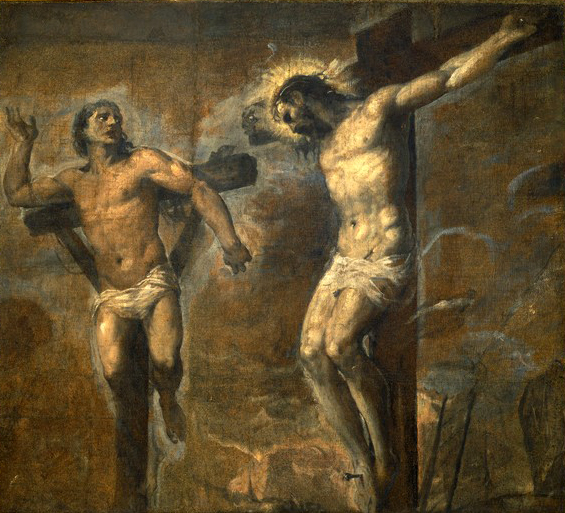
Our sins lifted the Lord up on the cross and He repays us, not as we deserve, but with “God’s love,” as the commentary notes, the chance for redemption, for eternal life, for paradise, as He promised to Dismas who was crucified next to Him (see Lk 23:40-43).

Considering that we raised Jesus by our sins, now it is our obligation to raise Him in exaltation, in prayer, in song, in word, in deed, in interactions.  That is, as Kempis implores, to be “with Jesus” now, to experience a foretaste of “sweet paradise” here on earth, so that through this belief (meaning: embracing the entire Deposit of Faith) we “may have eternal life.”  The alternative “is an unbearable hell” starting here and lasting forever.

Jesus invites us to friendship (see Jn 15:14).  Let us embrace this most generous offer and treat Him as our very best and faithful companion for the rest of our lives so that we can spend all eternity with Him in glory.

File:Titian - Christ and the Good Thief - WGA22832.jpg
Christ and the Good Thief (c. 1566) by Titian

“If in all things you seek Jesus, you will certainly find Jesus.” (IC 2,7,3) | “[Nicodemus] came to Jesus at night and said to him, ‘Rabbi, we know that you are a teacher who has come from God, for no one can do these signs that you are doing unless God is with him.'” (Jn 3:2)

Wrapping up this chapter on loving Jesus, it seems appropriate to provide this Kempis quote (2,7).  Clearly inspired by Scripture (see Mt 7:7-8), this line wraps up neatly what should be our quest: seeking Jesus above all things, listening to Him (see Mt 17:5) and imitating Him (see 1 Cor 11:1) in every moment.

Pharisees in general do not come out looking good in the Gospels, particularly in John.  Yet, in today’s reading (Jn 3;1-8), we find a true seeker who is moved by Jesus’ works, and undoubtedly, His words.  He is not yet ready to boldly approach Jesus (thus the night visit), but he is stepping out on a limb even approaching this wonder worker newly on the scene considering the disposition toward Jesus of his fellow members of the Sanhedrin (being a “Pharisee…a ruler of the Jews” (v.1) “[p]resumably [meant] that he sat on the Jewish high court known as the Sanhedrin [cf. John 7:48; 12:42]” — Scott Hahn, Gen. Ed. Catholic Bible Dictionary [New York: Doubleday, 2009], 649).  Yet, seeking the truth, he wants to know more, even at great personal risk.  He does not get an easy answer, as he is challenged by Jesus to think of the nature of spiritual rebirth, even questioning his understanding of Scripture (v. 10 as we’ll hear tomorrow).  Being an authentic seeker of God and thus of truth, we find him later defending Jesus (and being blasted for it) (see Jn 7:50-52) and finally helping to bury Jesus (see Jn 19:38-42).  He’s even on our calendar of saints (August 3)!

Like Nicodemus, we must be willing to step out in faith, even when it may impact us harshly.  Seeking and defending the truth is not optional for our well-being here or hereafter.  But prepare to be challenged by Christ, to question, to find difficulties (but never doubts), and along the way to defend the Lord without counting the cost and, in the end, to remain with Him in the darkest hour with full confidence that He is with us and empathizes with us.

Jesus and Nicodemus (1899) by Henry Ossawa Tanner
“Keep yourself close to Jesus both in life and in death, and rest on His fidelity, Who alone can help you when all others fail.” (IC 2,7,2) | “[N]ow for a little while you may have to suffer through various trials, so that the genuineness of your faith … may prove to be for praise, glory, and honor at the revelation of Jesus Christ.” (1 Pt 1:6-7)

Kempis, provides another nugget regarding what is entailed in esteeming the Lord above all things (2,7).  If we truly love Jesus with all of our being then we should keep Him close, in sickness and in health, in good times and in bad, until death do us meet.  Our tendency is to appeal to prayer and conversation with God during the rough patches, but the persons of the Trinity want us to have a daily ongoing relationship with them, a familiarity that, unlike the human saying, does not breed contempt, but rather a deepening respect for the unwavering faithfulness of the Lord in our lives.

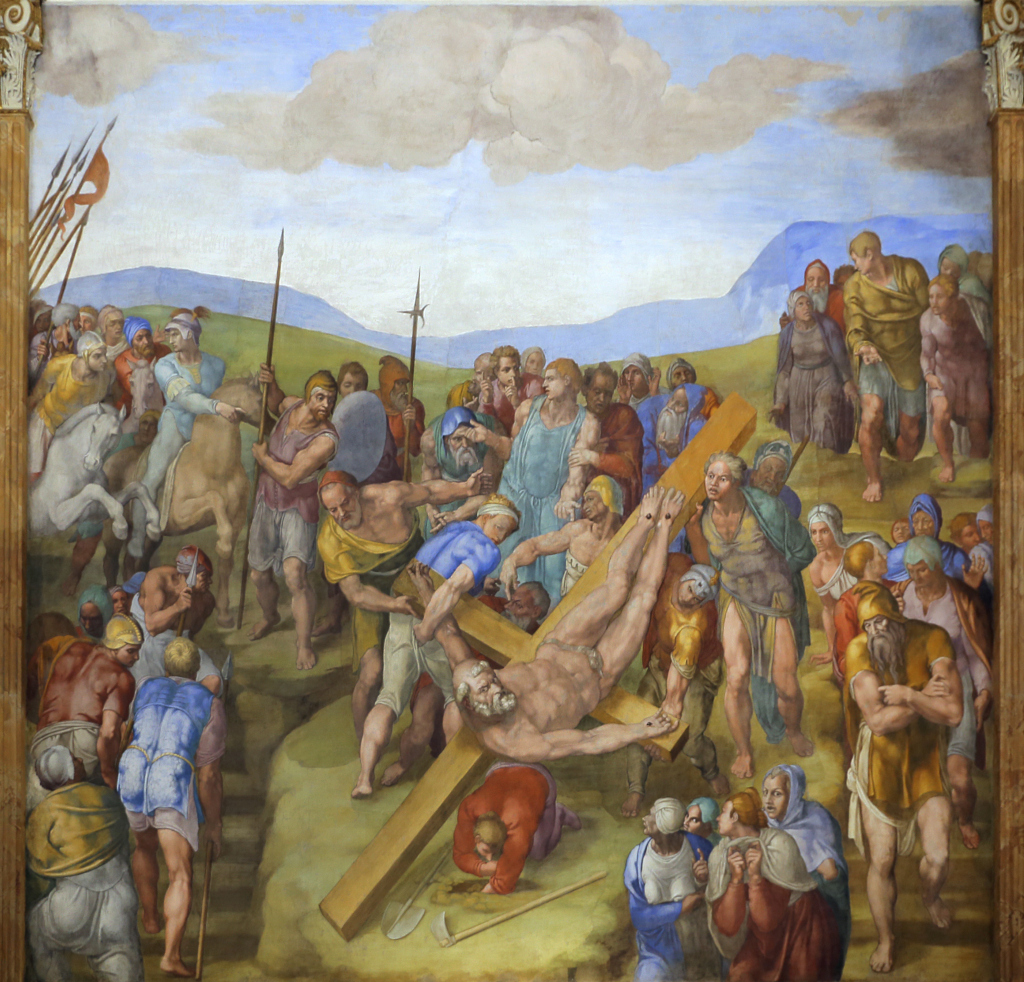
Peter, a man acquainted with suffering, knows from whence he speaks, when he preaches about affliction as a test of faith (1 Pt 1:3-9).  What first comes to mind is the famous story of the Quo Vadis?, from the apocryphal Acts of Peter, in which the first pope is urged to flee Rome (“that thou mayest yet be able to serve the Lord”) due to the imminent danger he faced there:

And as he went forth of the city, he saw the Lord entering into Rome. And when he saw him, he said: “Lord, whither goest thou [quo vadis] thus (or here)?” And the Lord said unto him: “I go into Rome to be crucified.” And Peter said unto him: “Lord, art thou (being) crucified again?” He said unto him: “Yea, Peter, I am (being) crucified again.” And Peter came to himself: and having beheld the Lord ascending up into heaven, he returned to Rome, rejoicing, and glorifying the Lord, for that he said: “I am being crucified”: the which was about to befall Peter. (Acts of Peter, XXXV)

Peter remained faithful to his Master never forgetting the lessons he learned at the charcoal fires (see Jn 18:15-18 and Jn 21:9-14).  It is a strong tradition of the Church that Peter did suffer martyrdom in Rome as depicted below and, in fact, his manner of death was provided to us by John (see Jn 21:18-19), who surely would have known Peter’s ultimate fate.

But, also, we have already been hearing at daily Mass about the persecution of Peter and companions shortly after Pentecost with more to come as we continue to hear Acts proclaimed each day.  Peter was not to be spared numerous difficulties the rest of his life in proclaiming the Good News.

Like Peter, we should be confident in the faithfulness of the Lord in all circumstances, even if it should happen that those closest to us, that we trust most, fail us.  This experience alone can be a great trial for us, especially if it occurs because of our faithfulness to Jesus.  But by uniting our sufferings to Christ we bring “praise, glory, and honor” to God through our example of faithfulness and perseverance.  How many persons have been brought to the Church through the heroism of persecuted saints?  It is with good reason that an early Christian writer said, “the blood of the martyrs is the seed of the Church” (Tertullian, Apologeticus, Chapter 50).  We will likely not be required to shed blood for our faith, but the white martyrdom of persecution will be a herald of our faithfulness that will disgust some but, I’m quite confident, will move many more others.

G.K. Chesterton famously said:

The Christian ideal has not been tried and found wanting. It has been found difficult; and left untried. (What’s Wrong with the World, Part I, Chapter 5, “The Unfinished Temple”)

Through our fidelity, let us prove him wrong.

Michelangelo Buonarroti: The Martyrdom of St PeterThe Martyrdom of St Peter (1546-50) by Michelangelo Buonarroti

“He who attaches himself to creatures, shall fall with the one who falls; he who embraces Jesus shall stand firm in eternity.” (IC 2,7,1) | “It is impossible for us not to speak about what we have seen and heard.” (Acts 4:20)

We come now to a particularly beautiful chapter in The Imitation of Christ: “Of the Love of Jesus Above All Things” (2,7).  The title speaks for itself.  Jesus must be loved above all things to keep one’s orientation properly directed in regards to oneself, others, and this world’s enticements.  One is to attach himself to the Lord above all things with the promise that he “shall stand firm in eternity.”

Today’s first reading (Acts 4:13-21) gives us the ongoing saga of the first arrest of some of the apostles (in this case, Peter and John).  Not knowing what to do with these men, especially as they have become very popular, particularly because of the miraculous healing of the crippled man, the religious leaders ultimately decide to warn them sternly not to preach in Jesus’ name.  What the apostles think of this order is stated by Peter at the top.

The apostles were not interested in popularity, either with the Pharisees or with the general populace.  What they were interested in is embracing Jesus’ message and sharing it with the world, whatever the consequences.  The Holy Spirit at Pentecost reminded them of their calling (see Jn 14:26) and gave them the spiritual fortitude to carry out their mission (Mt 28:19-20), even unto persecution and ultimately martyrdom (tradition holds that only John escaped this fate, although a long life of hardships and persecutions were to be his lot).

We have the same gifts and mission!  True, it is to be carried out in different ways based on our station in life, but we all are called to spread the Good News in some fashion.  Maybe it’s in the way we raise our children.  Or it could be in the integrity we show in the workplace.  Donations of time or talent or treasure or all of the above might be our witness.  The religious life might be the way we more explicitly follow the Lord and lead others to Him.  But, for all of us, a religious life of prayer and good works, even if hidden, even if homebound, certainly must be part of our daily living.  When we embrace Jesus it will be impossible not to speak of Him (and to Him) regarding the difference He has made to us.  Let us stand firm in the Faith here so that we “shall stand firm in eternity.”

File:Luca Signorelli - The Apostles Peter and John the Evangelist - WGA21268.jpg
The Apostles Peter and John the Evangelist (1477-1482) by Luca Signorelli

“The joy of the just comes from God and is in God, and their joy is born from truth.” (IC 2,6,2) | “[M]any of those who heard the word came to believe and the number of men grew to about five thousand.” (Acts 4:4)

Kempis hits on an obvious truth if one ponders it for just a moment (2,6).  No one is joyful when they find out they have been lied to.  We all (should) want to hear truth from other persons.  We are guaranteed by the church Christ established that we will hear truth from Divine Revelation.  The Gospel, by definition, is “good news.”  Good news brings the well-adjusted person joy!  Jesus, who gives us the Gospel, in fact all of Revelation as the Word of God, is the Truth (see Jn 14:6) who promised this happiness to all who are faithful to Him (see Mt 25:21).

We read in today’s first reading (Acts 4:1-12) that five thousand came to believe after Peter and his companions’ arrest after hearing them preach and witnessing a miraculous healing just beforehand.  These disciples gladly made that trade: suffering for the conversion of souls (see Acts 5:41).  They are so emboldened by the Holy Spirit that they preach Christ to those very religious leaders who arrested them and arranged for Jesus’ execution.  Bold and fearless (and joyful!) were they with the power of the Spirit.

“Joy” appears well over two hundred times in the Bible (over three dozen times in the Psalms alone).  Let us look at just three of these occurrences as it relates to this discussion.

Consider it all joy, my brothers, when you encounter various trials, for you know that the testing of your faith produces perseverance. (Jas 1:2-3)

The disciples spoke truth to power and were joyful in doing so despite the persecution they received for it.  They could not compromise on the message of the Gospel, even to spare their lives, as so many were harassed, threatened, arrested, and even killed for being stalwart in their faith.  Most of us in the western world need not (yet?) have to deal with the possibility of martyrdom, but being attacked and threatened personally and in the media is a common occurrence for even the slightest deviation from corrupt, godless, secular orthodoxy.  Where do you stand?

Nothing gives me greater joy than to hear that my children are walking in the truth. (3 Jn 4)

John, the beloved, and longest lived apostle, writes this short letter near the end of his life.  So it is not to be taken lightly that his greatest joy is that those he serves as bishop are “walking in the truth.”  Again, joy and truth go together.  It is worthwhile examining all our actions in this light.  Are all of our thoughts, words, and actions “in the truth”?  If not, are we sincerely joyful in those areas in which we are not in conformity with the truth of God?

[T]he fruit of the Spirit is love, joy, peace, patience, kindness, generosity, faithfulness, gentleness, self-control. (Gal 5:22-23)

Paul famously lays out the nine fruits of the Holy Spirit to the Galatians.  Joy is mentioned second only to the everlasting (see 1 Cor 13:13) theological virtue of love.  The connection among all of these fruits, and especially in this example with joy, is evident in the apostles.  They exuberantly burst forth at Pentecost when the Spirit descended upon them in fire (Acts 2:1-4).  For the baptized in right relationship with God, the Spirit dwells in us as well (especially the Confirmed).  Do we tap into this great gift and pray for its increase so that we live every moment, regardless of circumstances, in the joy of truth?

“Man considers the actions, but God instead examines the intentions.” (IC 2,6,3) | “Now I know, brothers and sisters, that you acted out of ignorance, just as your leaders did” (Acts 3:17)

Kempis, in speaking about conscience, writes the words above (2,6).  Unimportant is what other persons think of us; important is that we act according to a well-formed conscience which is a gift from God.

Today’s first reading records Peter’s second speech to the Jews (the first coming on Pentecost) (Acts 3:11-26).  Peter has just healed a lame man amazing the people and causing them to surround him and John, who was with him.  Peter goes on to accuse them of putting Jesus to death, but then utters the words at top, before urging them to repent and convert, for the forgiveness of sins.

Among the Jews being addressed here, certainly there were ignorance and a conscience poorly formed and then manipulated by certain of their religious leaders that led them to call for Jesus crucifixion on that fateful Friday morning.  Their actions were deplorable, but even Christ recognized their blindness from the cross:

Then Jesus said, “Father, forgive them, they know not what they do.” (Lk 23:34)

While we know Jesus is speaking to all of us since every sinner put our Savior on the cross, the elapsing of two thousand years should lead us to know better.  We have no reason to claim ignorance in our intentions.  There are many opportunities to alleviate ignorance as Catholics are blessed with Scripture (the Word of God put to writing), Tradition (all of Divine Revelation), and the Magisterium (the safeguard of authentic belief).  Knowledge gained from these sources alleviates ignorance and helps us to form our conscience well.  Whether or not the actions that flow from the demands of such a conscience are approved by our neighbor, we know that they are pleasing to God.

Peter and John Continue Preaching the Gospel -