“For he whom God will help, no man’s malice can hurt.” (IC 2,2,1) | “The Lord GOD is my help, therefore I am not disgraced” (Is 50:7a)

Continuing to look into Kempis’s chapter on humble submission (2,2), we come across the words in the headline.  We have gone far afield if we believe that with our own power we will legitimately avoid the malevolence of others.  In a world that militates against the truth, only by compromising the truth might we temper malice at least temporarily, and ultimately to our own destruction.  Rather, we are to live and speak the truth boldly (always in love), recognizing that it is “sharper than any two-edged sword, penetrating even between soul and spirit, joints and marrow” (Heb 4:12) . In other words, the truth hurts.  But “[f]or he whom God will help, no man’s malice can hurt.”  With God on our side, we need not fear the world.

Isaiah, in one of his servant songs, gives us a prophecy we easily recognize as Jesus during His Passion.  Despite the horrendous injustice, insults, blasphemies, and tortures He endured, Jesus was “not disgraced” and not “put to shame,” as it says later in that same verse.  To most observers that day on Calvary, and for many more observers throughout the ages, this manner of execution could not have any redeeming value.  Yet it was for our redemption that the God-Man endured all of this for us.  “[H]e humbled himself, becoming obedient to death, even death on a cross. Because of this, God greatly exalted him,” Paul tells the Philippians in the second reading (2:8-9).  His Father was His help; the vindictiveness of man was no match.  His Father was His help, therefore He was not disgraced.

Nothing anyone does to us can disgrace us when we humbly trust in God.  Only we have the ability to dis-grace ourselves by mortal sin through pride (i.e., we think we know better than God how to behave) which kills God’s life within us.

[D]o not be afraid of those who kill the body but cannot kill the soul; rather, be afraid of the one who can destroy both soul and body in Gehenna. (Mt 10:28)


Ecce Homo (contemporary) by Michael O’Brien

“It belongs to God to help us and deliver us from all turmoil.” (IC 2,2,1) | “I will deliver them from all their sins of apostasy, and cleanse them so that they may be my people and I may be their God.” (Ez 37:23b-c)

Kempis here reminds us that humility informs us that we can do nothing on our own; deliverance from evil comes from God alone (2,2).

Ezekiel turns from condemnation to consolation in this section of his book.  Writing in the time just after the fall of Jerusalem to the Babylonians in 587 B.C., the prophet gives the peoples of both the Northern Kingdom (Israel, here called Joseph, which fell to the Assyrians in 722 B.C.) and the Southern Kingdom (Judah, which just fell) hope in a restored, reunited, and everlasting kingdom headed by a new David.  God does not forget the sinfulness of the Chosen People but will deliver them from it.

The sin God focuses on in this passage from Ezekiel is apostasy (Ez 37:21-28).  Fr. John Hardon’s Modern Catholic Dictionary defines this term: “a desertion from a solemn commitment.”  We know that littered throughout the Old Testament are episodes of the Jews reneging on their promised covenant with Yahweh to chase after false gods.  This warning is suitable for our world as well.  How often do we desert from our solemn commitment to place the Lord above all things?  How often do we effectively apostatize by not living up to Christ’s expectation of His followers?  Do we seem to others to be counter-culturally Christian or are we indistinguishable in word, deed, attitude, and perspective, from the prevalent paganism?

Only God can deliver us from the turmoil of our own sinful ways and a decadent society.  We need to pray all the more for His help to militate against our own fallen nature and fallen world.  Coming to Him with sincere hearts and a firm purpose of amendment we, like the Chosen People in Ezekiel, can count on the Almighty to “cleanse [us] so that [we] may be [God’s] people and [He] may be [our] God.”

Icon of Ezekiel the Prophet (Serbian) – P98 | | Skete.com

“[The Lord] knows the time and the manner of your deliverance; and, therefore, you must resign yourself into His hands. It belongs to God to help us and deliver us from all turmoil.” (IC 2,2,1) | “In my distress I called upon the Lord, and he heard my voice.” (see Ps 18:7)

Chapter Two of Book Two of The Imitation of Christ is on the subject of humble submission (IC 2,2).  As we have seen over and over again, humility is the pervasive theme of the author’s, Kempis’s, writing in this volume.  God bestows great gifts on the humble when they consider themselves inferior to all.

The psalm today is attributed to David in his thanksgiving for being delivered from the evil designs of King Saul.  From what we read from Jeremiah in the first reading, the prophet may well have been praying this very psalm in his deep trepidation regarding his enemies’ intentions toward him.  Both David and Jeremiah had great confidence that, in their grave circumstances, the Lord would hear their cries and come to their aid.

We, too, should have confidence in crying out to God in our distress.  But not only then.  Does the Almighty only hear from us when we are in dire straits?  Or have we developed the interior conversation much more robust, in which daily interaction breeds a familiarity in which we just as easily express praise, thanks, and contrition, as we petition Him.  The Lord wants us to be humble: trust God completely and think of ourselves as the lowest of all human creatures.  Resignation to the will of God will “deliver us from all turmoil.”   Maybe not as quickly as we’d like, possibly in an unexpected manner, or it may await us in the next life.  But we must have full confidence that Father knows best.

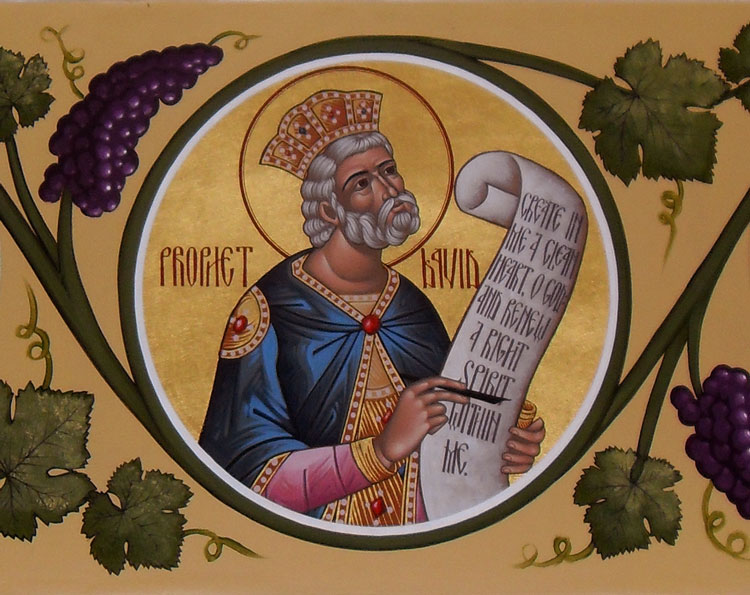
The Psalms of David

“He who is well disposed and orderly in his interior, is not concerned about the strange and perverse actions of men.” (IC 2,1,7) | “So the Jews said to him, ‘Now we are sure that you are possessed.'” (Jn 8:52)

Closing out Kempis’s chapter on interior conversation (2,1), we note in a special way his promise of peace inside ourselves when we know God intimately and trust God completely. regardless of the words and deeds directed toward us, no matter how vile or unjust.

The Jews call Jesus “possessed” in today’s Gospel that continues the last several days interactions between Jesus and the Jews (Jn 8:51-59).  Once again, their inability to think beyond the natural level, leads them into trouble (not new for the Chosen People — see Num 21:4-9).  Talk about having your poles reversed!  This man of God, who preached truth, healed the sick, and raised the dead, is now demonic?

Ah! Those who call evil good, and good evil,

who change darkness to light, and light into darkness,

who change bitter to sweet, and sweet into bitter!

Ah! Those who are wise in their own eyes,

prudent in their own view!  (Is 5:21-21)

Isaiah knew the Chosen People well.  Things hadn’t changed much in the next several centuries apparently.  It is a wonder that a calamity did not visit itself upon Jesus’ adversaries then and there when they accused Him of demonic activity.  Despite the unconscionable accusations of these pillars of the community, Christ was at peace knowing He was perfectly in accord with His Father’s will, a Father with whom He was in constant contact.

In a society, a world, that militates against truth, we must be stalwart, having the interior peace that comes with knowing the Father’s will and doing it.  Let us not grow anxious, disturbed, or afraid for boldly proclaiming the Word, regardless of the blowback.  And may it never be said of us that we “exchanged the truth of God for a lie and revered and worshiped the creature rather than the creator” (Rom 1:25).

The Transfiguration of Christ: Part of an iconostasis in Constantinople style. Middle of the 12th century.

 

“Christ had adversaries and detractors, and would you have all to be your friends and benefactors? Whence will your patience be crowned if you meet with no adversity? If you suffer no contradiction how will you be a friend of Christ? Suffer with Christ and for Christ if you desire to reign with Christ.” (IC 2,1,5) | “[Y]ou are trying to kill me, because my word has no room among you…a man who has told you the truth that I heard from God” (Jn 8:37,40)

Christ promised adversity and detraction to His faithful followers.  One of the many benefits that comes with deep and sustained interior conversation with the Lord is the growth in patience and fortitude to see through these difficulties without compromising the truth regardless of personal consequences (see Mk 10:29-30 and Lk 6:22).  Kempis tells us here (2,1) that if Christ suffered these things who are we to think that we can (or should) avoid them (“Remember the word I spoke to you, ‘No slave is greater than his master.’” — Jn 15:20).

Once again, in today’s Gospel proclamation (Jn 8:31-42), Jesus contends with the Jews.  Unlike the usual back and forth with the Pharisees (with whom He sparred immediately before this episode) and other religious leaders, this crowd were “those Jews who believed in him” (v.31).  So why does Jesus accuse those who believe in Him of trying to kill Him?  How strong was their belief, really?  Jesus challenges their preconceptions and ours.  He  also knew of the abandonment that would be His at the time of His death.

Jesus knew what was coming to Him.  So do we.  Are we going to our deaths not adhering to the truth?  Do we leave space for compromising the truth in ourselves or in our dealing with others (Rev 3:15-16)?  Will we also abandon Christ?  Is there room for the Word and His words (all of them) in us (see Jn 16:13)?

If Jesus is the Jewish Messiah, Then Why Don't Most Jews Believe ...

“The kingdom of God is within you, says the Lord. Convert yourself with your whole heart to the Lord, and quit this miserable world, and your soul will find rest.” (IC 2,1,1) | “You belong to this world, but I do not belong to this world. That is why I told you that you will die in your sins.” (Jn 8:23-24)

The quote above contains the first words of Kempis in this chapter (2,1).  How does one have a deep interior conversation with God (the theme of this chapter) when one’s heart is in this world and its distractions?  When one’s status is considered paramount and the affairs of others is a bigger concern than the Lord and personal conversion?

Certainly, Jesus’ calling out of the Pharisees in today’s Gospel (Jn 8:21-30) is meant to bring conversion, not condemnation (see Jesus’ different conversation with a Pharisee at Jn 3:17).  Many Pharisees did not accept Jesus despite claiming to know the Scriptures (see Mt 22:29).  These men were far too concerned with their status among the people and the affairs of others.  Jesus wishes to shake them from their erroneous ways, often with pointed language like we hear in this reading and particularly in the quote at top.  Jesus loves (He is Love — see 1 Jn 4:8), but sometimes it is tough love.

“The kingdom of God is within you,” Kempis says (see Lk 17:21).  Our challenge is to get our “whole heart” to fall in line.  Quitting this “miserable world” does not mean we want out as soon as possible or that we don’t engage the world (although certainly some of the monks and nuns to whom Kempis was [and is] speaking to did take that route — and thank God for the men and women who devote their lives to prayer).  Rather, as we have already seen frequently in The Imitation of Christ, our focus must remain on eternity, on the Christ who came into the world for us but who does “not belong to this world.”  His warning about “d[ying] in your sins” was meant to serve as a wake up call for the Pharisees of his time as it is for us today.

Because he spoke this way, many came to believe in him.

This last line of the reading is interesting isn’t it?  One might have expected folks to be upset or walk away, but His strong words to the Pharisees, His declaration that He is God (“I AM”), and His statement that He always pleases the Father, were attractive to many of his hearers that day.  It serves as a lesson this day that we are never to soft peddle the truth: we are sinners and need to hear this fact in no uncertain terms (see Heb 4:12); Jesus is God and that entails that we believe in Him and listen to Him (see Mt 17:5); Jesus followed the will of His Father in all things and this perfect example is what we are called to follow (see Mt 5:48).

https://richardgrebenc.com/wp-content/uploads/2020/03/7300f-trinity2bcreation2b2.jpg

“Christ will come to you, and reveal to you His consolation, if you will prepare Him a fit dwelling within you.” (IC 2,1,1) | “‘Woman, where are they? Has no one condemned you?’ She replied, ‘No one, sir.’ Then Jesus said, “Neither do I condemn you. Go, and from now on do not sin any more.'” (Jn 8:10-11)

Today we begin the second, and shortest, of the five books of Thomas à Kempis’s masterpiece, The Imitation of Christ.  This book is entitled, “Admonitions Concerning the Interior Life.”  The first chapter: “Of Interior Conversation.”  Once again, Kempis discourages materialism and distractions so that we can better communicate interiorly with God — the better disposed we are to listen, the more fruit will come of this practice.  The headline gives us in a nutshell the entire chapter.  We will be consoled if we allow in Christ fully.

The Gospel proclaimed this day (only in Jn 8:1-11) is the episode in which the Jewish religious leaders bring to Jesus (forcibly, most assuredly) a woman caught in adultery in order to attempt to trap Him: let her go and He breaks the Law of Moses; authorize her killing and He breaks Roman law (executions were only to be carried out by Roman officials).  As always, Jesus cleverly avoids their trap by turning it around on them: are they willing to break Roman law and do they feel interiorly disposed to cast this judgment?  Eventually they all drop their rocks and go away.  The words above are the only discourse between Jesus and the woman in this story.

It seems to me that this is a very good example of something good coming from something evil.  Actually, two evils: the woman’s adulterous act and the conniving of the scribes and Pharisees.  The woman, undoubtedly ashamed, embarrassed, and afraid for her life, is dragged to the temple area, no less, in front of this great teacher, preacher, and healer (I wonder how much she knew of Him — He must have been the talk of all Jerusalem by that time).  This all changes quickly as, in a matter or minutes, Jesus frees her and commands her to amend her life.  What began as a horror fer her turned out to be the greatest blessing of her life.

Per Kempis, Christ did come to her (or maybe better put, Christ brought her to Himself).  What consolation must she have felt when Jesus not only caused her freedom but also doesn’t condemn her.  He desired to make for Him “a fit dwelling within [her]” if only she would renounce her previous immorality and embrace holiness.  We do not know what becomes of her (at least explicitly; this short article makes a compelling case for her as Mary Magdalene).  But, it’s hard to imagine that her life was not changed forever.  We hope that her consoling encounter with Jesus kept Him in her heart always and that she gave up her sinful ways for her remaining days.

Just the same, we are freed by Jesus (see Gal 5:1) and commanded to amend our lives so Jesus can find “a fit dwelling within [us].”  We dispose ourselves to the ever greater lordship of Christ in our lives through daily prayer, contemplation, examination of conscience, Scripture and other spiritual reading, along with frequent sacramental Confession, and weekly or more Holy Communion (at least spiritually, if not able to get to daily Mass).  If we are faithful, we need not be ashamed, embarrassed, and afraid for our spiritual life.

Christ and the Woman Taken in Adultery (1565) by Pieter Bruegel

“Oh, if only there were nothing else to do but to praise the Lord our God with all our heart and tongue!” (IC 1,25,10) | “Now many of the Jews who had come to Mary and seen what he had done began to believe in him.” (Jn 11:45)

It seems fitting to end this chapter (1,25) and, thus, Book One of The Imitation of Christ, with the words above.  If God consumes “our heart and tongue” then all that we do will be in accord with God’s will and we will work all the more diligently to correct all the deficiencies in ourselves that he has not hesitated to point out.  Kempis goes on to the bemoan the fact that, sadly, of fleshly necessity, we must eat, drink, and sleep instead of being entirely focused on spiritual things.

Today’s Gospel reading gives us the story of Jesus raising Lazarus from the dead.  While all gospels tell of Jesus raising persons from the dead, this particular episode only appears in John (11:1-45).  Jesus, upon hearing of Lazarus’s illness and the call of his sisters to come heal his friend, delays the visit in order to manifest in a special way the glory of God.  When Jesus finally arrives with the apostles, the poor man has already been dead and buried four days.  Martha is bothered that Jesus did not come post haste, but still expresses faith.  In front of many, Jesus cries, but then orders the tomb opened at which time He calls Lazarus to come out.  The line in the headline concludes the story.

I bring the two quotes together because it is not hard to imagine that, for at least Mary, Martha, and Lazarus (and hopefully many more in the crowd who “began to believe”), they must have desired to unceasingly “praise the Lord our God with all our heart and tongue” after this unexpected event — their beloved brother was returned to the sisters!  Now, of course, as Kempis lays out in this chapter, we should wish that nothing would distract us from this disposition.  But, life and nature being what it is, we can only continue to strive, by the grace of God, to approach the Lord in this way in all our tasks and circumstances.  It is unlikely that we will ever witness a miracle like the one proclaimed today; our challenge is to give glory and praise to God in everything, even when it’s difficult to understand how a greater good will come from it (that may only come in the next life).

As an aside, in my reading of this passage, I noticed (or at least interiorized) for the first time that this last sentence says the Jews “had come to Mary” (presumably referring back to v. 31 when they followed her to the tomb).  Now, of course, the context refers to Mary of Bethany, Lazarus’s and Martha’s sister.  But, in finally taking note of this, it is impossible not to think of another Mary, Jesus’ own mother, and how she can be an avenue to show what her Son has done (leading them first to the tomb and then bearing witness to the Resurrection) and to help people believe in Him and come to praise Him.  I am certain that both Marys are available for that assistance right now and until the end of time.  Mary of Nazareth and Mary of Bethany, draw ever more persons to Jesus!

As an aside to the aside, there is debate as to whether Mary of Bethany and Mary Magdalene are the same person.  I have heard good arguments on both sides of this question.  But it is worth pondering: is it not somehow fitting that both(?) Marys are the first to tombs (Lazarus’s; Jesus’) and led others there (the Jews; Peter and John)?

Parma - The fresco of Assmption of Virgin Mary in side cupola of church Chiesa di Santa Cristina by Filippo Maria Galletti (1636-1714).

“Be vigilant and diligent in God’s service; and think often for what end you came here, and why you left the world.” (IC 1,25,1) | “I knew their plot because the LORD informed me; at that time you, O LORD, showed me their doings. Yet I, like a trusting lamb led to slaughter, had not realized that they were hatching plots against me” (Jer 11:18-19)

Kempis begins this chapter on amendment of our whole life (1,25) with the words above.  He is speaking specifically to those who have committed to the religious life, but all of us can take lessons from it.  Certainly, religious have “left the world” in a special way but, as we’ve often seen, Kempis calls all Christians to “leave the world” by renouncing any undue attachment to material things.  A (super)natural outgrowth of being increasingly “vigilant and diligent in God’s service” is being decreasingly interested in passing things.

Today’s short excerpt from Jeremiah (Jer 11:18-20) finds the reluctant prophet again (thus we get the word “jeremiad“) bemoaning the fact that plenty of folks are out to get him.  He entrusts his cause to the Lord and he asks vengeance on those plotting against him.  He certainly must once again be recalling the mission he received as a youth and does not want cut short his work for his God.

Like Jeremiah, per Kempis’s call, we too are to keep foremost in mind “for what end you came here” — not specifically the monastery (unless it is your calling) but more generally life in Christ through baptism. Living that life intentionally is challenging — not only because of the weakness of our fallen nature but because the world militates against a Christian outlook.  Unlike Jeremiah, we don’t ask for vengeance against our enemies (in fact, they are the enemies of Jesus whose rage is taken out on us — the good news: Mt 5:11-12), rather we pray for their conversion (see 1 Tim 2:3-4).

Michelangelo Buonarroti 027.jpg
Jeremiah, as depicted by Michelangelo from the Sistine Chapel ceiling

“[I]f you see anything that is reprehensible take care that you do not do the same; or if you, at any time have done it, strive to amend yourself quickly.” (IC 1,25,6) | “[T]heir wickedness blinded them” (Wis 2:21)

Kempis closes out Book One (“Useful Admonitions for a Spiritual Life”) of his The Imitation of Christ with his longest chapter so far: “Of the Fervent Amendment of Our Whole Life” (1,25).  In a certain way, it is a good summary of the entire first book, focusing on those in religious life, but certainly applicable to all who seek to please God.  It is filled with short helps and admonitions like the one above: see bad behavior for what it is and avoid it or, if you have been guilty of it yourself, repent and do better.  Even the bad example of others can lead to (a return to) good behavior in ourselves.

The Book of Wisdom starts off with guns a blazin’, so to speak.  The wicked are called out within the first few verses of this book, carrying through the entire second chapter.  In the first reading today (Wis 2:1a, 12-22), it quickly becomes clear why this passage was chosen as we quickly approach Holy Week.  We can hear plainly the religious leaders of Jesus’ day in this passage.  The author (Solomon gets the attribution) speaks of a “just one” who “boasts that God is his Father” and “judges us debased” so “[l]et us condemn him to a shameful death.”  The author’s conclusion regarding their sentiments can be seen in the headline.

Kempis warns his readers to not do the reprehensible things they see others do, and to change our ways quickly if they are guilty of the same.  The danger if they don’t: the blindness that comes with sinning habitually.  Justification for bad behavior comes more and more easily: everyone else is doing it; others are doing much worse things; I’m basically a good person so I can allow myself this “little” vice; I’m only human; and on and on it goes.  The inevitable result: growing blind to offenses against God and becoming more easily disposed to give into temptation to do even worse things.  Amend quickly!  The consequences of being obstinate in wickedness are dire indeed, as Wisdom attests.

File:087.King Solomon in Old Age.jpgKing Solomon in Old Age (1866) by Gustave Doré