“Thereupon the whole town came out to meet Jesus, and when they saw him they begged him to leave their district.”

I could not help but thinking of our country, much of our world, really, seeming to react toward Jesus the way the Gadarenes reacted to Him at the end of today’s gospel reading (Mt 8:28-34).  The Lord travels into their territory, encounters two men who terrorized the entire region, expels enough demons from them to fill a whole herd of pigs, and then is promptly asked to leave the area.
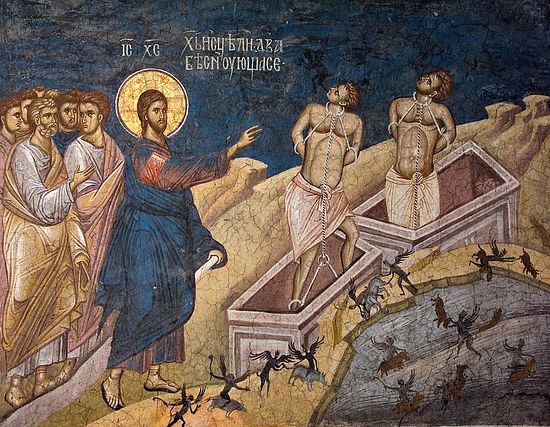
https://i0.wp.com/www.pravoslavie.ru/sas/image/101902/190270.p.jpg

With Jesus’ presence demons flee and are gone for good.  Yet as our Savior’s reality is ignored, mocked, and denied, society slips further and further into the clutches of the “prince of this world” (Jn 12:31, 14:30, 16;11).  We are now in a time in which, among growing numbers of persons and groups, good is called “intolerant,” “unjustly discriminatory,” and even “hate speech,” while evil is lauded under the guise of “choice,” “inclusiveness,” and even “love.”

Ah! Those who call evil good, and good evil,
who change darkness to light, and light into darkness,
who change bitter to sweet, and sweet into bitter!
…they have rejected the instruction of the LORD of hosts,
and scorned the word of the Holy One of Israel.
Therefore the wrath of the LORD blazes against his people,
he stretches out his hand to strike them.
                                                                            — Is 5:20, 24b-25a

And if the light in you is darkness, how great will the darkness be.
— Mt 6:23 (see also Lk 11:35)

When Jesus is asked to leave, He does so, honoring our free (if misguided) will.  Is it any wonder that the sheep go astray when the master is no longer the guide?

As happened on the Emmaus road, let us beg the Lord to “stay with us” (Lk 24:29).  Our “light must shine before others” (Mt 5:16), never compromising the truth or failing to share fully the truth.

Finally, and at least as importantly, do not forget what the Lord told His disciples when they failed to drive out a demon from an afflicted person:

This kind can only come out through prayer and through fasting.
–Mk 9:29

So, let us redouble our efforts in these two areas so as to hasten the coming of God’s kingdom.


“Put your finger here and see my hands, and bring your hand and put it into my side.”

Jesus’ words to Thomas (Jn 20:24-29) that we read on this his feast day have given the poor man untold grief this past two millennia.  I, for one, do not think it is deserved.  Considering the cast of characters that were Jesus’ constant companions during His ministry, do you really think any one of them (or us) would have behaved any differently if he were the one to have been absent at Jesus’ first appearance on that glorious Sunday?  Even though Jesus was explicit in speaking of His death and resurrection, shock, grief, fear, inattentiveness, or whatever, made them in no state of mind to process the whole situation.

Yet, Thomas had an extraordinary grace given to him!  The invitation to touch the wounds that healed all of us (see Is 53:5).  The gospels do not record whether Thomas took the Lord up on His offer (I’m betting he didn’t, although Caravaggio [see the painting below] thinks differently), but what an opportunity for him.  I am reminded of the stigmatists, like St. Francis of Assisi, St. Catherine of Siena, and Padre Pio, who in their own way touched the wounds of Jesus — but here Thomas was with the glorified Lord who humbly offers His body to Thomas (as He does to us at each Mass).

https://upload.wikimedia.org/wikipedia/commons/e/e0/Caravaggio_-_The_Incredulity_of_Saint_Thomas.jpg

Caravaggio, The Incredulity of Saint Thomas, 1601/2, oil on canvas

I invite you to read a recent article on this same subject.

St. Thomas, Apostle, pray for us.  And, for you, dear reader, no doubt (hehe), your Tom, Tommy, Thomas, and Thomasina friends would be happy to receive your prayers, through St. Thomas’s intercession, this day.

“Why do you recite my statutes, and profess my covenant with your mouth, Though you hate discipline and cast my words behind you?”

The response for today’s psalm (Ps 50:16bc-17, 18-19, 20-21, 22-23) is what God says to the wicked.  He calls out those who run with thieves, throw in their lot with adulterers, give their mouths free rein for evil, yoke their tongues in deceit, and speak against brother and slander him.  The psalmist concludes with these ominous words from Yahweh:

Now understand this, you who forget God,
lest I start ripping apart and there be no rescuer.

This should serve as a warning to all of us, imperfect as we are.  But I think especially of politicians and celebrities who claim religious faith yet advocate for evil publicly, unashamedly, and obstinately.  I am particularly saddened by Catholics in the public square who claim to be faithful to their religion yet espouse that which is directly opposed to the Faith.  They hate discipline, and those who can enforce it seem, in the main, to hate giving it.  Let no one accompany these scandalous public figures along the wide road that leads to destruction (Mt 7:13-14), but, rather, might they receive correction humbly, then repent and convert.  Our country, our world, needs many more courageous men and women to stand up for the Truth, no matter the cost.


https://abcnews.go.com/images/International/GTY_pope_congress_11_mm_150924.jpg

Some of the most outspoken advocates for abortion in the Senate are Catholics (twenty-four senators profess to be Catholic — 15 Democrats and 9 Republicans).  Over 80% of senators claim Christianity as their faith.  Pray for enlightenment for the misguided so they can be witnesses (mártyres) not scandalizers.

https://en.wikipedia.org/wiki/Religious_affiliation_in_the_United_States_Senate

“God did not make death, nor does he rejoice in the destruction of the living. For he fashioned all things that they might have being.”

The beginning of today’s first reading (Wis 1:13-15; 2:23-34) seems very appropriate for these days as we experience, from certain corners, hysteria over the Supreme Court vacancy.  A most disgusting display by those who seem to believe that the murder of innocents is the most important pillar of American society.  Rightly decried is “babies ripped from their mother’s arms,” but many of that same crowd wish that babies ripped from their mother’s wombs becomes permanently enshrined here and everywhere.  However sad the former is, it is only temporary in this life.

https://static.independent.co.uk/s3fs-public/styles/article_small/public/thumbnails/image/2014/04/16/17/web-sperm-rex.jpg

The Catechism of the Catholic Church:

2271 Since the first century the Church has affirmed the moral evil of every procured abortion. This teaching has not changed and remains unchangeable. Direct abortion, that is to say, abortion willed either as an end or a means, is gravely contrary to the moral law:

You shall not kill the embryo by abortion and shall not cause the newborn to perish. (Didache 2,2:SCh 248,148; cf. Ep. Barnabae 19,5:PG 2 777; Ad Diognetum 5,6:PG 2,1173; Tertullian, Apol. 9:PL 1,319-320.)

God, the Lord of life, has entrusted to men the noble mission of safeguarding life, and men must carry it out in a manner worthy of themselves. Life must be protected with the utmost care from the moment of conception: abortion and infanticide are abominable crimes. (GS 51 § 3.)


If you are on the wrong side of this issue, repent now, and no longer have anything to do with this heinous crime — directly or indirectly.  It is a life and death issue for bodies and souls.


“Do not be afraid; just have faith.”

This quote, from today’s gospel (Mk 5:21-43), is taken from the New American Bible, Revised Edition for use in the Lectionary.  I rather favor the translation from the 1970 NAB: “Fear is useless; what is needed is trust” (v. 36; thanks to Fr. Ruff for the reference), because it brings home the point more forcefully.

And what is the point?  In the reading, Jesus utters the words at top to the synagogue official, Jairus, who earlier approached Him to heal his sick daughter, but now has learned that she has since died.  Undoubtedly devastated by the news, he may well have begun to turn away, with the people from his house, from the Lord.  Why would he be afraid at this moment?  A hint may be in the words of the people who brought the news: “Why trouble the teacher any longer?”  Maybe the official was concerned that he had wasted Jesus’ time.  Also, by seeking, in desperation, this controversial figure, now with nothing to show for it, what repercussions from his peers and other members of the synagogue might be coming his way?  And what about a future without his beloved daughter?  An only daughter, or an only child, possibly?  How would he and his wife go on?

https://i.pinimg.com/originals/d7/9c/74/d79c7440f694c6c8163a0d8574a158ee.jpg

Jesus disregards the people from Jairus’s house in telling Jairus to not be afraid.  Had he not raised the dead before (this story also appears in Luke [8:41-56] after the raising of the son of the widow of Nain [7:11-15])?  Of course, in one of the most beautiful scenes in scripture, Jesus goes to the girl and brings her back to life (I love to envision Jesus kicking out all the mourners who ridiculed Him).

Lessons for us?  Let’s take them one by one from my speculation about Jairus’s experience:

  1. Are we afraid we are troubling God with our problems, wasting His time?  Maybe we feel we don’t deserve any favors?  Maybe fear overcomes trust?  Maybe interior or exterior voices say “don’t bother”?  Do what Jesus did, and ignore these murmurings.
  2. Are we afraid of what other people with think about our appeal to the Lord?  Does appealing to prayer bring ridicule from those who don’t believe or who think physical actions are the only hope?  Do accusations of being a “holy roller” or believing in “superstition” give us pause?  Might we fear straining or losing friendships or uncomfortable future interactions with colleagues and acquaintances?  Or maybe someone (especially ourselves) might intimate that we are not deserving of favors (read Job for an object lesson).  “Put out” the naysayers.
  3. When the news is devastating do we trust unreservedly “that all things work for good for those who love God, who are called according to his purpose” (Rom 8:28)?  Augustine, dealing with the problem of good and evil tells us, “God judged it better to bring good out of evil than to suffer no evil to exist” (Enchirid., xxvii) (see here).  We might not see how this works now, or even in our lifetimes.  But we will know on the last day, when God’s entire plan will be made manifest (see CCC 1040).  Do we unreservedly trust Jesus?

“Fear is useless; what is needed is trust.”  Another challenge from Jesus.  Are we up to it?

“Lord, I am not worthy to have you enter under my roof; only say the word and my servant will be healed.”

When I hear today’s gospel (Mt 8:5-17), Jesus Heals a Centurion’s Servant, one of my favorite episodes in the gospels, I cannot help but remember its portrayal in the film Jesus of Nazareth.

Below is a post containing two of my favorite past posts on this event, the second containing a clip of the scene from the film.

https://richardgrebenc.com/2017/09/18/i-tell-you-not-even-in-israel-have-i-found-such-faith/

https://i0.wp.com/www.moviesbydecade.com/christianmovies/jesus_of_nazareth-3.jpg

In the film, the centurion is also portrayed as the Roman soldier at the cross who confesses Jesus as the Son of God (see Mt 27:54), a pious legend, but not unbelievable at all considering his *amazing* faith.  I’ll say again, when we meet, I fully expect Jesus to look like Robert Powell and the centurion to be a spitting image of Ernest Borgnine (may he rest in peace).


“I will give you the keys to the Kingdom of heaven.”

Much has been written about today’s gospel passage (Mt 16:13-19) as it relates to the special role of Peter and his successors as Vicars of Christ.  Rightfully, Mt 16:18 is the go to verse (not the only one, of course, but the primary one) for apologetic purposes against those who question or attack the institution of the papacy with Peter (reams have been produced on this, but here is one helpful resource).

Rather than go over that here, though, I would like to focus on the “key” to the Church established by Christ and how it ties in with Peter and the apostles.  The Vatican II document Lumen Gentium tells us that “the Eucharistic sacrifice…is the fount and apex of the whole Christian life” (11; also see CCC 1324).  We also remember Jesus’ promise, “I am with you always, until the end of the age” (Mt 28:20).  Our Lord fulfills this promise through His presence, Body, Blood, Soul, and Divinity, in the Eucharist.  And He has ordained that this gift only comes to us at Mass through the hands of His priests, who were ordained by bishops, who were ordained by bishops, and so on, going back to the eleven apostles (thus our Church is one, holy, catholic, and apostolic).

Ephesians says:

So then you are no longer strangers and sojourners, but you are fellow citizens with the holy ones and members of the household of God, built upon the foundation of the apostles and prophets, with Christ Jesus himself as the capstone [also translated keystone]. (19-20)

So Jesus is the key(stone) of the Church that He entrusted to Peter (and his successors) to lead faithfully with the assurance of the guidance of the Holy Spirit.  But, beyond that, He also remains truly present, through the action of the priest, to sustain us and give us an unparalleled source of grace, the key to eternal life.


“Not everyone who says to me, ‘Lord, Lord,’ will enter the Kingdom of heaven, but only the one who does the will of my Father in heaven.”

This excerpt from the beginning of today’s gospel reading (Mt 7:21-29) is the first scripture I turn to when countering the “once saved, always saved” proposition of some Christians.  The gospels, especially Matthew, are replete with commands from Jesus on the requirements (not options) of living out the Faith.  Accepting Jesus as Lord and Savior is necessary, but our commitment cannot stop there.

Puzzling here, though, is that Jesus acknowledges that even those who prophesy, exorcise, and do mighty deeds in Jesus’ name after calling out “Lord, Lord” may not be saved and are “evildoers.”

https://i.pinimg.com/736x/d3/1b/64/d31b6426b314678f323620aebb4fd844.jpg

The question that immediately arose for me was: How is this reconciled with another passage that states: John said to him, “Teacher, we saw someone driving out demons in your name, and we tried to prevent him because he does not follow us.”  Jesus replied, “Do not prevent him. There is no one who performs a mighty deed in my name who can at the same time speak ill of me.” (Mk 9:38-39; see also Lk 9:49-50)?

Upon personal reflection, it seems that Jesus, in Matthew, is warning that even doing great things in His name, without living out the gospel in one’s own life, provides no guarantee of being in, or remaining in, friendship with God.  This is borne out by Jesus seemingly lumping such folks as described here in with the “false prophets” he describes in the paragraph just before this one (starting in v. 15).  Some commentaries I consulted bear this out, build on it, and add other insights.

Acts versus disposition:

The point is that religious confession is no substitute for a personal relationship with Jesus and the obligation to obey his Father’s will.  If our creed and our conduct are out of alignment, then our profession of Jesus as Lord is not a true submission to his lordship.  The mere fact that believers can perform miracles in Jesus’ name, which is the exercise of charismatic grace, is not proof that sanctifying grace has penetrated their lives or brought them closer to Christ. (Edward Sri and Curtis Mitch, The Gospel of Matthew, Catholic Commentary on Sacred Scripture, [Grand Rapids: Baker Academic, 2010], 121)

Expounding on these charismatic gifts:

These charismatic graces are…not conclusive evidence of one’s personal sanctity or membership in the family of God. (Scott Hahn and Curtis Mitch, The Gospel of Matthew, Ignatius Catholic Study Bible [San Francisco: Ignatius, 2000], 30)

What we do not want Jesus to judge:

I have ratified your words because they were true and of benefit to others; but as regards yourselves, “Depart from me, you workers of iniquity.” (Alfred Durand, S.J., The Word of Salvation: The Gospel According to Matthew [Milwaukee: Bruce, 1957], 131)

Fr. John Hardon’s definition expands on this understanding of charisms:

Literally “gifts of grace” (charismata), described by St. Paul as gratuitous blessings of an extraordinary and transitory nature conferred directly for the good of others. Indirectly they may also benefit the one who possesses the charisms, but their immediate purpose is for the spiritual welfare of the Christian community. (Emphasis added)

So, whether we perform ordinary or extraordinary good works, our attitude must be not one of “Look what I have done!” but “Look what Jesus has done through me!”  That is, humility must be operative, not pride.  And living out what we profess, as the exorcist in Mark must have been doing.


“Truly you have formed my inmost being; you knit me in my mother’s womb.”

(Ps 139:13)

I give you thanks that I am fearfully, wonderfully made;
wonderful are your works. (Ps 139:14)

The LORD called me from birth,
from my mother’s womb he gave me my name. (Is 49:1)

For now the LORD has spoken
who formed me as his servant from the womb. (Is 49:5)

Before I formed you in the womb I knew you,
before you were born I dedicated you,
a prophet to the nations I appointed you. (Jer 1:5)

Since my mother’s womb, you have been my strength. (Ps 71:6)

He will be filled with the Holy Spirit even from his mother’s womb. (Lk 1:15)

As we see above, the readings for the Solemnity of the Nativity of St. John the Baptist (day and vigil) are replete with pro-life messages.  How any Bible believer can hold any other stance is beyond me.  John the Baptist, of whom Christ said, among those born of women there has been none greater (Mt 11:11), was destined from all eternity to be the forerunner of Christ.  Tradition even has it that he was sanctified in his mother’s womb, being cleansed of original sin during the Visitation (see Lk 1:15 above and Lk 1:41).

https://i0.wp.com/sites.nd.edu/oblation/files/2014/12/visitation-e1417617194601-526x372.png

How many others, destined for great things, have not been able to fulfill that for which they were known, dedicated, and appointed by God?  Maybe the woman who would develop the cure for cancer, maybe the man who would become the greatest Christian evangelist of his time, or maybe the child who would bring inspiration to millions through musical talent.

Here I am reminded of one of my favorite Star Trek: The Next Generation episodes.  The clip below is a powerful witness.

Ironically, it is the technology used in the visor that saves the society, which eliminates “imperfections,” from which the woman comes.

Through the intercession of St. John the Baptist, his mother St. Elizabeth, and his father, St. Zechariah, may the sanctity of life from conception be impressed upon every person.

“Therefore I tell you, do not worry about your life, what you will eat or drink, or about your body, what you will wear.”

I must confess that today’s gospel (Mt 6:24-34) has long caused me consternation.  While I have never experienced serious want for any physical necessities, I know that hundreds of millions in the Christian Era have been deprived of food, clothes, and shelter, even unto death, often due to oppressive regimes and war, or simply because of climate and natural disasters.

So how are those persons in the most desperate conditions to understand, “If God so clothes the grass of the field…will he not much more provide for you…?”?  We know Jesus only speaks the truth (He is the Truth), yet so many have suffered for want of the basics even to the present day.

Now, Jesus does place conditions on these provisions.  He berates the anxious for having “little faith” (v. 30).  He adds that we are to “seek first the Kingdom of God and his righteousness and all these things will be given you besides” (v. 33).  But certainly many suffer and die who have strong faith and seek the Kingdom (we may even include some non-Christians here — see CCC 847). We hope and pray that folks suffering in these ways would be relieved through justice and charity, and this passage should be seen as a call to practice these virtues toward the least of our brethren, but this still does not seem to deal with the question.  Or does it?

Commentaries speak of preoccupation with, or anxiety over, possessions instead of a primary focus on God and eternal life which will be the fulfillment of all our desires; certainly, we should strive to please God in all of our interactions with Him and neighbor.  The most helpful commentary I have come across emphasizes, in these hard cases, the practice and promotion of justice and charity mentioned above.

It sometimes happens…that despite their industry individuals are in want of necessities; but that is an accident which proves nothing against the general rule.  In the interests of the whole order, God ordinarily respects the natural course of events which he has established, even when the innocent suffer from it.  But most of the time man must be held responsible for the misfortunes from which the impious take occasion to blaspheme.  The one who suffers is not always guilty.  Not infrequently his suffering is imputable to those who, by reason of social and Christian fellowship, should come to his assistance and fail to do so. (Alfred Durand, The Word of Salvation, vol. 1, The Gospel According to St.Matthew [Milwaukee: Bruce, 1957], 116)

While I would heartily encourage everyone to strive for abandonment to God’s will so as to attain the Kingdom, and to advance that same Kingdom by imitating Christ, I find myself still dissatisfied with the explanations for this passage that I have come across regarding the most desperate cases.  I would be happy to hear from you, dear reader.