Advent Day 23: No greater man

TODAY’S GOSPEL (Lk 1:57-66)

From Luke 1:66b:

“What, then, will this child be?
For surely the hand of the Lord was with him.”

From Opening the Scriptures: Bringing the Gospel of Luke to Life, page 41

“Luke concludes his account of the birth and naming of John with his own comment: “For surely the hand of the Lord was with him.” The Old Testament uses the expression “hand of the Lord” to convey the power of God (Joshua 4:24; see Exod 7:4; 13:3; 15:6); the hand of the Lord being with or upon someone means that he is empowered and guided by God (1 Kings 18:46; 1 Chron 28:19; Ezra 7:28; Ezek 1:3; 3:14, 22)/ Surely someone born to a previously barren woman in fulfillment of an angel’s words has been sent by God to carry out a special work, and surely God will empower and guide him to accomplish his mission/ By adding that final comment, Luke invites his readers to join those pondering what this child will be and to share their sense of anticipation.”

My take

“Amen, I say to you, among those born of women there has been none greater than John the Baptist; yet the least in the kingdom of heaven is greater than he.” (Mt 11:11)

We think much of and revere deeply the greatest woman to be born of woman, the Blessed Virgin Mary, but how much do we consider the greatest man born of woman, as declared by Jesus Himself!, John the Baptist? Fittingly, he is the only person in Heaven, aside from Jesus and His mother, whom we honor by celebrating his earthly birth on the liturgical calendar (June 24, appropriately, six months before Christmas).

This man was repeatedly asked if he was the Messiah. How powerful must his preaching have been? Herod wondered if Jesus might be John reincarnated. What sort of impact must John have had on all of Judea? People flocked to him from miles around, confessing their sins and seeking a baptism of repentance. How much weight must his words have carried with the general population? The wife of Herod wanted John shut up for good. What weight must his words have carried with the commonfolk?

My suggestion is to read everything in Scripture about John the Baptist in one sitting (it won’t take very long). I have listed and linked below, all Gospel passages pertaining to John:

  • Lk 1:5-25 (annunciation and conception of John)
  • Lk 3:1-22 (John’s public ministry, his future arrest by Herod, Jesus’ baptism)
  • Mt 3:1-16 (John introduced and the baptism of Jesus)
  • Mk 1:2-11 (John introduced and the baptism of Jesus)
  • Jn 1:6-8, 15 (from the Prologue)
  • Jn 1:19-37, 40 (John’s public ministry, his prophesying about Jesus and the retelling of the Spirit coming upon Jesus, his encouraging his disciples to follow Jesus)
  • Lk 7:18–23 (John sends disciples to Jesus to ask if He is the Messiah)
  • Jn 3:23-30, 4:1-2 (John baptizing and commenting on Jesus baptizing; Jesus’ disciples baptizing)
  • Jn 5:31-36 (Jesus extolling John as a precursor to Him)
  • Lk 7:24-35 (Jesus extolling John to the crowds)
  • Mk 1:14-15 (indicates John’s arrest)
  • Mk 3:18-22 (John’s disciples; on fasting)
  • Mk 6:14-29 (Herod’s suspicions about Jesus; the recounting of John’s imprisonment and death)
  • Lk 9:7-9: (Herod’s suspicions about Jesus and his speaking of John’s death)
  • Mk 8:27-30 (speculation that Jesus is John)
  • Lk 9:18-22 (speculation that Jesus is John)
  • Jn 10:40-41 (the crowds compare Jesus and John)
  • Lk 11:1 (Jesus asked to teach His disciples how to pray as John taught them)
  • Mk 11:27-33 (Jesus’ authority questioned and He invokes John)
  • Lk 16:1 (John invoked by Jesus as the last prophet)
  • Lk 20:1-8 (Jesus’ authority questioned and He invokes John

John’s baptism is also referred to in Acts 1, 10, 11, 13, 18, 19.

John the Baptist, pray for us, that we may join you in the kingdom, even as the “least.”
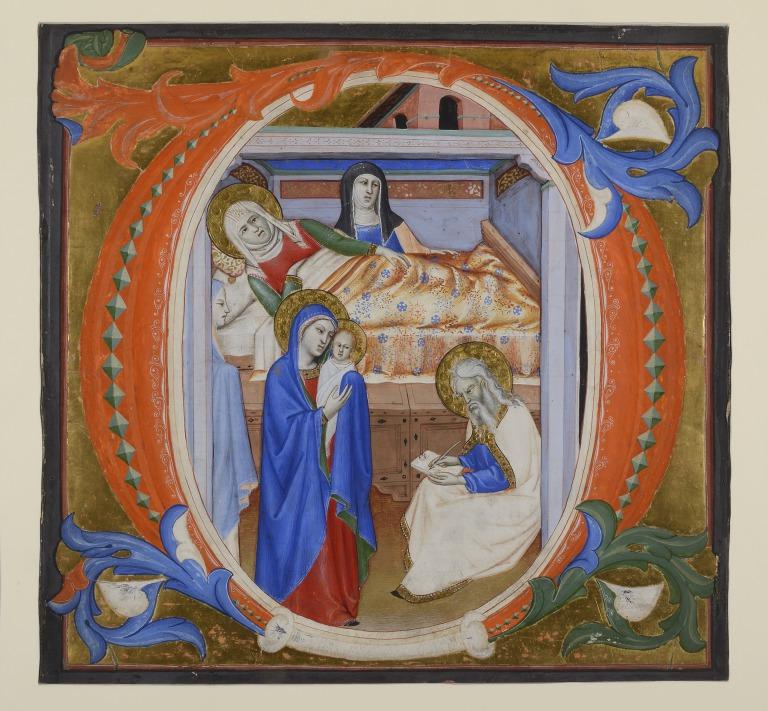
The Birth of St. John the Baptist (1370 – 1371 probably) by Don Silvestro dei Gherarducci

God bless!

Advent Day 21: What’s in a name?

TODAY’S READINGS

The Gospel reading is from Lk 1:57-66, again picking up where we left off from the previous day. Here, Elizabeth names her newborn son to those gathered round.

When they came on the eighth day to circumcise the child,
they were going to call him Zechariah after his father,
but his mother said in reply,
“No. He will be called John.”
But they answered her,
“There is no one among your relatives who has this name.”
(vv. 59-61)

“[C]ircumcision of Jewish males incorporated them into God’s covenant with his people (Gen 18:9-14; it was ‘the mark of the covenant’ (Gen 17:11). Circumcision was done on the eighth day after birth (Gen 17:12; Lev 12:3). Elizabeth and Zechariah observe all God’s commandments (1:6); their son is circumcised on the proper day. Neighbors and relatives (verse 58) came to celebrate the circumcision…

“The Hebrew name that comes into English as John means ‘God has shown favor’ (using God’s personal name — Yahweh); it was not an unusual name in priestly families (1 Macc 2:1-2). Luke does not explaining the meaning of John’s name, but it is highly appropriate: God has shown favor to Elizabeth and Zechariah and would show favor to his people through their son (see 1:16-17)…

“If a son was not named after his father, it was customary to name him after one of his other relatives. But no one in the families of Elizabeth and Zechariah is named John. Breaking with customary practice in naming John is a sign that he is someone out of the ordinary. His significance will not lie in his family heritage but in who he is an what he will do.” (Bringing the Gospel of Luke to Life, 38-39)

I’ve long wondered why it was so astonishing to those visiting John’s parents that the little boy was not named after his father. I an unaware of any instance in the Bible where a Jewish parent and child had the same name (Abraham Jr., anyone) or even that of a relative (at least mentioned)? I did a bit of research: some speculate that it was because John had a special mission (as mentioned above); others that it was a specifically Levite custom at the time, or still others that Luke got some bad info (which doesn’t square with my understanding of biblical inerrancy). If anyone has come across anything more definitive or explanatory, please let me know in the comments.

Also, check out the article, What’s Your Name?, that gives important scriptural insights and practical application to this Gospel story. Maybe it will inspire you to look up the etymology of your own name (here’s mine).

CATHOLIC COMMENTARY ON SACRED: SCRIPTURE: OLD TESTAMENT!

I had been checking in from time to time on the Catholic Commentary on Sacred Scripture website to find out if, after having published volumes covering the entire New Testament, the Old Testament would be tackled. Well, to my surprise, a suggestion came up yesterday on Amazon about a new commentary on Wisdom from this series (already in my cart)! I checked the site again, but no news there. So I contacted one of the General Editors, Dr. Mary Healy, who tells me, “Yes, we’ve started work on the OT, and Wisdom and Ezekiel will be coming out in 2024! Next will be Sirach and Isaiah, and roughly two volumes every year.”

This is a phenomenal series. I have the entire NT set, and have worked through many of the volumes, even using one to lead a Bible study. Scholarly, but accessible, these are meant for interested and engaged Catholics of all stripes. If you have not seen these yet, I encourage you to pick up at least one (maybe the one that covers your favorite Gospel or epistle) and read it.

CHRISTMAS…HISTORICALLY

Finally, I listened today to one of my more recently adopted favorite podcasters, Catholic Answers apologist Jimmy Akin, who explores what we know, or can reasonably speculate, about the first Christmas. I can assure you, without question, that you will learn something new. For example, there is a decent reason to believe the first Christmas happened on September 11, 3 B.C. — and you’ll be entirely surprised the scriptural warrant for this. Learn this and a lot more in the podcast. And check out the many subjects Jimmy covers in his Mysterious World.

God bless.

The Birth and Naming of Saint John the Baptist (1450-1460) by Sano di Pietro

Advent Day 17: Nazirites Old (Testament) and New (Testament)

TODAY’S READINGS

The first reading is from Jgs 13:2-7, 24-25a. An angel declares that a barren woman shall bear a special child, set aside by God for great things.

As for the son you will conceive and bear,
no razor shall touch his head,
for this boy is to be consecrated to God from the womb.
It is he who will begin the deliverance of Israel
from the power of the Philistines.
(v. 5)

“Samson’s vocation wad decided by God from even before he was conceived…God sends his angel to a woman who is barren and tells her she will have a son (v. 5), who will be consecrated to God as a Nazirite (cf. Num 6:1-21 and its note), and he will perform a specific mission — to save his people from the Philistine. In this account, vocation, dedication to God and mission are all closely linked.

“The main features of vocation are outlined her. The initiative comes from God who sees his people’s predicament and prepares, from birth onwards, a man who will save them from their enemies. In due course he announces his plans through a messenger: an angel presents himself to the wife of Manoah (v. 3) — she see him as a ‘man of God’ (v. 6) — and he tells her God’s plans. The couple’s readiness to go along with God’s will is plain to see (vv. 8 and 12). As happens in some supernatural communications, in special circumstances the Lord offers some remarkable sign to demonstrate that the message indeed comes from him and that what he says will happen (cf. 6:21; Lk 1:20, 36)…

“The way Manoah and his wife make themselves available for God’s plans to work, as also Mary’s great refinement and generosity in doing the divine will, are messages to the reader of God’s word in Scripture — to check his or her own readiness to go along with God’s plan.” (The Navarre Bible: Joshua-Kings, 161-163)

“‘Nazirite’: One who is set apart and consecrated to God in a special way. Nazirites vowed to abstain from drinking wine and eating grapes, from cutting their hair, and from making physical contact with death (Num 6:1-8). Normally the vow was taken voluntarily and its obligations were temporary. Samson is unusual for being a consecrated as a lifelong Nazirite before his birth (13:7), and yet he will show himself less than committed to living within its limits…Samson prefigures John the Baptist, whose mother is initially barren (Lk 1:7), whose birth is announced by an angel (Lk 1:13), and whose designation as a Nazirite is made before his birth (Lk 1:15). ‘begin to deliver’: Hints that Samson will score several victories against the Philistines, but they will remain a threat to Israel after his death.” (Ignatius Catholic Study Bible: Judges and Ruth, 36)

From the Gospel (Lk 1:5-25), check out a previous post on a question I had about the naming for John the Baptist. Also, find here an entry from the same year with a short reflection on the passage expounded upon at the top.

Samson is certainly a type of John, although seriously flawed (types rarely match-up well with their antitypes). Yet, in the end both die heroic deaths for causes worth dying for.

God bless.

The Angel with Manoah and His Wife by Pieter Lastman (1617)

Advent Day 15: Much to rejoice about

TODAY’S READINGS

The first reading is from Is 61:1-2A, 10-11 . A Servant Song of the prophet in the first person.

The spirit of the Lord GOD is upon me,
because the LORD has anointed me
(v. 1a)

“Prophets, priests, and kings were anointed in ancient Israel. The Servant is probably all three. The combination of anointing and the reception of the Spirit calls to mind the figure of David, who was filled with the Spirit when Samuel anointed him in in 1 Samuel 16. David, too, was prophet (2 Sam 23:1-2), priest (Ps 110), and king.” (John Bergsma, The Word of the Lord: Reflections on the Sunday Mass Readings for Year B [Steubenville, OH: Emmaus Road, 2021], 22)

The Responsorial Psalm is from Lk 1:46-48, 49-50, 53-54. Not from the book of Psalms at all, but in the same spirit, the words of Our Lady to Elizabeth (and to the whole world for all time).

He has filled the hungry with good things,
and the rich he has sent away empty.
He has come to the help of his servant Israel
for he has remembered his promise of mercy.
(vv. 53-54)

“Here we see Mary is adopting the attitude and posture of the ‘Servant of the LORD’ in Isaiah 61:1-2. How can she do this? Isn’t the ‘servant of the Lord’ Jesus himself? Yes, but the Blessed Mother has Jesus in her womb. She is the first Christian, the first person to be united as one flesh with Jesus. What is true of Jesus is true of her by extension. She is taken up into the Messianic mission of Christ, to ‘proclaim good news…and liberty’ (Isa 61:1) and to find in God the ‘joy of her soul.’ (Isa 61:10). Mary speaks as if God has already established ‘justice’ (Isa 61:11) through his Messiah: filling the oppressed ‘hungry’ with good things (think of the feeding miracles) and sending the rich oppressors away empty (think of the rich young ruler in Matt 19:22). (ibid, 25)

The second reading is from 1 Thes 5:16-24. It directly addresses the theme for this Third Sunday of Advent: Gaudete! Rejoice!

May the God of peace make you perfectly holy
and may you entirely, spirit, soul, and body,
be preserved blameless for the coming of our Lord Jesus Christ.
(v. 23)

“Following Christ means not just believing but actually being transformed, becoming ‘blameless’ so we can stand at the final judgment. This calls to mind Advent’s dual focus on both the First and Second Coming of Jesus. We want to keep our sight on both horizons. Waiting for the liturgical coming of Christ (Christmas) recalls his First Coming and looks forward to his Second.” (ibid, 27)

Last, but certainly not least, is today’s Gospel. Our preparation for Christmas focuses on the ultimate preparer, John the Baptist.

[The priests and Levites] asked him,
“What are you then? Are you Elijah?”
And he said, “I am not.”
“Are you the Prophet?”
He answered, “No.”
So they said to him,
“Who are you, so we can give an answer to those who sent us?
What do you have to say for yourself?”
He said:
I am the voice of one crying out in the desert,
‘make straight the way of the Lord,’”
as Isaiah the prophet said.”
 (vv. 21-23)

“There were at least three figures the Judeans expected to come at the end of the age:

  1. The Messiah or ‘Anointed One’ predicted by the prophets (see Isa 61, Dan 9, etc.);
  2. Elijah himself, whom Malachi prophesied would return before the ‘day of the LORD’ (Mal 4:5, RSVCE; and
  3. ‘The Prophet,’ that is, the prophet like Moses, whom Moses predicted would come someday (see Deut 18:15-22)…

“‘I’m none of these,’ John says. Who is he, then? ’I am the voice of one crying out in the wilderness…’ This is a quote from Isaiah 40, a famous chapter that serves as an introduction to the long vision of the age of the Messiah that is Isaiah 40-66. So, John is an introduction incarnate, a prologue in person, a foreword in the flesh.” (ibid, 28-29)

You may have noticed that all commentary was taken from Dr. Bergsma’s outstanding series, The Word of the Lord. I worked through Year A for the liturgical year recently completed and am now keeping up with the readings for our current cycle. I have mentioned this set of books previously, here: the four-volume set contains commentary on every Sunday, solemnity, and feast day over the three year cycle of readings implemented after Vatican II. Certainly, this should be in every Christian rectory and religious house or institution. But, also, serious Catholics would do well to have these books handy for weekly preparation and/or follow-up to weekend and holy day Mass.

Today’s exposition was particularly outstanding, so I though it a great time to highlight some of his key insights (there is much more for this Sunday and every Sunday in the book). Yes, we are to rejoice in so great a savior. And we can also rejoice in the faithful witnesses, like John Bergsma, who cooperate with His grace to edify and enlighten the faithful.

Please check out his weekly conversation with Dr. Scott Hahn here (a small fee but definitely worth every penny and more).

BP BARRON SERMON

My big takeaway: Per Jesus, “among those born of women there has been none greater than John the Baptist” (Mt 11:11). Pious tradition has it that John was consecrated in the womb when he leaped there after he and his mother encountered Mary (and Jesus in her womb). Yet, John says in today’s Gospel, “the one who is coming after me [is one] whose sandal strap I am not worthy to untie” (Jn 1:27). If this greatest of human persons puts himself in that position, where does that leave us? Humility must be our default position.

BOOK RECOMMENDATION

Speaking of Dr. John Bergsma, I finally cracked open a book of his that’s been on my shelf probably since it came out four years ago: Jesus and the Dead Sea Scrolls: Revelating the Jewish Roots of Christianity. Bergsma is an expert on the Dead Sea Scrolls and often invokes his knowledge of these famous documents to enlighten his readers and listeners on now the knowledge we get from these works contemporaneous to Jesus give us a better understanding of the times, customs, and biblical figures of the New Testament, particularly John the Baptist. So I felt compelled to dive in today. I have found it difficult to put down. Endlessly fascinating and highly recommended. If our homilists were to consult works like this to enhance their preaching, they would have more than a few congregants riveted. The Bible is exciting and interesting! Would it be that more Christians of all stripes encounter the word of God in this way.

PODCAST RECOMMENDATION

My friend, Dr. Jim Papandrea, has recently taken over The Way of the Fathers from my friend Mike Aquilina. An interesting, informative, and fun way to dive into early Church history. Keep up and/or check out the archives here.

SUBSTACK RECOMMENDATION

I just discovered that my friend, Quanah Jeffries, has started a substack called “Living Theology.” A deeply faithful and erudite man, his insights are always interesting. Check it out here (you can subscribe to substack for free if not already a member).

God bless.

Baptism of Christ by Perugino (1482)

Advent Day 14: John, Elijah, and Jesus

The Gospel reading is from Mt 17:9a, 10-13. The first reading from Sirach (48:1-4, 9-11) prepares us for Jesus words by speaking of the great prophet Elijah. Undoubtedly, Jesus had this passage, and many other related passages, in mind when responding to the question from Peter, James, and John after they had just seen Jesus conversing with the prophet during the Transfiguration.

[T]he disciples asked Jesus,
“Why do the scribes say that Elijah must come first?”
He said in reply, “Elijah will indeed come and restore all things;
but I tell you that Elijah has already come,
and they did not recognize him but did to him whatever they pleased.
(vv. 9a, 10-12)

“‘In popular belief and scribal teaching Elijah was expected to return in some sense in the last days and prepare the way for the Lord (Mal 3:23-23; Sir 48:10). Since Peter, James, and John just saw Elijah speaking with Jesus, they wonder if that expectation has now been fulfilled. Jesus agrees with the popular belief saying, ‘Elijah will indeed come and restore all things,’ a reference to Elijah’s ministry of preparing the people for the Lord by calling them to repentance and mending kingship relationships wounded by sin (Mal 3:23-24). However, Jesus adds the contrasting phrase, ‘but I tell you.’ As in 5;22, these words denote a contrast in which Christ offers something in addition to what was taught previously. While Jesus endorses the scribal expectation of Elijah’s return, he adds that ‘Elijah has already come.’ In other words, the scribes and many other is Israel were righto look for Elijah’s return but, unfortunately, they have missed his coming. The great eschatological reappearance of Elijah has already taken place in the person and ministry of John the Baptist (11:14; 17:13; see 3:4). Like Elijah, John was a great prophet who called the people to repentance and was persecuted by a wicked king (see 14:3-12).” (The Gospel of Matthew [Catholic Commentary on Sacred Scripture], 219-220)

The first thing to comes to mind here is John the Baptist directly addressing whether or not he was Elijah returned in John chapter 1. John denies it. But does Jesus affirm it here? The always helpful Catholic Answers addresses this seeming conundrum. Also check out the brilliant Dr. John Bergsma who grapples with this same question while expounding on different Mass readings (particularly starting at 4:23 but I recommend listening to it all for further context and deeper insights).

For a refresher on Elijah’s exciting story, read 1 Kgs 17-19, 21 and 2 Kgs 1-2.

(The Responsorial Psalm reminds me of the St. Louis Jesuits song based on it, Save Us, O Lord. These men get substantial flak for their music from certain corners, but I very much appreciate at least some of their work. This song is one of my favorites of theirs.)

God bless.

Advent Day 12: Violence!

The Gospel reading is from Mt 11:11-15 . Jesus heaps the greatest of praise upon His cousin, John the Baptist. Then Jesus says something that baffles me. I share my research below.

From the days of John the Baptist until now,
the Kingdom of heaven suffers violence,
and the violent are taking it by force.
(v. 12)

“‘What does this mean? In all likelihood, Jesus is talking about the messianic woes of Jewish tradition. Before and during the New Testament period, it was believed that the kingdom of God would make its appearance in the world during a time of intense tribulation. These days would witness savage persecution of the faithful and the apostasy of many. Against this background, ‘violence’ is a reference to the dreadful realities of persecution during the final tribulation, and ‘taking’ means either the plundering of the kingdom of believers by persecutors or the snatching of the kingdom away from those who might be open to embracing it, presumably to those who denounce it (see 23:13)” (The Gospel of Matthew [Catholic Commentary on Sacred Scripture], 155)

“Some interpret the word violence as a reference to asceticism. In this case, it is those who discipline themselves by prayer and fasting who seize hold of the kingdom. From a historical viewpoint, it seems likely that Jesus is referring to the onset of the “messianic woes”. This was the Jewish expectation that the kingdom of God would come during a time of intense tribulation and distress. These days would witness mass apostasy, rampant lawlessness, and a violent persecution of the saints. John the Baptist, executed for his witness to the Messiah (14:10), is the first of the faithful to perish with the arrival of these woeful days. Jesus will suffer the same violence (20:18–19), as will his disciples (10:17–18, 23; 24:9).(Curtis Mitch, “Introduction to the Gospels,” in The Ignatius Catholic Study Bible: The New Testament [San Francisco: Ignatius Press, 2010], 25.0)

“[O]nce John the Baptist announces that the Christ has already come, the powers of hell redouble their desperate assault, which continues right through the lifetime of the Church (cf. Eph 6:12). The situation described here seems to be this: the leaders of the Jewish people and their blind followers, were waiting for the Kingdom of God the way people wait for a rightful legacy to come their way; but while they rest on the laurels of the rights and rewards they thing their race entitles them to, others, the men of violence (literally, attackers) are taking it, as it were, by force, by fighting the enemies of the soul — the world, the flesh and the devil.

“‘This violence is not directed against others. It is a violence used to fight your own weaknesses and miseries, a fortitude, which prevents you from camouflaging your own infidelities, a boldness to own up to the faith even when the environment is hostile’ (Bl. J. Excriva, Christ is passing by, 82).

“This is the attitude of those who fight their passions and do themselves violence, thereby attaining the Kingdom of heaven and becoming one with Christ.” (The Navarre Bible: St. Matthew, 113-114)

“The mysterious formulation…appears to mean that the ‘violence’ or ‘forcefulness’ that God himself is using so as to tear down the barriers that the human heart has erected against the approach of grace must be matched by the decision on the part of individuals to respond just as violently and forcefully in embracing that grace. (Fire of Mercy, Heart of the Word, Vol. I, 660)

“We might understand Jesus’ meaning to be something like the following: John’s baptizing and Jesus’ public ministry mark the first stirrings of God’s reign being established on earth. But God’s reign is meeting resistance; those who are part of the coming of God’s reign experience opposition and violence. John is in prison and will be beheaded (14:3-12); Jesus will also be executed. God’s conquest of evil will be complete only when his reign is as fully established on earth as it is in heaven (6:10).” (Bringing the Gospel of Matthew to Life, 214-215)

Violence has been with us since the first murderer killed his brother, Abel. Violence outside the Church, violence against the Church, violence within the Church, and violence within ourselves. It is only the Prince of Peace that can remedy any and all of these sad realities. With Christmas nearly upon us, it is a most appropriate time to invoke our Lord under that title, as well as His Mother, Our Lady Queen of Peace.

God bless.

Advent Day 8: God’s Patience, Our Repentance

TODAY’S READINGS

The second reading is from 2 Pt 3:8-14 . “Repentance” is the key word today.

The Lord does not delay his promise, as some regard “delay,”
but he is patient with you,
not wishing that any should perish
but that all should come to repentance.
(v. 9)

“The purpose of this ‘delay’ is salvation: the Lord is showing great patience, postponing the day of judgment, because he desires that all should repent and that none should perish. We can hear an echo of John 3:17 here: ‘For God did not send his Son into the world to condemn the world, but that the world might be save through him.’

“What is the Lord’s disposition toward the human race? He is being ‘patient.’ The verb is in the present active tense, indicating ongoing, active patience by the Lord. He is giving space for all to come to repentance, Along with 1 Tim 2:4, this is one of the strongest biblical assertions of God’s universal desire that all come to salvation. The Lord takes no pleasure in the death of he wicked, but desires repentance (Ezek 18:23); his kindness is meant to lead to repentance (Rom 2:4), and he waits to have mercy on all (Rom 11:32).” (Daniel Keating, First and Second Peter, Jude [Catholic Commentary on Sacred Scripture], 180-181)

Today’s Gospel gives us the opening verses of Mark (1:1-8). Continuing our repentance theme:

John the Baptist appeared in the desert
proclaiming a baptism of repentance for the forgiveness of sins.
(v. 4)

“Repentance (Greek metanoia) means literally ‘a change of mind.’ Like the prophets of old (see Isa 55:7; Jer 18:11; Zech 1:4) John was calling Israel to a wholehearted return to the Lord, a deep interior conversion through the acknowledgment of their sinful state and their need for forgiveness. The time of complacency and human self-sufficiency was over; the time to turn back to God in humble contrition had arrived. Although John’s message was hardly a soothing one, it met a spiritual hunger in the people, attracting crowds throughout Judea.” (Mary Healy, The Gospel of Mark [Catholic Commentary on Sacred Scripture], 32)

“The Greek word for repentance that is used here means a changing of one’s mind. It also means a feeling of remorse, an undergoing of conversion, or a changing of one’s behavior. We often focus on the aspects of remorse and behavioral change when we think of repentance. Sometimes what is needed is a change of thinking and fundamental outlook if our remorse and changed behavior are to have lasting results.” (George Martin, Bringing the Gospel of Mark to Life: Insight & Inspiration, 7)

“The baptism given by the Precursor was not Christian Baptism; it was a penitential rite; but it prefigured the dispositions needed for Christian baptism — faith in Christ, the Messiah, the source of grace, and voluntary detachment from sin.” (The Navarre Bible: St. Mark, 66)

Thank God that He doesn’t have my patience or many of us would be doomed. Our task is not to try His patience until our end so that in the end we well be welcomed home.

BP BARRON SERMON

WORD OF THE LORD exposition

Registration required but well worth it.

St. John the Baptist by El Greco (1597-1603)