“[T]hey hated their lives in this world, that they might possess them for eternity.” (IC 1,18,2) | “Keep my life, for I am devoted to you; save your servant who trusts in you.” (Ps 86:2)

Kempis tells us of the devotion that the holy fathers to their vocation and to their God for the sake of their salvation (1,18).  David also seeks salvation — for him it is salvation from his own fallenness and from his enemies (Psalm 86).

The fathers could certainly relate to David as we should be able to, as well.  That the fallen state of our nature makes it a challenge to do what is right and good should be obvious.  Knowing that our enemies are the world, the flesh, and devil, should bring us to the realization that we are to hate our lives in this world and that devotion to God is what is needed to save our lives for eternity.  With a full trust in God, the fathers strove to reject all that hindered them from full communion with the Lord.

All the faithful are bound to do the same, regardless of what walk of life we have chosen or been relegated to.  Anything in this life that  hinders devotion to God must be set aside so that eternal life is not placed in jeopardy.

King David Praying to The Most High. Book of Hours, Late France 🇫🇷 King David, Most High, Book Of Hours, History Facts, Brown Skin, Renaissance, Pray, Medieval, BibleKing David Praying to The Most High. Book of Hours, Late 1400’s France

“They considered themselves as nothing, and were despised by this world; but in the eyes of God they were very precious and beloved.” (IC 1,18,4) | “A heart contrite and humbled, O God, you will not spurn.” (Ps 51:19b)

The primary example of the holy fathers, as Kempis relates it, is humility (1,18).  Their prayer, hard work, mortification, and poverty all resulted from this foundational trait.

Psalm 51 is one of the most famous songs of David, a primary penitential psalm.  The king essentially wraps up the psalm with the words in the headline after laying out in very raw terms his sorrow for his sins, his desire to repent (asking for God’s grace to convert him), and his drive to make amends.

The holy fathers Kempis harkens back to surely took this Scripture to heart.  Seeking only God’s approval, a life of contrition and humility is all they strived for.  The “daily grind” was burnishing them for a heavenly reward — this is what they aspired to in this hidden life that the world could not (and still cannot) understand (at best) and even despised (at worst).  Such an attitude goes against all the world preaches: “Have it your way!” “You’ve earned it!”  “Just do it!”  “Look out for number one!”

Rather, the fathers we are to imitate said: “Do it God’s way!”  “Jesus earned it for us!”  “Just do the Almighty’s will!”  “The Lord is number one!”

Let us ponder often Psalm 51 as it applies uniquely to our own sins and deficiencies while considering the saints who overcame their personal challenges with transgressions and vice day by day to gain Heaven.

Stained glass window, St. Wenedlin Catholic Church, St. Henry, Ohio. Photo © Russ Martin, AKA Steeple Chaser. Used by permission of the photographer. Artist is unknown.Stained glass window, St. Wendelin Catholic Church, St. Henry, Ohio.
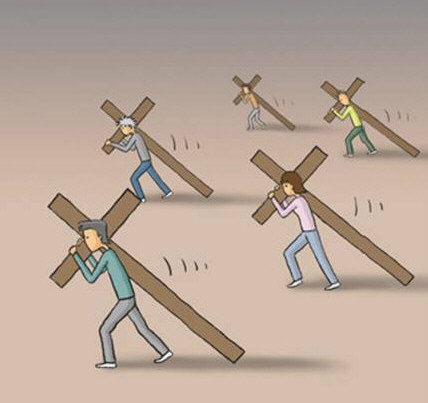
Photo © Russ Martin, AKA Steeple Chaser.

“Ah! how many and how grievous tribulations were suffered by the apostles, martyrs, confessors, virgins, and all the others, who were willing to follow Christ’s footsteps.” (IC 1,18,2) | “If anyone wishes to come after me, he must deny himself and take up his cross daily and follow me.” (Lk 9:23)

We begin chapter 18 (“Of the Examples of the Holy Fathers” [1,18]) of book one with this quote highlighting the life of extraordinary virtue that so many of our ancestors in the faith exhibited.  It is why reading the lives of the saints, and praying to these holy men and women, is so profitable to us.  A daunting example, but eminently possible, because they showed it could be done — entirely relying upon God’s grace for aid and perseverance — despite our fallen nature.

These persons we hold in esteem radically embraced what Jesus says in today’s Gospel (Lk 9:22-25) will surely come to His best friends: a daily cross.  For their deep and abiding faith, they lost their worldly lives (sometime literally) to gain eternal life.

We must be willing to do the same for the sake of the Kingdom of God.  Are we willing to be radical instead of conformist?  Are we open to be possessed by the Holy Spirit?  Do we embrace our daily challenges (big and small) that come our way?

In this Lenten season, let us be especially attuned to God with increased prayer, fasting, Bible study, and spiritual reading (especially the lives of the saints — find books on a favorite saint or read a compilation and come to Easter with a favorite saint).

Image result for take up your cross(Click here for the entire strip from which  this image was taken — excellent!)

“He who seeks many other things, and not solely God and the salvation of his soul, will find nothing but trouble and sorrow.” (IC 1,17,2) | “Even now, says the LORD, return to me with your whole heart, with fasting, and weeping, and mourning” (Jl 2:12)

Today we will have one last reflection based on Kempis’s chapter on the monastic life (1,17).  It seems a quote particularly worth considering as we once again begin Lent.  This penitential season is a particularly appropriate time to divest ourselves of the many worldly things we seek so that we can refocus on “God and the salvation of our soul.”  Is it not the case that we ultimately “find nothing but trouble and sorrow” when the world consumes us and causes us to neglect what is all=important: our eternal destiny?

Joel (2:12-18) is writing due to the people’s lack of awareness that the agricultural failure they are experiencing is because of their unfaithfulness; if they continue in their obstinance surely a worse fate will befall them.  The remedy: “fasting, weeping, and mourning” for their transgressions.

Like us, the Chosen People far too often became wrapped up in concerns of the flesh and idolatry.  While we may not run after foreign deities, we can easily fall prey to the temptation to treat material things as if they were gods, consuming our time, energy, and interest, but never fulfilling our deepest desires, all the while causing us to deviate from the “narrow path” (Mt 7:13-14)

So let us take this blessed season that the Church graciously gives us to fast from sin and weep and mourn for our past sins.  Let us focus on God and what is required of us for eternal salvation.  There is not a better way to do this than to consider deeply and frequently Jesus’ sacrifice for us for which we are preparing during Lent.  Paul provides a good approach for this period of the liturgical calendar and all of our days:

For I resolved to know nothing while I was with you except Jesus Christ, and him crucified. (1 Cor 2:2)

Image result for fast weep mourn


“Here no man can stand, unless he be ready with all his heart to humble himself, for the love of God.” (IC 1,17,3) | “If anyone wishes to be first, he shall be the last of all and the servant of all.” (Mk 9:35)

Kempis closes out his rich chapter on the monastic life (1,17) with the words above.  As we have seen with Kempis, the theme of humility (right relationship with God that leads to right relationship with others) is something that he, and thus we, must continue to come back to.

As does Jesus.  Today we hear in the Gospel (Mk 9:30-37) that Jesus demonstrates to the apostles the correct attitude they should have regarding their place in the Kingdom.  They were arguing who is the greatest among them.  Yet He shows them that the humility and openness of a child is to be their disposition.  (Mt 18:1-5 expands upon this idea and clarifies it.)

Humility makes us receptive to Jesus “for the love of God.”  And in so doing, we are better able to be truly agents of God’s love and mercy toward others whether in a monastic setting or not.  This is not easy for us with our fallen nature, but through prayer and perseverance, “for God all things are possible” (Mt 19:26).

Image result for let the children come to me

“You must learn to renounce your own will in many things, if you wish to keep peace and concord with others.” (IC 1,17,1) | “[W]here jealousy and selfish ambition exist, there is disorder and every foul practice.” (Jas 3:16)

Kempis opens his chapter on monastic life (1,17), that we have been going through the last several days, with the words above.   His words of wisdom, right off the top, have to do with the proper disposition of the religious in the monastery.

But, as we’ve said before, much of what Kempis writes applies to all persons.  Isn’t it the case in marriage, the workplace, and among friends, that we find it is better to go along, defer, rather than attempt to impose our desires on others?  Now, of course, this does not mean we are ever to follow in sin or shy away from fraternal correction when it is necessary to alert someone to the error of their ways in the moral life.  But, in those matters that are indifferent, might not we wish to please others by happily following their lead even if it is not nearly as pleasant for us, or maybe downright annoying?

“Selfish ambition” leads to “disorder and every foul practice,” James tells us (Jas 3:13-18).  How true.  Kempis: renouncing our will in favor of God and others leads to peace.  James: desiring our will about God’s and others’ leads to disorder.  There is no order in peace, no contentment in disorder.  Peace is a Godly thing (Is 9:6; by the way, don’t let Mt 10:34-36 fool you — the discord Jesus speaks of comes because of disobedience to the truth).  Disorder a demonic thing (Mt 13:24-30).  James comes around to the result of right living at the end of the reading, aligning perfectly with Kempis’s thought:

And the fruit of righteousness is sown in peace for those who cultivate peace.

Let’s give peace a chance.

Adoration.jpg

“You must be content to be made a fool for Christ, if you wish to lead a religious life.” (IC 1,17,1) | “If any one among you considers himself wise in this age, let him become a fool, so as to become wise. For the wisdom of this world is foolishness in the eyes of God” (1 Cor 3:18-19)

I think there is little doubt that Kempis (1,17) was thinking of Paul’s teaching when he wrote his line about the religious life (1 Cor 3:16-23 — see also chapters one and four of this letter as well as chapter eleven of the second letter; only to the people of Corinth does he give this teaching in Scripture) .  I suspect that most folks reading this are not specifically in the vocation of the priesthood or religious life, but we are all meant to live our lives in conforming with our religious beliefs and the (hopefully) well-formed conscience that should come along with that faith.

So we are all to become “fools for Christ.”  Worldly “wisdom” tells us that we should not only be okay with sin but that we should embrace it, even laud it.  And when we don’t?  We are laughed at, verbally abused, shunned, even prosecuted.  True wisdom, the first of the gifts of the Holy Spirit (see Is 11:2), acknowledges the truth (my favorite definition of humility).  Jesus is the Truth.  He established His Church to safeguard that truth (remember yesterday: Mt 16:18).  When we are steadfast in acknowledging, living, and spreading this message, we may be considered a fool in this world, but not in God’s eyes.  As Paul says, it is then that we truly become wise.

Priests and religious have a special challenge in that they have devoted their entire lives and work to advancing the Kingdom of God.  It should not be surprising, then, that they come in for special abuse.  But the call to evangelize is meant for all of us (Mt 28:19).  Are we willing to boldly be a fool for Christ?  Let us pray to the Holy Spirit for the true wisdom to do so.

A God´s Fool Sitting on the Snow (1885) by Vasily Surikov

“You came hither to serve, not to govern; know that you are called to suffer and to labor, not to pass your time in idleness and talk.” (IC 1,17,3) | “Do not lord it over those assigned to you, but be examples to the flock.” (1 Pt 5:3)

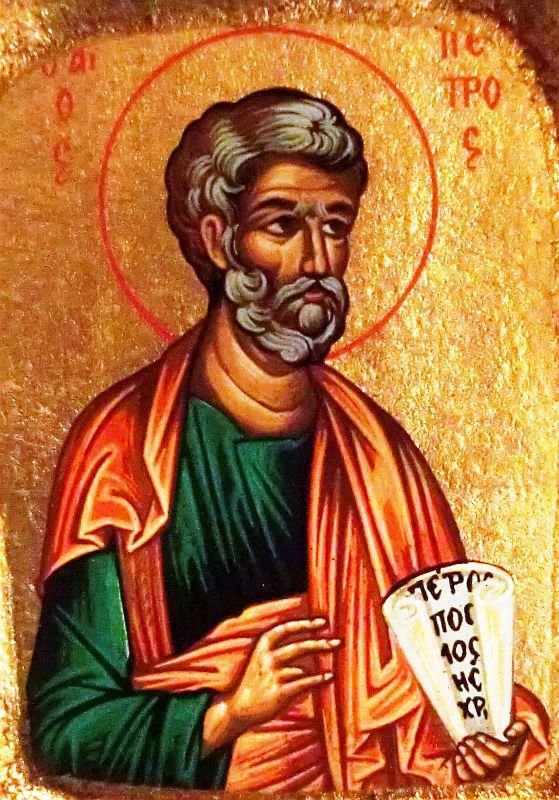
It is always a particularly blessed event when the readings from Kempis (1,17) and the day’s Scripture (1 Pt 5:1-4) align so perfectly.  On this Feast of the Chair of St. Peter, Apostle, we have such a happy occasion.

Kempis, in this chapter, deals with the religious life.  Peter, as part of the first ordination at the Last Supper, and now pope (see the note below), speaks to his presbyters (from which we get “priest”).  The first among the apostles exhorts them to imitate the Good Shepherd, Jesus, in tending their flocks well; key to this is humility and service.  They are not to “lord it over” their followers but to imitate the Lord in tending to the needs of the people or, as Kempis says, “to serve, not to govern.”

We are to be grateful to God for all the wonderful priests who selflessly serve the Church.  Let us support them by helping, volunteering, encouraging, and outdoing each other in generosity (see Rom 12:10).  Of course, most importantly, pray for your parish priests, and for all priests in the world (and those in purgatory), daily.  It is not an easy life but the benefits are out of this world, since those who are faithful in their duties, as Peter concludes, “will receive the unfading crown of glory” (v. 5).  May more men heed the call to this special vocation through our intercession, as Jesus requested: “The harvest is abundant but the laborers are few; so ask the master of the harvest to send out laborers for his harvest.” (Mt 9:37-38)

An important side note: today’s Gospel not only give us the institution of the papacy, but also of the Sacrament of Reconciliation.  Peter is the Rock on whom the Church (the only time Jesus says this word in the Gospels) is built.  Remember Matthew 16!

Let us pray in special way this day, but throughout the year, for the occupant of the Chair of Peter, that he will be strengthened in mind, body, and spirit by the Holy Ghost.  May he be an exemplar of his master and ours, Jesus the Christ.

Image result for peter as pope

“If you wish to act as you ought, and make due progress, look upon yourself as an exile and a pilgrim upon earth.” (IC 1,17,1) | “Whoever wishes to come after me must deny himself, take up his cross, and follow me. For whoever wishes to save his life will lose it, but whoever loses his life for my sake and that of the Gospel will save it.” (Mk 8:34-35)

We now come to Thomas à Kempis’s seventeenth chapter of the first book of The Imitation of Christ, entitled, “Of a Monastic Life” (1,17).  It may be tempting for us who do not live in a monastery or are not in the priesthood or the religious life, to bypass this chapter and others like it.  That would be a mistake.  There are profound lessons for those in all walks of life here, including: renouncing one’s own will, mortification of the passions, and the value of suffering and labor.

Jesus’ words in the Gospel (Mk 8:34-9:1) were addressed not only to His disciples, but also to the large crowd gathered to hear Him — this was meant for all of them to take to heart as it is likewise meant for everyone in all ages.  Not succumbing to the world and the culture, especially in these times, automatically entails carrying a cross.  Being counter-cultural often leads to scorn, derision, exclusion, and even threats (of course, countless thousands of Christians have paid the ultimate price for their steadfastness in the Faith — may it not come to that for us).  Yet, as Kempis says, no advancement is made without considering oneself “an exile and a pilgrim upon earth.”  Our true home, where the Lord “will wipe every tear from their eyes” (Rev 21:4), is in the mansion God has prepared for us (Jn 14:2).  When we convey the Truth, that is Jesus, who is the Word, and are persecuted for it, we are to “Rejoice and be glad, for your reward will be great in heaven” (Mt 5:12).

Compromising the Gospel is not an option for the Christian.  Our call, our duty, is “living the truth in love” (Eph 4:15).  Let us never miss the opportunity to share the reason for our hope (1 Pt 3:15).

Finally, a quick note on the first reading from James.  This passage is the primary defense for Catholics against the doctrine of sola fide that Martin Luther devised some five hundred years ago.  He pointed to Paul’s letter to the Romans (specifically 3:28) to back his argument; in fact, Paul does not even write the words “faith alone.”  Those words, back to back, are only found in James (2:24), whose words refute this false teaching (no wonder Luther wanted to “throw Jimmy into the stove”).  All Catholics should be aware of where to find it, or at least know that this defense exists.

Isn’t it wonderful that James and Kempis agree with Jesus that faith requires action?  Who are we to argue with them?

“We are willing that others should be bound up by laws, and yet we cannot suffer ourselves to be constrained. Thus it is evident how seldom we weigh our neighbor in the same balance with ourselves.” (IC 1,16,3) | “[I]f you fulfill the royal law according to the Scripture, You shall love your neighbor as yourself, you are doing well. But if you show partiality, you commit sin, and are convicted by the law as transgressors.” (Jas 2:8-9)

Kempis’s words remind us of the old saying, “Do as I say, not as I do.”  Wouldn’t life be so much easier if everyone agreed with me and did as I desired them to do?  Don’t they know that I know best?  And when things don’t fall precisely in line for me, then I might spout Jean-Paul Sartre famous and oft-quoted line, “Hell is other people.

Kempis, in this chapter (1,16), tells us we gain merit by our patience and exercise of virtue in our challenges with others.  No, it is not hell, but our duty, our command, to love others and bring a glimpse of the kingdom of heaven to them with the goal of bringing them to eternal glory with us.  Both Kempis and James (2:1-9) speak of the law.  We are constrained by the law…of love.  Being transgressors of this law, means conviction and punishment.

The tie-in of the two excerpts is clear: Kempis speaks of dealing with the “defects” of others.  James speaks of partiality, especially regarding having a dim view of the poor.  Aren’t those of a lesser stature in society an easy target for our ire?  Poor breeding?  From the other side of the tracks?  Lacking ambition?  Lazy?  Stupid?

Is this a Christian approach?  Is this showing love of neighbor?  Is this not making judgments, often with little information and based on stereotypes?

May such talk and attitudes never be found among us!  Remember, there, but for the grace of God, go I.

Image result for rich man and poor man bible