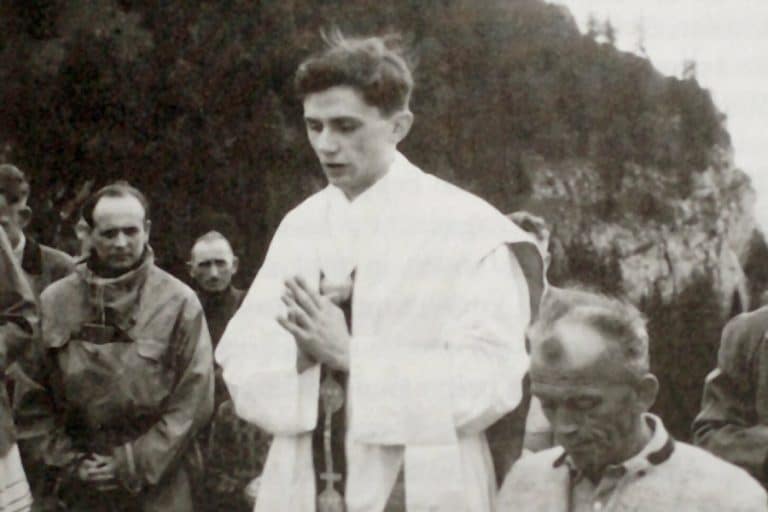
Today is the seventieth(!) anniversary of the priestly ordination of Pope Emeritus Benedict XVI (Joseph Ratzinger). It seems providential that his ordination was on the Solemnity of Saints Peter and Paul, Apostles (find here the beautiful work of Michelangelo honoring both men in the Pauline Chapel next to the Sistine Chapel [backstory]) since he was a successor of Peter (as pope) and one of the greatest biblical theologians since Paul. Both, certainly, have guided and assisted in his long ministry.
According to the liturgical practice of that time, these words conferred on the newly-ordained priests the authority to forgive sins. “No longer servants, but friends”: at that moment I knew deep down that these words were no mere formality, nor were they simply a quotation from Scripture. I knew that, at that moment, the Lord himself was speaking to me in a very personal way. In baptism and confirmation he had already drawn us close to him, he had already received us into God’s family. But what was taking place now was something greater still. He calls me his friend. He welcomes me into the circle of those he had spoken to in the Upper Room, into the circle of those whom he knows in a very special way, and who thereby come to know him in a very special way. He grants me the almost frightening faculty to do what only he, the Son of God, can legitimately say and do: I forgive you your sins. He wants me – with his authority – to be able to speak, in his name (“I” forgive), words that are not merely words, but an action, changing something at the deepest level of being. I know that behind these words lies his suffering for us and on account of us. I know that forgiveness comes at a price: in his Passion he went deep down into the sordid darkness of our sins. He went down into the night of our guilt, for only thus can it be transformed. And by giving me authority to forgive sins, he lets me look down into the abyss of man, into the immensity of his suffering for us men, and this enables me to sense the immensity of his love. He confides in me: “No longer servants, but friends”. He entrusts to me the words of consecration in the Eucharist. He trusts me to proclaim his word, to explain it aright and to bring it to the people of today. He entrusts himself to me. “You are no longer servants, but friends”: these words bring great inner joy, but at the same time, they are so awe-inspiring that one can feel daunted as the decades go by amid so many experiences of one’s own frailty and his inexhaustible goodness.
One other quote from Benedict, from the same book:
[A]t the moment when the old archbishop laid his hands on me, a bird, a lark perhaps, rose from the old cathedral high altar and trilled a little song of joy. That was like an encouragement from above. It is good. You are doing the right thing.
Peter Seewald (trans. Dinah Livingstone), Benedict XVI: A Life (Vol. 1), (London: Bloomsbury Continuum, 2020), 247.
Yes, you did the right thing, Fr. Benedict, and you still are.
Here are a few other places to read and see more about his ordination:
Father Joseph Ratzinger, chaplain in the parish of St. Martin in the Moosach district of Munich, celebrates Mass in a mountainous area near Ruhpolding in July 1951 after having been ordained a priest June 29, 1951. (CNS photo/KNA)
No pope has lived longer than him, yet still I exclaim, “Long live Benedict!”
God did not make death, nor does he rejoice in the destruction of the living. … But by the envy of the devil, death entered the world, and they who belong to his company experience it.
Wis 1:13, 2:24
A great pro-life message from the aptly titled Book of Wisdom. God made man to live in harmony with Himself and with others. Through the temptation of the devil to pride, our first parents fell (Gen 3) and we inherited the effects of their decision.
Well, clearly, Satan is still at work today. And “his company” is working overtime to destroy innocent life. Make no mistake, our culture of death is the work of the Evil One with plenty of willing associates on this planet in his organization.
He was a murderer from the beginning and does not stand in truth, because there is no truth in him. When he tells a lie, he speaks in character, because he is a liar and the father of lies.
Jn 8:44b
This liar and murderer has always envied God and His human creation and he uses some of these same humans to advance his cause. Beelzebub is laughing at the defiance of human beings, especially those who call themselves Christians, toward God. But remember,
it is appointed that human beings die once, and after this the judgment
The passage proclaimed today about the raising of Jairus’ daughter “interrupted” by the healing of the woman with the flow of blood is so rich it is hard to know where to begin. I will offer some thoughts, but I encourage you to dive in yourself and take a slow stroll through these verdant pastures (some Bible study aids if you’d like).
Note that Jairus is mentioned by name. I always take notice when a figure appearing only in one episode in Scripture is actually named. For one, this lends authenticity to the account — here is someone that the first hearers of the Gospel could have spoken to directly or, if he was no longer living then, to his family or acquaintances (and most scholars believe that Mark was the first Gospel account to be written, although there is growing dispute over this). As a “synagogue official” he had status and was prominent, at least in his town (likely Capernaum, additionally significant as Jesus’ base of operations during His early public ministry, which was on the western shore of the Sea of Galilee, across from Gerasa from where Jesus just came [per Mt 9:1]).
Mary Healy makes another point about Jairus: “This man’s humble posture…is remarkable in the view of the fact that Jesus’ last visit to a synagogue ended with a plot to kill him (Mark 3:6)” (The Gospel of Mark[Catholic Commentary on Sacred Scripture] [Grand Rapids, MI: Baker Academic, 2008], 105). Not caring what anyone thinks, he prostrates himself before this prominent healer, desperate to do anything to save his daughter who is at the point of death.
Jesus’ interrupts this episode to deal with a woman with a hemorrhage. As he walks with Jairus and the rest of the crowd, this long-suffering lady touches Jesus’ clothing (her ritual impurity is eliminated by Jesus’ purity) which immediately has Jesus looking around for who did it. She (notice she goes unnamed – maybe because she represents all of us?; later legend has her as the Veronica of the Stations of the Cross) comes forward, “in fear and trembling,” now healed. Why does Jesus look for her? I believe because He needed to deliver a message: “Daughter, your faith has saved you.” This message was for her benefit, to be sure, but it was also for the entire crowd and for everyone who has ever heard or read this passage. It is faith that saves. It is not a magic trick that causes healing and He does not due it to impress. Remember how Jesus could not heal in His hometown: “And he did not work many mighty deeds there because of their lack of faith” (Mt 13:58)? Fear and trembling are out; faith is in. Then, like her, we can “go in peace.”
Remember “daughter” and note the length of her illness: twelve years.
Now, back to our regularly scheduled program. Immediately after this healing, news comes that the little girl has died. Everyone is ready to give up, but not Jesus. He disregards the message and again speaks of having faith. I can’t help but be reminded of the Lazarus story (Jn 11:1-44). There, upon hearing of His friend’s serious illness, Jesus purposely delays His return and then upon arriving at Lazarus’s tomb says, “I am glad for you that I was not there, that you may believe” (v. 15). Here, also, we have Jesus demanding faith when apparently all others have given up. He then encounters not mere skepticism, but actually ridicule, for speaking of the girl’s condition as “sleeping.” He puts all the doubters out and then raises up the girl (of twelve). Then He tells them to give her something to eat (she is well and she is not a ghost!) and to not let anyone know of this — I wonder how that turned out.
As an aside, I love the imagery of Jesus “pu[ting] them all out.” Do you ever wonder what that looked like? Was it as stern verbal rebuke from our Lord? Maybe just a look? Or opening the door and waving them out? Could it have been a gentle, but firm, escort? If there was anytime that the Messiah was annoyed, and He had plenty of situations in which that could have been the case, it was this one. I’ll bet the room emptied out in short order. (Although a good point is made by Michael Pakaluk: “It is not clear they even knew who he was. A man walks in, apparently without good information, and says something which seems foolish [The Memoirs of St. Peter (Washington, D.C.: Regnery Gateway, 2019), 93]. Maybe I should be more sympathetic.
Now, regarding “daughter” coming up in both situations, this certainly serves to tie the two stories together (Leroy Huizenga writes, “Right when Jesus is speaking words of benediction to the woman, calling her “daughter,” the group informs Jairus his daughter is dead, and the reader is to imagine the two utterances of “daughter” occurring at the exact same time. [Loosing the Lion (Steubenville, OH: Emmaus Road, 2017],152), just as the “twelve years” does (more on that next). Our deacon said at Mass today that the scene with the woman was the only time Jesus referred to someone as “daughter.” Then there is the daughter of Jairus. It seems to me that this clearly shows that, at any age, both of the afflicted were children of God — He cares for us from the moment we come into existence. He hears our prayers and the intercessory prayers of our loved ones. No one, regardless of age or circumstance, escapes the Almighty’s loving care and compassion. All may ask for healing, all may receive healing.
As for the twelve years brought to our attention in both cases, this also serves to tie the stores together. (Here, I will again remind readers of the value of searching out instances of a number throughout Scripture to potentially gain additional insights into the passage in question.) The twelve year mark brings a drastic change in both lives. For one, a return to full health, and for the other, at that precise moment, an early death. What one other significant event has ties with twelve years in all of the Bible? The only insight we have into Jesus’ formative years: the finding in the Temple. Might Jesus have been thinking about His own parents’ concern and worry for His well-being just as Jairus fervently expressed for his little girl? Might that not have pulled at His heartstrings all the more? What joy He must have felt when the girl arose and fell into the arms of her father! I can certainly imagine Jesus giving a big hug to His parents as they left the Temple together as a family.
Let me close with these words, again from Huizenga (page 155):
The two stories are tied tightly together, then. Both Jairus and the woman are desperate, coming to Jesus in the face of impossible odds, throwing themselves at his feet. The sandwiching of these stories involves deep dramatic effect, but Mark has done more. He has stitched the stories together. Each female is called “daughter.” Each has ritual impurity: menstrual impurity in one case, corpse impurity in the other. The girl is twelve years old, and the woman has suffered twelve years. Might the same demon be at the root of the suffering of each? And might “twelve” — the number of the Apostles — suggest that the Church is the mediator of healing? And both women are restored to fullness of life by Jesus’s power, which conquers here the power or death and its demonic source, the devil.
For wonderful insights into this passage, I urge you to listen to Bp Barron’s homily. His exposition of the “interruption” and his insightful speculation as to the disposition of both main characters is not to be missed.
Allow a bit of a segue here, please. The hemorrhaging “woman actually touched Jesus…not only with her hand but with the faith she bore in her heart….When we receive Jesus in the Holy Eucharist, we obtain this physical contact through the sacramental species. We too need to enliven our faith if these encounters with our Lord are to redound to our salvation” (The Navarre Bible: St Mark [Dublin: Four Courts Press, 1992], 102).
A fine piece by the intellectual Robert Royal first encouraging, then discouraging, on what stands to happen in our land as a result of the bishops’ forthcoming document on the Eucharist.
Pray fervently for the bishops. As for me, if there is one thing I would tell them regarding this matter (although it applies to all their decisions impacting their flock): Remember, one day you will be standing alone in front of the Lord to give an account. The Catechism of the Catholic Church states:
Bishops, with priests as co-workers, have as their first task “to preach the Gospel of God to all men,” in keeping with the Lord’s command.They are “heralds of faith, who draw new disciples to Christ; they are authentic teachers” of the apostolic faith “endowed with the authority of Christ.”
CCC 888
And what does Scripture say about teachers?
Not many of you should become teachers, my brothers, for you realize that we will be judged more strictly,
James 3:1
WOULDN’T IT BE NICE
I’ve been on a bit of a Beach Boys kick since watching a short interview with Brian Wilson. A version of Wouldn’t It Be Nice, a cappella, allows the group’s talent to shine even more brightly. Brian Wilson wrote this at age 23 (the members ages ranged from 19 to 25 here but they actually put out their first single five years earlier!). How can it not brighten one’s day?
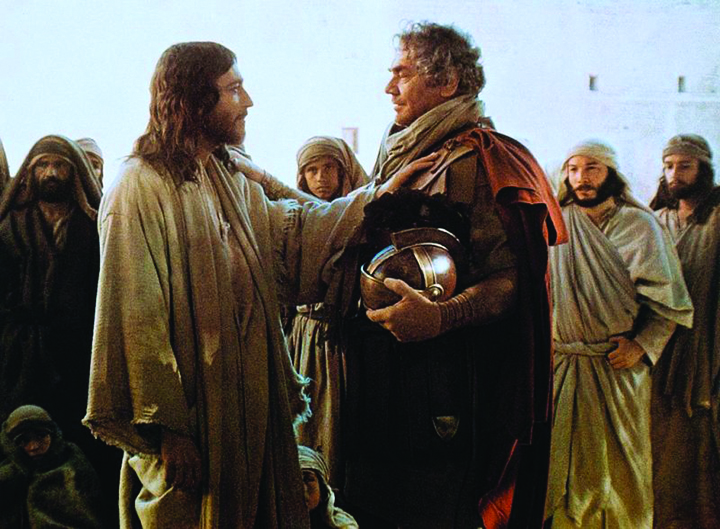
One of my favorite Gospel passages was proclaimed at today’s morning Mass. It is the very familiar episode of Jesus’ encounter with the centurion whose servant is very ill. I have written about this before (I encourage you to follow the links and watch the video).
Just one thing to add, that came to me upon hearing it this morning. That is, that I never before connected this passage with the verse that has been my tagline for many years now, Luke 17:10 (also, the inspiration for the name of this blog). Now, I’m quite certain that the centurion did not have the same sentiment as the Luke passage, but the Roman’s approach adds to our appreciation of unworthiness. None of us are worthy to have the Lord come to us (particularly in Holy Communion, immediately before which we now [since 2010] recite this soldier’s words verbatim save for one word). But with the Lord’s word, we become worthy. It is important to remember that it is God’s initiative, not ours, in providing us His Body and Blood.
This is why I cringe when those who don’t know better, or are simply careless, including Catholics, speak of “taking” Communion. No. We receive Communion as an undeserved gift of the Church, the Body of Christ. For those who are in the state of mortal sin, the word of the Lord must first come through the ministry of the ordained presbyterate in which we hear the priest pronounce the words of absolution, in persona Christi, after a good Confession.
(For an interesting little Bible study, contrast this passage with this episode as relayed by Luke [7:1-10].)
One more past post, one of my favorites, regarding Jesus reaction to this man who approached Him.
YOUTUBE FUN
I have enjoyed watching old episodes of Password (the original series) on YouTube. I watched a whole week’s worth from 1966 in one sitting, with Peter Lawford (an amazing player) and Barbara Eden (still going strong today just a few weeks shy of 90). A congenial host, great guests, fun banter, and a neat concept make for good watching.
Also, the Archive of American Television is an ongoing project capturing entertainers of many stripes speaking of their careers providing really cool stories and interesting insights, particularly into their past series and co-stars. It’s wonderful that they capture them later in life before they pass away, as a number of those interviewed already have.
Enter through the narrow gate; for the gate is wide and the road broad that leads to destruction, and those who enter through it are many. How narrow the gate and constricted the road that leads to life. And those who find it are few.
Mt 7:13-14
These words of Jesus, in the last chapter of the Sermon on the Mount, should give us pause, to say the least. The Lord does not mince words here. He asks us to reform our lives constantly. There are many temptations to take us off the straight and narrow path that leads to life. We must keep our eyes on the prize (remember Mt 5:29).
God our savior…wills everyone to be saved and to come to knowledge of the truth.
1 Tim 2:4
How does this square with the verses at top? Free will is the answer — we are able to accept or reject the Almighty. But, God gives the baptized access to graces that He is most willing to pour out on us if only we are receptive. As for the non-Christian, God can work out their salvation as well, although He calls us to evangelize to make that process easier (see CCC 847 and Dominus Iesus, 22).
As far as the ongoing controversy, which has reemerged with some intensity, regarding how many will be saved, or even the possibility that all are ultimately saved, I would point you to two videos and at least one related book:
The bottom line, I think both men would agree on, regarding universal salvation: Don’t count on it.
(THOMAS) MORE IS MORE
Today is the feast day of St. Thomas More and St. John Fisher, two brave men, who stood, essentially alone, in the face of the tyranny of King Henry VIII who had the audacity to declare himself head of the church in England. For their bravery, and for the cause of religious freedom, both paid with their heads. We need their courage today..
For Lent, I read More’s last book, The Sadness of Christ(my review), written from imprisonment in the Tower of London. Good reading any time of year.
CLEAN IS FUNNY
For some uproarious clean adult humor, check out Ryan Hamilton (a YouTube clip). I just got a note today from him that he is back on tour. Very funny, I laughed a lot at his Netflix Original special, Happy Face, that we happily came across in the midst of the pandemic.
Today, I have a bunch of stuff I’d like to share. So, a few quick hits that are kind of all over the place.
TODAY’S FIRST READING
What’s in store for an apostle:
I am still more, with far greater labors, far more imprisonments, far worse beatings, and numerous brushes with death. Five times at the hands of the Jews I received forty lashes minus one. Three times I was beaten with rods, once I was stoned, three times I was shipwrecked, I passed a night and a day on the deep; on frequent journeys, in dangers from rivers, dangers from robbers, dangers from my own race, dangers from Gentiles, dangers in the city, dangers in the wilderness, dangers at sea, dangers among false brothers; in toil and hardship, through many sleepless nights, through hunger and thirst, through frequent fastings, through cold and exposure. And apart from these things, there is the daily pressure upon me of my anxiety for all the churches.
2 Cor 11:23b-28
And we think we have it bad when we experience a little inconvenience for the Faith?
(Today’s St. Paul Center reflection does an excellent job of framing this passage and elaborating on it: https://youtu.be/UXfLjlrAxO4.)
FAIRFIELD (PA) CARMELITES
As I recall, I heard about the Carmel of Jesus, Mary, & Joseph on a Catholic radio show. I was so impressed with the mission of these good sisters that we have begun to support their monastery financially.
Today I received my first newsletter from them that informed me of their YouTube channel. This latest reflection (9 minutes) from one of the sisters is getting real.
AQUILINA ON “THE MOTHERS OF THE CHURCH”
By happenstance, I came across a video on my laptop of Mike Aquilina giving a talk to my parish in Chicago on “The Mothers of the Church” back in 2012 so I thought I would post it to YouTube (with permission) so everyone could benefit. Excellent, as usual, and particularly well received, as I recall. Watch Part I and Part II.
USE WORDS!
I heard another homily today in which St. Francis of Assisi is quoted as exclaiming: “Preach the Gospel at all times; when necessary, use words.” I understand the sentiment, if the speaker means to say that a person should “practice what he preaches” or should not have the attitude of “do as I say, don’t do as I do.” Of course we should strive to live out the fullness of the Catholic Faith in our behavior, bringing the latter into closer and closer conformity with the former. Additionally, it is certainly the case that grave scandal can — and often does — occur when those who are known for their association with Christianity fail miserably and sometimes criminally (witness the sex abuse scandal as the most abhorrent in recent years).
But if this pithy little saying is used as an excuse to not evangelize, not catechize, not make one uncomfortable, not learn the faith, not lose friends and colleagues, then it is way off base. Beside, FRANCIS NEVER SAID IT! His reliquaries should be spinning practically constantly considering how often this phrase is tossed around. Francis was bold in speech, as well as action, and we should be as well.
Let’s retire this proposition once and for all and give St. Francis and all the faithful a break.
IN THE WAKE OF THE VIRUS
I just received notice that a free e-book from Word on Fire is now available:
I have already recommend it to several friends in parish administration, including a pastor. You may wish to do the same.
ESTHER
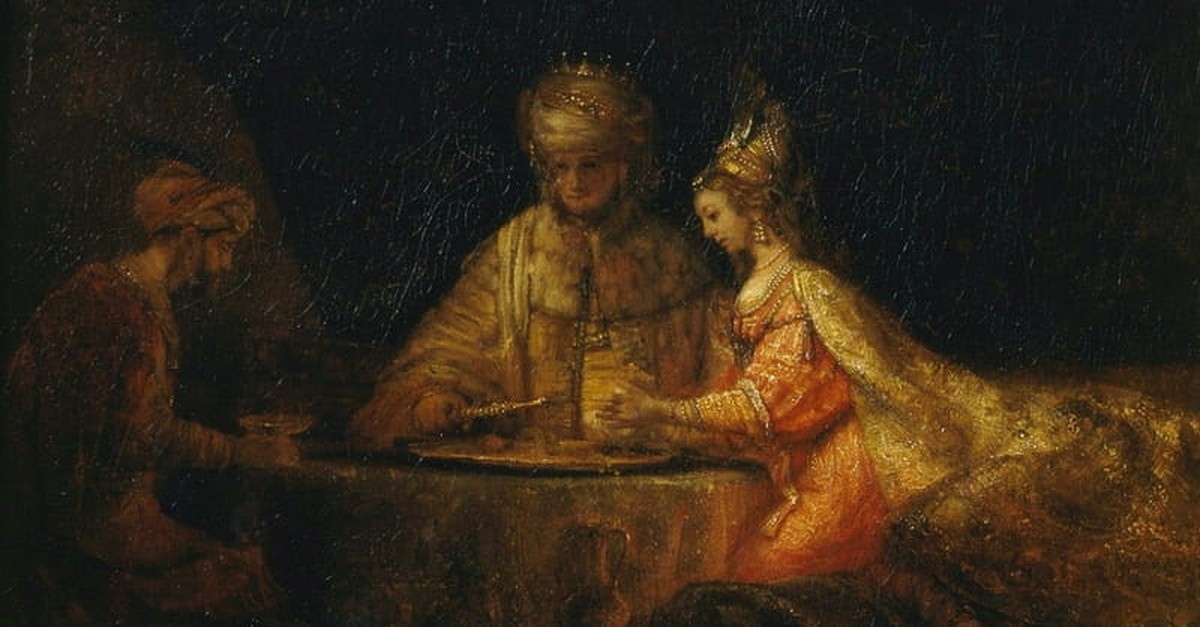
I just finished (re-)reading the Book of Esther. What a fantastic story. It is debated whether it is actually historical or partially historical. No matter. It is an absolute page turner. I don’t know of another entire book in the Old Testament that matches Esther for interest and engagement, as a complete story, than this book (of course, there are many wonderful episodes in the Hebrew Scriptures — but an entire book with one cohesive tale?). Very little research brought to my attention this 1999 Hollywood film on the subject. I look forward to watching it (I hope it does the Bible justice).
MORE DESERT
A voice cries: “In the wilderness prepare the way of the LORD, make straight in the desert a highway for our God.”
Is 40:3
Continuing my exploration of the “desert experience,” we have here one of Isaiah’s more famous lines (made so, in particular because of John the Baptist). For our purposes, though, the lesson I take away is that the desert experience is meant to be an opportunity to make straight our path, to get us back on the straight and narrow road that leads to life eternal.
Maybe the time of challenge is of our doing due to sin. Maybe it is given to us to help us to straighten out our priorities. Maybe it’s just a time to think and pray. No matter what the reason, the key for us is not to fall into the extremes of either deep resentment or abject resignation. Yes, we are to resign ourselves to God’s will; but we are to use the time and circumstances wisely: How can I give God the glory in these circumstances? What do I need to do to “straighten up” before the Lord? What virtues can I build up and what vices can I work on eliminating in these trying times?
NEW BOOKS
A nice little care package came from Ignatius Press today. Three books I looked forward to receiving:
I’m particularly excited about the last one. This completes the quartet of books on Matthew clocking in at around 2,700 pages in total. A phenomenal work. If you love Matthew and have the means to grab these four volumes, you will have many weeks of pleasurable and informative reading, as well as a great resource for Bible study.
ONE MORE BOOK
I was inspired by some other reading to purchase a book on early heavier than air flight. I am particularly interested in the first fifteen years (1903-1918) of such planes. I found what appears to be the perfect book for this subject.
by purity, knowledge, patience, kindness, in the Holy Spirit, in unfeigned love, in truthful speech, in the power of God; with weapons of righteousness at the right and at the left; through glory and dishonor, insult and praise
2 Cor 6:6-8a
I have often quoted Jesus when writing of the challenges of proclaiming the Faith or even simply living it out day to day:
Amen, amen, I say to you, no slave is greater than his master nor any messenger greater than the one who sent him. If you understand this, blessed are you if you do it.
Jn 13:16-17
f Jesus endured for us all that Paul lists as part and parcel of Christian ministry, we should not be surprised that we, too, will be asked to put up with some blow-back (likely not to the extent Jesus did — for now at least) for doing the same. Maybe the most difficult part of all this is not returning the vitriol in kind, but simply remaining pure, patient, and kind, steadfast in “truthful speech.” We can only do this in the Holy Spirit, in the power of God.
Fear is useless; what is needed is trust.
Luke 8:50; Mark 5:36
JESUS DESERTED
As I continue to ponder “desert experiences,” none in the New Testament stands out more prominently than the forty days our Lord spent in the wilderness preparing for His public ministry and ultimately His Passion and death (Mt 4:1-11; Lk 4:1-13). In attempting to be a bit clever with the section heading I actually stumbled upon something I had not considered before. Jesus began His public ministry alone and ended it, all but abandoned, on the Cross. (We could also add, as a midpoint, the nearly complete dispersal of His followers when proclaiming the truth of the Eucharist in John 6.)
There are many ways to approach the three temptations of the devil with which he sought to entice Jesus to sin (this explanation of the whole episode is very good; this analytical approach comes from a very helpful website). For our purposes, I would simply focus on how temptations to sin can become acute when a person is in a vulnerable place physically, mentally, psychologically, or spiritually. Jesus stayed strong by trusting the Father. Luke tells us that He went into the desert “[f]illed with the Holy Spirit” (Lk 4:1). This is our recipe to combat the Evil One: Trust God and eliminate sin from our lives. Jesus, like His mother before Him, was filled with the Holy Spirit — there was no room for sin in their souls. This is what we must strive for through prayer, confession, penance, and mortification. The less of an opening we give to the Tempter, the greater the possibility of being steadfast and remaining so. We cannot let our guard down because, even with Jesus, the devil “departed from him until an opportune time” (Lk 4:13b). Satan is the great exploiter of our vulnerabilities; we must always be prepared for battle.
THE PRAYING SINNER
For quite some time now I have planned to read daily (and rarely miss doing so) something about St. Dominic, the Dominicans, or a spiritual work by a Dominican since I hope to become a Lay Dominican some day. I am currently working through Fr. Paul Hinnebusch’s, Prayer, the Search for Authenticity (long out of print). It is the first of a trilogy of works based on lectures on contemporary spirituality he gave in 1968 in the Graduate School of Theology, The University of Notre Dame. His goal: “to work towards an authentic spirituality for our time” (from the preface of the third volume,Secular Holiness: Spirituality for Contemporary Man). (The second volume is entitled, Dynamic Contemplation: Inner Life for Modern Man; I plan to work through all three books.)
Anyway, it has been a bit of a slog at times, but one of the last few chapters, that I read today, held my attention and struck a chord. It is entitled, “The Compatibility of Authentic Prayer and Human Sinfulness.” I have often heard from folks who don’t go to Mass or have even left the Church because of all the “hypocrites” there. That is an accusation from the outside. There are also folks who believe they have deceived themselves because their prayer seems to do them no good. This is an accusation from the inside. This short chapter works through both of these perspectives, giving hope. I have attached it here. But one paragraph to entice you to read more:
To conclude that the prayer of an imperfect man is self-deception, or to call a prayerful man a hypocrite just because in weakness he occasionally falls into sin, is to insult the Holy Spirit of grace and the God of love. For prayer is a gift of God’s grace, and it is God who takes the initiative in prayer, offering the grace of prayer even to sinners and to the imperfect. Prayer is one of the best remedies for sinfulness and imperfection, and it is not hypocrisy for a sinner to pray. The grace of prayer is a call to conversion, an invitation to turn more deeply to God in love and to turn away from the ways of sin. It is quite normal, then, that a person, though still very imperfect in love of neighbor.
Paul Hinnebusch, O.P., Prayer, the Search for Authenticity (New York, Sheed & Ward, 1969), 238-239.
Just heard about this today. Might be worth bookmarking this one, especially on your phone.
FLAG DAY
There is much controversy surrounding certain flags in vogue these days and their appropriateness to be flown at certain buildings or of being displayed in certain places. One I would hope that no person living in our great land would object to (even though I realize that some do) is Old Glory. The story of Flag Day can be found here. One excerpt:
On June 14, 1777, the Second Continental Congress took a break from writing the Articles of Confederation and passed a resolution stating that “the flag of the United States be 13 stripes, alternate red and white,” and that “the union be 13 stars, white in a blue field, representing a new constellation.”
For an excellent, informative dive into today’s first reading (Ez 17:22-24), and its importance for truly appreciating the subsequent Gospel (Mk 4:26-34), one would be hard pressed to do better than “The Last King Standing” — Bp. Barron’s Sunday Sermon that was posted today. One of St. Augustine’s most famous quotes is, “The New Testament lies hidden in the Old and the Old Testament is unveiled in the New” (read more here). Few are better at employing this principle than the good bishop.
I will make some short comments on the psalm (Ps 92:2-3, 13-14, 15-16) and second reading (2 Cor 5:6-10), though. Yes, it is good to give thanks to the Lord, as the psalmist exclaims. I will be the first to admit that it is something I often forget to do. Asking for stuff? I’m good at that. Complaining about everything? Ditto. But just showing simple appreciation? Too often, this does not even come to mind. Of course, it is “right and just,” as we say at Mass, to praise God — it is due Him in justice. But note the list of benefits to us described by the psalmist: flourishing, growth, bearing fruit, vigor, and sturdiness. See, whatever we give to God we get back a hundred-fold. Praise God!
The last verse of the second reading makes me shudder:
For we must all appear before the judgment seat of Christ, so that each may receive recompense, according to what he did in the body, whether good or evil.
2 Cor 5:10
The Lord is a God of mercy, and we don’t underestimate that (just read St. Faustina). But he is also a God of justice. He perfectly blends the two. So, we don’t presume heaven or hell for ourselves or for anyone else (unless the Church canonizes someone). This is one of many instances when Jesus speaks of the importance of our behavior in this life in determining are eternal fate in the next life. We must pay heed. Confession, penance, and reform are needed. But it all begins with prayer since we do not have the means to go it alone. All is grace.
PRIDE
We’ve been hearing a lot about “pride” the last two weeks. I thought it worthwhile to see what Scripture says about this matter. I again use my favorite search engine to find references to this word. I encourage you to take a deeper dive, but here I list a few stand out verses:
[17] But if you will not listen, my soul will weep in secret for your pride; my eyes will weep bitterly and run down with tears, because the LORD’s flock has been taken captive.
[9] Therefore, as I live,” says the LORD of hosts, the God of Israel, “Moab shall become like Sodom, and the Ammonites like Gomor’rah, a land possessed by nettles and salt pits, and a waste for ever. The remnant of my people shall plunder them, and the survivors of my nation shall possess them.”
[10] This shall be their lot in return for their pride, because they scoffed and boasted against the people of the LORD of hosts.
[12] The beginning of man’s pride is to depart from the Lord; his heart has forsaken his Maker.
[13] For the beginning of pride is sin, and the man who clings to it pours out abominations. Therefore the Lord brought upon them extraordinary afflictions, and destroyed them utterly.
The overwhelming number of references to pride in Scripture are its problematic nature. Pride in man is always a problem, though. Humility counters this vice. Just click here for overwhelming proof.
I have been remiss in not providing a link to the channel that contains all of the Zoom talks from the Spring Speaker Series my high school hosted. Find here excellent presentations by Rachel Bulman, Katrenia Reeves-Jackman, Daniel Boyd, Michael Dauphinais, and Mike Aquilina. Enjoy!
NEW BOOKS
As often as I say I need to stop buying books, I run across another I “must” have. It is true that I have substantially reduced my personal library in recent years, and I am better about continuing the weening process, but I do still pick up certain works I can’t resist.
What Is Redemption? How Christ’s Suffering Saves Usby Philippe de la Trinité. Scott Hahn says this is “the book that made me start thinking like a Catholic.” The podcast in which Dr. Hahn reads his Foreword to this new edition is worth a listen and may well compel you to pick up this work yourself. In it he refers to the 150 volume 20th Century Encyclopedia of Catholicism. I have that! And this gem has been in there all along.
(By the way, I want to encourage you again to download the St. Paul Center app (at the very bottom right of the home page) to your phone if you have not already. Free and chock full of outstanding resources.)
I’m looking forward to diving into all of them.
So many books, so little time.
AND ONE MORE BOOK
Victor Davis Hanson is an amazing mind and a brilliant military historian. Having come across a talk promoting his book, titled: The Second World Wars: How the First Global Conflict was Fought and Won, I was compelled to purchase it. I’m not quite a third of the way through it, but I can already recommend it highly to anyone interested in military history, especially WWII. If nothing else, at least check out the talk (there are many others by him on the same topic on YouTube).
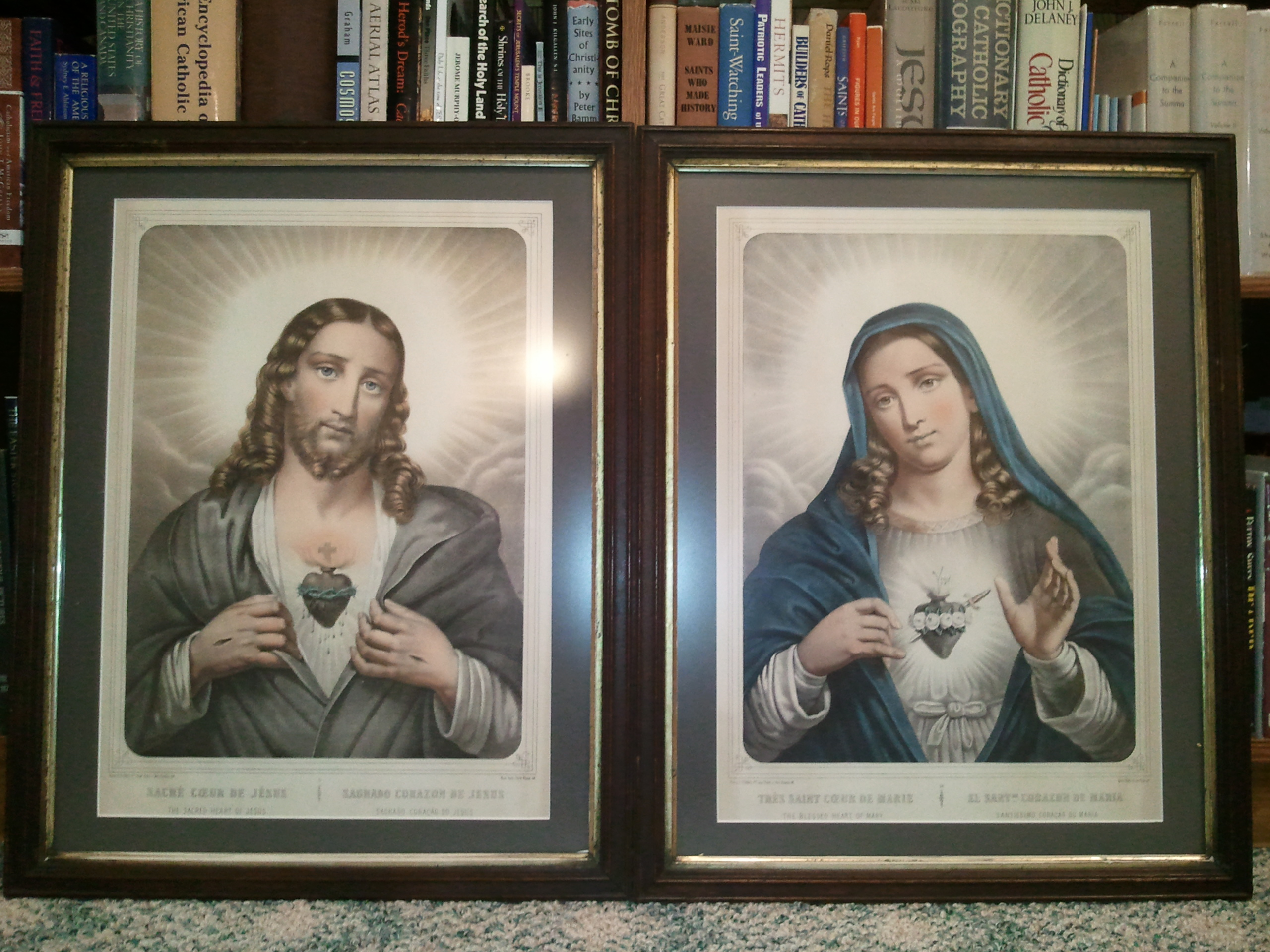
It is fitting that the day after commemorating and contemplating the wonders of Jesus’ Sacred Heart that we glory in the heart that kept the God-Man alive in the womb and that He must have often leaned on in His formative years. Thus we have the Memorial of the Immaculate Heart of Mary.
…and his mother kept all these things in her heart.
Lk 2:51b
The Gospel for today (Lk 2:41-51) appropriately mentions the Virgin Mary’s heart. The passage gives us the only glimpse of Jesus “hidden life” (that is, the time between His infancy and the beginning of His public ministry). In it we have the whole range of emotions for a parent: sorrow in losing a child, anxiety in searching for him, joy in finally finding him, and perplexity in the explanation as to why the whole thing happened in the first place. Jesus’ response, “Did you not know that I must be in my Father’s house?,” gives her another of many moments throughout her life, undoubtedly, to contemplate her Son and His mission.
Mary and Joseph realized that his reply contained a deeper meaning which they did not grasp. They grew to understand it as the life of their Child unfolded. Mary’s and Joseph’s faith and their reverence towards the Child led them not to ask any further questions but to reflect on Jesus’ words and behaviour…
Faculty of Theology of the University of Navarre, The Navarre Bible: St. Luke (Dublin: Four Courts Press, 1988), 62-63.
Consider how many opportunities Mary had for reflection. She is prominent in Scripture in all the key moments of Jesus’ life: His conception, birth, presentation, beginning of His public ministry (at Cana), and passion and death. We know also that she was involved in His public ministry (see here). And I am thoroughly convinced that she was the first person to whom Jesus appeared at the Resurrection, although the Gospels do not record such an event. Her heart must have been full to overflowing at the wonders God wrought through His Son and hers.
This is why we are wise to take refuge in Mary’s immaculate heart — immaculate because it was never touched by sin from the moment of her conception until she was taken up to heaven body and soul. Overflowing with love for God and man and a sanctuary of all that Jesus said and did, many of which no other person would have been party to, the deepest core of her being is a welcome home for our hearts as well. Nothing compares to the tender heart of a mother, especially one who experienced uniquely the full gamut of emotions that the Mother of God did. In a time of great confusion, when even the word “mother” is incomprehensibly trying to be eliminated by the misguided (in the most charitable explanation), we need the guidance and safety of this mother’s heart more than ever.
As I continue to consider the desert (or wilderness) experience, I came across this reference to Our Lady famously found in Revelation 12:
…and the woman fled into thewilderness, where she has a place prepared by God, in which to be nourished for one thousand two hundred and sixty days.
Rev 12:6
Most of the time when we come across references in the Bible to the desert or the wilderness, it is a time of trial. For John writing his final book, Revelation, it is a place of refuge Again, let us turn to the Navarre Bible:
The figure of the woman reminds us of the Church, the people of God. Israel took refuge in the wilderness to escape from Pharaoh, and the Church does the same after the victory of Christ. The wilderness stands for solitude and intimate union with God. In the wilderness God took personal care of his people….The Church is given similar protection…and Christ nourishes it with his body and his word…as the Second Vatican Council teaches, “in the meantime [while the Church makes its pilgrim way on earth], the Mother of Jesus in the glory which she possesses in body and soul in heaven is the image and beginning of the Church as it is to be perfected in the world to come. Likewise she shines forth on earth, until the day of the Lord shall come (cf. 2 Pet 3:10), a sign of certain hope and comfort to the pilgrim people of God” (Lumen gentium, 68).
Faculty of Theology of the University of Navarre, The Navarre Bible: Revelation (Dublin: Four Courts Press, 1992), 99.
So, the experience of dryness or trial does not only have to be approached or endured as something to fight through, but it can also be seen (through the eyes of faith) as a place of “intimate union with God.” May the good Lord give us the graces we need to take full advantage of the blessings available in our journey through the wilderness, this valley of tears.
I have been following with great interest the Church’s renewed concern regarding pro-abortion politicians presenting themselves to receive Holy Communion. Opinions and suggested approaches vary. The U.S. bishops will be meeting beginning Wednesday with this matter the most prominent agenda item. This short piece from the Registeris worth a read; the crux of it:
Building up Catholics with a greater belief in the Real Presence and with personal appreciation of how the Eucharist can inform our every action has to happen for there to be any understanding of why the conduct of some Catholic political leaders like Joe Biden and Nancy Pelosi is so egregious.
Three recent pieces from The Catholic Thing on the same subject:
Saturdays are dedicated in a special way to the Virgin Mary. Let us beg for her intercession that offenses against the Eucharistic Heart of her Son will cease through the conversion of our stony hearts.
The Miraculous Medal. My mom, who was a promoter of this devotion, always pinned one on my t-shirt before sending me off to school. I continue to have one with me to this day, right next to my rosary and scapular. To learn more about St. Catherine Labouréand the medal’s history, click here.
For today’s Solemnity of the Sacred Heart of Jesus we get to relive the final indignity of the Passion (Jn 19:31-37): Jesus’ being run through with a sword.
But when [the soldiers] came to Jesus and saw that he was already dead, they did not break his legs, but one soldier thrust his lance into his side, and immediately blood and water flowed out.
Jn 19:33-34
Even after death, Jesus gives us life: With His Blood, signifying the Eucharist for spiritual sustenance; with water, signifying Baptism with which we become children of God with the promise of Heaven.
This same heart, God’s heart, was entirely given to the Chosen People of the Old Testament, even when they sinned grievously, as we hear in the first reading (Hos 11:1, 3-4, 8c-9):
My heart is overwhelmed, my pity is stirred.
Hos 11:8c
This same heart desires to transform our hearts — all hearts — as we hear in the second reading (Eph 3:8-12, 14-19), so that
Christ may dwell in your hearts through faith
Eph 3:17a
One can’t help to think of these words from one of the prophets:
And I will give them another heart and a new spirit I will put within them. From their bodies I will remove the hearts of stone, and give them hearts of flesh, so that they walk according to my statutes, taking care to keep my ordinances. Thus they will be my people, and I will be their God.
Ez 11:19-20
If Christ dwells in our hearts we will adhere to the Lord’s will and truly be His people, His children in faith. And how do we grow in faith? St. Paul has the answer:
But not everyone has heeded the good news; for Isaiah says, “Lord, who has believed what was heard from us? Thus faith comes from what is heard, and what is heard comes through the word of Christ.
Rom 10:16-17
Read the Bible! How can we say we know Jesus when we don’t know what He said? Jesus is the Word and all of Scripture is God-breathed, the Word of God.
Last here, but first in my mind as I heard the Gospel proclaimed at Mass today, is Mary the mother of Jesus and the words of Simeon to her at Jesus’ presentation in the temple:
Behold, this child is destined for the fall and rise of many in Israel, and to be a sign that will be contradicted (and you yourself a sword will pierce) so that the thoughts of many hearts may be revealed.
Lk 2:34-35
We are told by mystics that, interiorly, Mary felt every bit of Jesus’ Passion. Maybe we’ll learn about this in the next life. But one thing I’m absolutely convinced of is that she felt that Roman lance just as Simeon predicted — she felt the pain that Jesus mercifully no longer could. The first person to “fill[] up what is lacking* in the afflictions of Christ on behalf of his body, which is the church” (Col 1:24).
No recorded words of Mary’s are provided by the evangelists at the Cross. I believe this is not because they were not inspired to do so, but because there were no words spoken. What could she say at this point? Their conversation at this juncture was simply Heart to Heart. Just as Mary’s beating heart sustained Jesus in the womb, her heart now again must sustain the world until her Son’s Resurrection.
MORE DESERT
I mentioned in a recent post how a conversation I had with a friend about “desert experiences” inspired me to look up references to “desert” and “wilderness” in the Bible. Last time I focused on a psalm. This time I’d like to take up, briefly, the first mention of wilderness in the New Testament (for these discussions I will be using the RSV for the initial quote and the NAB for the rest):
For this is he [John the Baptist] who was spoken of by the prophet Isaiah when he said, “The voice of one crying in the wilderness: Prepare the way of the Lord, make his paths straight.”
Mt 3:3
It seems to me that the message here is that when we find ourselves in our own wilderness or desert, this time becomes a blessed opportunity to pay attention to the voice crying out to us. Consider that quite possibly it is this trial in which the Lord can finally get our attention. What is He asking of us? Is this a clarion call to make our own paths straight which have veered off the narrow path that leads to eternal life (cf. Mt 7:14)? Is this a preparation for us to not only get on the straight and narrow but also invite others to join us through our example?
For it was fitting that he, for whom and through whom all things exist, in bringing many children to glory, should make the leader to their salvation perfect through suffering.
Heb 2:10
Suffering is part and parcel of this valley of tears. “The servant is no better than his master” (Jn 15:20). So why not take advantage of this time of darkness by making it a blessing rather than perceiving it as a curse.
ETHICAL VACCINES
I am looking forward to ethical (non-abortion tainted) vaccines being made available. Following is a helpful article on the subject and below that some information from the National Catholic Bioethics Center that is of great value in keeping up with this matter.
We at the NCBC tend to trust information put out by the Charlotte Lozier Institute. They have an updated resource on their website (link) that includes a chart (scroll down) indicating which vaccines are being ethically developed and produced (not using any abortion-derived cell lines), those that are not ethically produced (use abortion-derived cell lines), and those for which there are questions. If a vaccine listed has all green squares in all its boxes (see the chart) it is morally fine. If it has red triangles in the “Design & Development” and “Production” boxes (Johnson & Johnson/Janssen and AstraZeneca), then it is heavily dependent upon the abortion derived cell lines. If it has a red triangle in the “Confirmatory Lab Test” box only (Moderna and Pfizer) then it is less dependent on the aborted fetal cells.
Right now, there are vaccines being developed here in the US that do not have any connection with abortion derived cell lines, but they are still in preclinical trials (see the Charlotte Lozier chart, linked above) and will likely not be available anytime soon. There is, however, a company called Ocugen that is looking to bring the COVAXIN vaccine from India here to the US. According to Charlotte Lozier, this vaccine has no connection with abortion derived cell lines. See this link: https://ocugen.com/vaccine/overview/ . Hopefully Ocugen will be able to make this vaccine available in the relatively near future.
In today’s first reading (Ex 24:3-8), this exclamation of the Chosen People, just released from bondage and miraculously saved from the Egyptians, coming immeidately after Moses received the Ten Commandments and a host of other laws from God, are words to live by, no? Unfortunately, we generally find it as difficult as the Israelites did to keep this promise, sincere as it may be. for any length of time (by chapter 32 we already have the infamous Golden Calf episode). And like them (as we hear of repeatedly in the Old Testament), just as they were prone to repeat over and over their waywardness, so are we.
But if we are to legitimately attempt to “heed and do” the Lord’s will, we must come to know it. How? Through the reading of Scripture, the knowledge of Tradition, and the sure teaching of the Church that safeguards two fonts of revelation “flowing from the same divine wellspring” (Dei verbum, 9). Praying to the Holy Spirit, that same Spirit that inspired the sacred authors, and that the Church has a guarantee of, is indispensable in this task.
Now, back to the text. Notice how the covenant is sealed with blood. The Church does not pick these readings willy-nilly. She, in her wisdom, makes obvious to us the vital connection between the Mosaic covenant and the New Covenant. Did a real sacrifice with real blood happen at the base of Mt. Sinai? Yes. Did a real sacrifice with real blood happen in the Upper Room? Yes. There are many defenses of the Real Presence of Christ in the Eucharist as to what Jesus intended and effected at the Last Supper; this typological one is just another on a long list.
How shall I make a return to the LORD for all the good he has done for me? The cup of salvation I will take up, and I will call upon the name of the LORD.
Ps 116:12-13
The psalmist (116:12-13, 15-16, 17-18) also prefigures the Eucharist. Our salvation comes through the Blood of Christ. We “make a return to the Lord” by participating at Mass as often as possible; Sundays, to be sure, as is our obligation, but also frequently throughout the week, as we are able. God doesn’t need us but He gives Himself to us entirely. We need God entirely since we can do nothing good on our own. And, in justice, we owe God praise and worship for who He is in the way that He designates through His Church. Why would anyone miss the opportunity? What could be more important?
[Jesus] said to them, “This is my blood of the covenant, which will be shed for many.”
Mk 14:24
All previous history led to this point and all subsequent history flows from this point. The Paschal Mystery, the Passion, Death, and Resurrection of Jesus, anticipated in the Eucharist, is actually made manifest at this Passover meal before these events happened in time. Thus, it was a timeless event that saved many who died before this moment and it is the only possibility for salvation for every person who has since lived or will ever live until the end of time. It is, at best, disappointing that so few Catholics, and even more so, Christians in general, do not appreciate this great gift that Jesus gave us at the cost of His own life.
The Eucharist is “the source and summit of the Christian life.” “The other sacraments, and indeed all ecclesiastical ministries and works of the apostolate, are bound up with the Eucharist and are oriented toward it. For in the blessed Eucharist is contained the whole spiritual good of the Church, namely Christ himself, our Pasch.”
CCC 1324
Pretty important? Much more than that. Vital, rather; that is, “‘of or manifesting life,’ from Latin vitalis ‘of or belonging to life,’ from vita ‘life,’ related to vivere ‘to live.'” (from Online Etymology Dictionary). “‘In [God] we live and move and have our being” (Acts 17:28). Jesus tells us as much elsewhere:
Amen, amen, I say to you, unless you eat the flesh of the Son of Man and drink his blood, you do not have life within you. Whoever eats my flesh and drinks my blood has eternal life, and I will raise him on the last day.
Jn 6:53-54
Quite an invitation. Yet so many turn it down. Let us not be in that number; rather, let us be exemplars, drawing other in by our actions, inviting others in with our words.
MORE CORPUS CHRISTI
Late last year, I hunted down a book called The Fathers on the Sunday Gospels edited by Stephen Mark Holmes. It is the only book I have found that provides sermons from the Fathers of the Church in book form that follows the current lectionary of readings. I have been reading along since around Christmas. This section, under Corpus Christi, from a homily of St. John Chrysostom particularly struck me:
I do not mean that we should not approach [the Sacrament of the Eucharist], but simply that we should not do so thoughtlessly. Just as coming to it in a casual way is perilous, so failing to share in this sacramental meal is hunger and death. This food strengthens us; it emboldens us to speak freely to our God; in it is our hope, our salvation, our light, and our life. If we go to the next world fortified by this sacrifice, we shall enter its sacred portals with perfect confidence, as though protected all over by armour of gold.
p. 177
May we ever draw closer to appreciating, as St. John did, the power and necessity of Holy Communion.
_____ As always, turn to Catholic Answers to defend the faith, in this case the Eucharist
VIRTUAL PERPETUAL ADORATION
My favorite site to do Eucharistic Adoration virtually (obviously, going to a church or chapel is preferred, but this is a nice option when that is not possible): EWTN Polska
P.S.
All of this can only help us appreciate all the more the very real and important controversy around politicians receiving the Eucharist unworthily. But more on that another time.







 Unworthy Servant