“If you wish, you can make me clean.”

Today’s gospel comes from the very end of Mark’s first chapter with Jesus’ first encounter with a leper (vv. 40-45).  Mark wastes little time getting into Jesus’ healing ministry.  In fact, we hear only one verse of preaching from Jesus before three pericopes of healing are presented.

https://i0.wp.com/bibleencyclopedia.com/picturesjpeg/Jesus_heals_leper_1140-152.jpg

The image that came to mind immediately at Mass was that of a trusting little child.  The leper, who undoubtedly received a lot of scorn for daring to come close to Jesus (and everyone else), endured it all to just make his plea to Jesus.  With total faith he makes no lengthy or eloquent speech.  Rather, eight simple words (above) elicit an even shorter response and an immediate healing.  And, like a youngster who is exuberant over a gift and can’t keep it a secret, he forthwith spreads the news even though the Lord told him not to say a word.  I imagine Jesus was not very upset about it (there is no hint in the gospels that He was), even though it made His life more difficult; likely he just shook His head with a hint of a smile — how could He expect someone to stay quiet when He had just saved that person’s life and allowed him to integrate back into society?  Elsewhere, Jesus says, “Amen, I say to you, unless you turn and become like children, you will not enter the kingdom of heaven” (Mt 18:3); maybe He was thinking of this man and others He had encountered, who, with the boldness that comes from an unwavering childlike trust, pressed upon Him for a need.

Was He thinking of you and me as well?

“Yet the world and its enticement are passing away. But whoever does the will of God remains forever.”

The final verse of today’s first reading (1 Jn 2:12-17) continues a prominent theme of John’s first letter: the vital importance of doing the Lord’s will.  And I use the word “vital” purposefully.  To attain life everlasting we must not “kick against the goad” (Acts 26:14) but prayerfully discern and actively live out God’s will for us.  As members of His body, the Church, each and every person has a vital (there’s that word again) role to play in advancing the kingdom (see 1 Cor 12:12-26).  We are given talents that we are to use in His service and if we bury those talents the consequences are devastating (see Mt 25:14-30).

https://i0.wp.com/www.ignitumtoday.com/wp-content/uploads/2016/08/Icon_of_transfiguration_Spaso-Preobrazhensky_Monastery_Yaroslavl-e1469737389638.jpg

Today’s passage emphasizes detachment from the world.  Now, God made the world good (see Gen 1) and we should appreciate it and tend to it responsibly.  But we are made for more than this, more that nature — a supernatural never-ending existence.  Let our only true and lasting attachment to the One who made us, to whom we will have to account, and who has prepared a home for us in heaven (see Jn 14:2).


“(And you yourself a sword will pierce) so that the thoughts of many hearts may be revealed.”

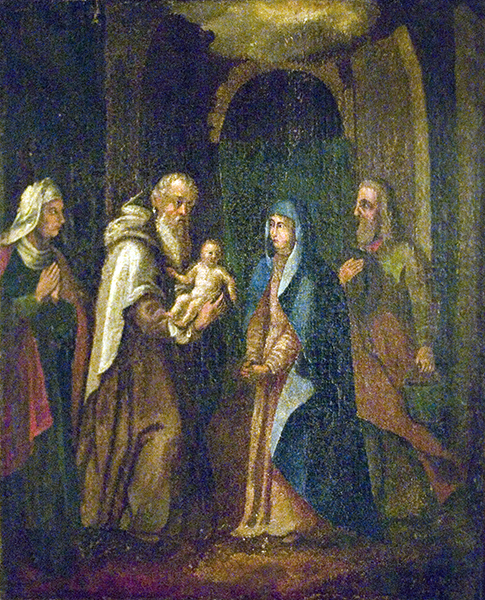
From yesterday’s gospel reading (Lk 2:22-35), the last recorded words of Simeon to Mary at her presentation of Jesus in the Temple.  I have long wondered about this prophecy and had hoped to find some good extended commentary or a scholarly article on them.  The commentaries I have do not deal with this extensively and I have temporarily lost access to databases that may yield more information.  I did find this (from a simple Google search) that has some helpful commentary and quotes from the Church Fathers.

https://osjusa.org/wp-content/uploads/2013/10/Presentation5902Czestochowa17XXSacristy.jpg

From a church sacristy in Czestochowa, Poland

If anyone can point me to a scholarly article that dives into Simeon’s prophecy it would be greatly appreciated.

“If we say, ‘We have fellowship with him,’ while we continue to walk in darkness, we lie and do not act in truth.”

https://ak3.picdn.net/shutterstock/videos/7761703/thumb/4.jpg

John the Evangelist writes these words very early in the first of his three biblical letters.  Here he reinforces the fact that belief in God/Jesus entails more than an acknowledgment of His existence or a mouthing of words that affirm that faith.  It means walking the walk as well.  He goes on to say that by admitting our sinfulness we have Jesus, whose Blood in sacrifice washes us clean.  Denying sinfulness is equivalent to calling God a liar, thus reversing the poles making God the devil (see the consequences for the Chosen People when they did this in Num 21:4-9).  In humility we acknowledge the truth of our waywardness begging the Divine Mercy to heal our woundedness, cleanse our sins, and help us to be never separated in the least from the God of love.

An additional benefit of acknowledging and avoiding sin is that “we have fellowship with one another.”  The greatest commandment and the second (see Mt 22:34-40) are intimately connected.  If we truly love God then we will love our neighbor because God loves us and them infinitely.  Desiring to be just like the Almighty (see Mt 5:48) we should grow, with grace, to see others as He sees them.

The world today is deficient in truth.  Pontius Pilate’s “What is truth?” (Jn 18:38 — while looking Truth in the eyes!) is repeated with increasing frequency around the world.  Let us do our part to stand firm in the truth and declare it boldly.

“We are writing this so that our joy may be complete.”

This message of the “beloved” apostle John (see Jn 13:21-30, Jn 18:15-18, Jn 19:26-27, Jn 21:7, and Jn 21:20), whose feast we celebrate today, certainly applies to these first words of his first letter that we hear proclaimed at Mass today (1 Jn 1:1-4).  What could be more joyful than conveying the Good News of “the eternal life that was with the Father and was made visible to us”?  The sense here is that John could not wait to spread these glad tidings to the entire world (and who could blame him?!), something he spent the rest of his long life doing.

https://i0.wp.com/www.artnet.com/WebServices/images/ll00025lld3XkFFgneECfDrCWvaHBOcCeF/giuseppe-vermiglio-saint-john-the-evangelist-on-the-island-of-patmos.jpg

St. John the Evangelist on the Island of Patmos attributed to Giuseppe Vermiglio (1585–1635)

But the inspired words at top really apply to all of Divine Revelation.  We can know much about God from what has been given to us in the material universe and in our own being.  But the Lord sent His Holy Spirit to give us the rest of the story.  Through oral tradition, some of which was written down in what became the Bible, we discover everything that God wanted to convey to us for the sake of our salvation (Dei Verbum, 11).  Our joy cannot be complete without knowing the One who created us, the One who saves us, and the One who sanctifies us.  Let this be a clarion call to every believer to dive into Scripture and the Catechism to learn about God and His plan for humanity in general and for each and every one of us personally.  I can think of no better New Year’s resolution than to come to grow deeper in our Faith and grow closer to the Church for which Christ died.

A great way to do this in the span of one year is to use The Coming Home Network’s free guide found here.  Use your Catholic Bible or find one in a local bookstore or online (here is the version used at Mass).  A great addition to your reading would be a Bible with a good commentary; I suggest these two worthwhile investments: the Navarre Old Testament (electronic here) and the Ignatius New Testament (electronic here).  The Catechism of the Catholic Church can be purchased or found electronically here.

May 2018 be an especially blessed year!

“Stephen, filled with grace and power…but they could not withstand the wisdom and the spirit with which he spoke.”

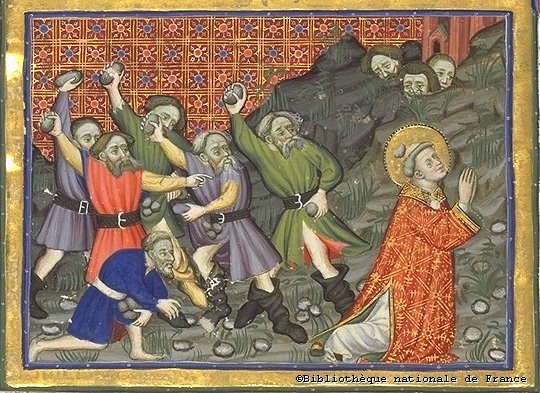
Today’s Feast of St. Stephen, Deacon and First Christian Martyr, presents quite a contrast to yesterday’s joyous celebration of the birth of our savior.  Or does it?  Of course, one episode gives us the beginning of life and the other the end of life (Acts 6:8-10; 7:54-59).  But Jesus’ incarnation, His coming in the flesh in His mother’s womb, is the reason Stephen could even have a vision of the Son of Man in heaven.  It was the end of Jesus’ earthly life and His Ascension into heaven that allowed Stephen to begin his heavenly life at his earthly death.

https://vridar.org/wp-content/uploads/2013/11/stephen.jpg

Would that we all could have the sentiment applied to us that “they could not withstand the wisdom and the spirit with which he spoke”!  Stephen spoke Gospel truth to power “in season and out of season” (see 2 Tim 4:1-5)  We must, in line with the Church Christ established, be unafraid to do the same.  If we sincerely wish to do the Lord’s will and embrace Him fully we have this promise from Jesus in today’s gospel (Mt 10:17-22):

You will be given at that moment what you are to say.
For it will not be you who speak
but the Spirit of your Father speaking through you.

Like Stephen, you may “be hated by all because of my name” but we are promised that “whoever endures to the end will be saved” (again from today’s gospel).  Sounds heavenly to me.

St. Stephen, pray for us that, like you, we may never compromise on the Truth.

“…him who brings glad tidings, announcing peace, bearing good news, announcing salvation…”

The great prophet Isaiah gives us the heartening words above (from Is 52:7-10) on this Christmas day.  Boy, can’t we use glad tidings, peace, good news, and salvation, particularly these days when the news more and more is filled with anything but.  Many folks get disappointed or utterly dismiss Christ because they don’t see these positive things happening in our world or even in their lives.  But they (and we at times) are simply not seeing clearly.  Sin clouds.  Sin brings darkness.  Sin is at the root of unhappy tidings, discord, bad news, damnation.  Jesus came but sin remained.  Yet Jesus overcame sin.  As today’s Gospel tells us, “The light shines in the darkness, and the darkness has not overcome it” (Jn 1:5).

Related image

Peter Paul Rubens  (1577–1640) The Adoration of the Shepherds circa 1608

For our part, we can imitate Christ by asking for the grace to eliminate sin in our lives and doing just what He came into the world to do: bring glad tidings that the Son of God became man for us, announce the peace of soul that only He can deliver, bear the Gospel (the Good News) to every one we encounter by our actions and words, and announce the salvation that is offered to every person who embraces the Lord with the obedience of faith (see Paul’s Letter to the Romans).

Whatever tidings or news come our way, however peaceful or turbulent our lives are here, we have the sure hope of joy, tranquility, and salvation if we only remain faithful.  All because the “Word became flesh and made his dwelling among us” (Jn 1:14) and fulfilled His Father’s will perfectly unto death and life.

May you and yours be blessed this Christmas and always by the Prince of Peace.


“Now I, in turn, give him to the LORD; as long as he lives, he shall be dedicated to the LORD.”

These words from Hannah, in the book named after her child (1 Samuel 1:24-28), whose prayers for having this child were answered, resonate through all ages.

The Infant Samuel brought by Hanna to Eli

The Infant Samuel brought by Hanna to Eli by Gerbrand van den Eeckhout (1621–1674)

Would it be that all mothers, all parents, exclaim these words!  Of course, any good and responsible Christian parent has his child baptized shortly after birth, making the infant a child of God.  But shouldn’t we desire in the depths of our being that our children “be dedicated to the Lord,” whether in the priesthood or consecrated life (this so needs to be encouraged or at least welcomed) or just in always striving to do the will of God?

Every child is a gift (born or unborn), whether pregnancy comes easy or, like with Hannah, only after much time and difficulty.  In any case, ultimately, we all belong to our heavenly Father and our hearts are restless until we rest in Him.  So let’s dedicate our children and rededicate ourselves to seeking God’s will and then following it.

“How can this be, since I have no relations with a man?”

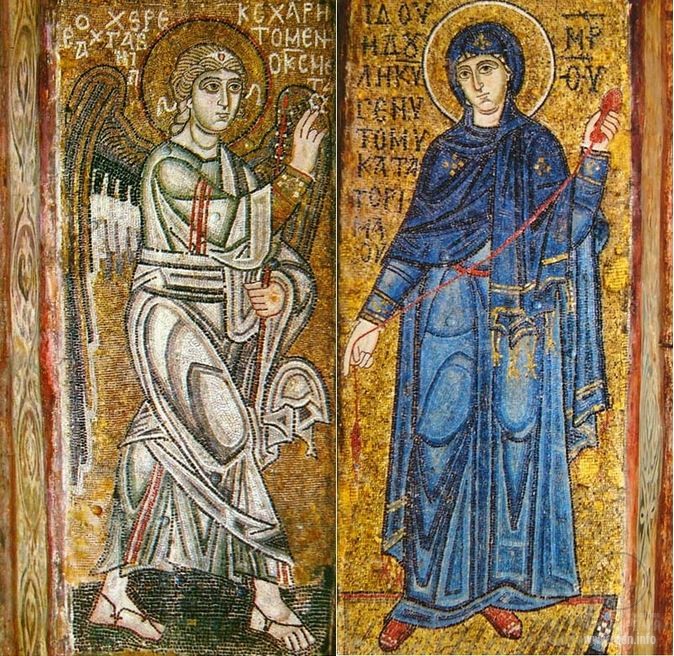
These words from Mary during the Annunciation scene (Lk 1:26-38) have perplexed many throughout the centuries.  I always attributed it to a vow that she must have made to remain a virgin, because why else would she say this unless she never intended to become pregnant.  Remember that she was already betrothed to Joseph and she certainly would have expected pregnancy with him assuming they were going to share the marriage bed.  And what was betrothal for the Israelites of the time?  George Martin tells us:

Betrothal was more than engagement: a betrothed couple was considered married [so much for Mary being pregnant and unwed] and were spoken of as husband and wife, even though the bride continued to live in her father’s house and the couple refrained from sexual relations.  A year or so after betrothal the husband would bring his wife to live in his house, and they would begin to have sexual relations.
(George Martin, Bringing the Gospel of Luke to Life [Huntington, IN: Our Sunday Visitor, 2011] 19)

So, what were Joseph’s expectations?  Pope Benedict works through several scenarios regarding Mary’s response above, but finds no definitive or even satisfactory answer.

Since Saint Augustine, one explanation has been put forward is that Mary had taken a vow of virginity and had entered into the betrothal simply in order to have a protector for her virginity.  But this theory is quite foreign to the world of the Judaism of Jesus’ time, and in that context it seems inconceivable.  So how are we to understand this passage?  A satisfying answer has yet to be found by modern exegesis.  Some say that at this point, having not yet been taken into the marital home, Mary had had no dealings with men, yet she saw the task as immediately pressing.  But this fails to convince, as the time when she would be taken into the marital home could not have been far off.  Other exegetes have wanted to view the saying as a purely literary construction, designed to continue the dialogue between Mary and the angel.  Yet this is no real explanation of the saying either.  Another element to keep in mind is that according to Jewish custom, betrothal was unilaterally pronounced by the man, and the woman was not invited to express her consent.  Yet this does not solve the problem either.

So the riddle remains — or perhaps one should say the mystery — of this saying.  Mary sees no way, for reasons that are beyond our grasp, that she could become mother of the Messiah through marital relations.  The angel confirms that her motherhood will not come about in the normal way after she has been taken home by Joseph, but through “overshadowing, by the power of the Most High,” by the coming of the Holy Spirit, and he notes emphatically: “For with God nothing will be impossible” (Lk 1:37).  (Joseph Ratzinger [Pope Benedict XVI],  Jesus of Nazareth: The Infancy Narratives [New York: Image, 2012], 34-35)

Maybe we will only come to know the answer in heaven.  Meanwhile, thank heaven Mary responded in the affirmative to the Father’s design for our redemption, the Word becoming flesh.
https://rgdn.info/assets/uploads/images/photos/4432b-blagovesthenie-5-.jpg

“O Leader of the House of Israel, giver of the Law to Moses on Sinai: come to rescue us with your mighty power!”

The “O” Antiphons are sung before the Gospel reading each weekday from December 17th through the 23rd.  From the USCCB site:

The Roman Church has been singing the “O” Antiphons since at least the eighth century….They are a magnificent theology that uses ancient biblical imagery drawn from the messianic hopes of the Old Testament to proclaim the coming Christ as the fulfillment not only of Old Testament hopes, but present ones as well.  Their repeated use of the imperative “Come!” embodies the longing of all for the Divine Messiah.

Regarding today’s “O” Antiphon, given in its entirety at top, yes, we need rescue these days (all days, to be sure, but now at least as much as ever).  In a world that largely wishes to push God out, or at least keep Him in His place (behind closed doors in your home or place of worship), wouldn’t it be awesome if our Leader would come in Power sooner rather than later (see Lk 22:69 and Lk 21:25-28)?

https://www.olqpsouthb.org/wp-content/uploads/Sundayreadings/son-of-man-in-glory.jpg

Meanwhile, it is up to us, who claim to be faithful, to take seriously Jesus’ instruction in the Our Father to hasten the coming of His Kingdom by praying and working “that all people submit to God’s reign” (per OT prophecies from which the “O” Antiphons themselves were developed) and “that God reign in [my] own life” for starters. (Mitch and Sri in The Gospel of Matthew, p. 106).