“Because of my relatives and friends I will say, ‘Peace be within you!'”

This line from today’s Psalm 122 struck me as I consider the imminent approach of Christmas.  So many persons have feelings of anything but peace as they fret about getting together for the holidays with relatives they may not have seen since last December.  (Hopefully the same feeling is not the case with friends; I recall the famous Harper Lee quote made known to me by Peanuts: “You can choose your friends but you sho’ can’t choose your family.”)  Anxiety builds as the party approaches.  Will Uncle Joe go off on a rant after one too many cocktails?  Will my Great-Aunt Joan ask me again this year why I haven’t yet married?  Will Cousin Carl bring up once more the slight he felt from my dad a dozen years ago?  Will the tension in the air be thick enough to cut with a knife as the competitive sisters try to outdo each other in their baking?  Will little Billy (who’s not that little anymore) continue to terrorize the guests with his bad behavior that mom won’t discipline?  It’s enough to make one not get out of bed the entire day.

While skipping the event might be tempting, let’s consider how we can help by our presence.  In the run up to Christmas (Advent, not the three months — or more — of advertising leading up to it) we should be preparing for the coming of Jesus Christ, the Prince of Peace (Is 9:6).  Since we are to imitate Him in all things, we should also imitate Him in this aspect (remember “Blessed are the peacemakers, for they will be called children of God” — Mt 5:9?).  Just your calming, patient, smiling presence may provide an island of refuge in the turbulence.  Engage Joe in conversation taking a real interest.  Tell Joan you appreciate her concern and would value her prayers.  Explain to Carl that no offense was meant if he brings it up.  Tell the ladies that both of their desserts are wonderful and made the day better.  Play a game with Billy and really engage him in conversation.  Some of these attempts will work better than others but you can rest assured there will be several folks who will appreciate your being there.  Whatever happens, pray before, during, and after for all the guests and everyone who needs to find peace so that they may properly enter into the silent night of our Savior’s birth.

A final note.  Helpful when coming across a particular word in Scripture that strikes you in a special way is looking for other instances of that word in the entire Bible.  “Peace” shows up well over 400 times (see my favorite Bible search engine here).  A systematic reading of even a few of these instances will quickly impress upon you the importance of this concept in the Word and will help you to experience it and to live it.

“All our good deeds are like polluted rags.”

Isaiah (63:16b-17, 19b; 64:2-7) today, the first day of Advent, laments the state of the Chosen People.  The history of God’s special ones is peppered with instances of the people falling away through sin, being called back to faithfulness, eventually being punished because they do not turn back to God, then repenting and being restored.  In this passage, probably written during the Babylonian exile, 6th century BC) we find the prophet’s plea to God to straighten out a people gone astray.  It is as if the author has given up on trying to convince his fellow sinners to repent.  Now he turns to the Lord as the only one who can make things right.

https://bjorkbloggen.files.wordpress.com/2012/04/filthy-rags.jpg

I highlight the excerpt in the headline because I have often heard it used by some Protestants as one defense of “faith alone” (St. Paul never uses that term but rather “faith working through love” [Gal 5:6] and “the obedience of faith” [Rom 1:5 and 16:26].  If even objectively righteous acts we perform are like “filthy rags” (“menstrual rags” is the literal translation), then these are less than nothing in God’s eyes.  To the Catholic (or any reader of the Gospels) this should sound rather odd.  Jesus often talks about the necessity of good works. most famously in the “sheep and the goats” (Mt 25:31-46).  So how does this work?  Doing a bit of research I went to the consistently reliable Catholic Answers.  An excerpt (you are encouraged to read the full text here):

This (Is 64:4-6, 10-11) pertains to a particular historical situation, not to a general condition…It was during that period of continued sin, leading up to the destruction of Jerusalem in 586 B.C., that they had “become like one who is unclean”–they hadn’t always been like that. In this state, even the nation’s acts of righteousness appeared like filthy rags to God, so he wouldn’t help them.

The whole debate regarding faith and works is intense and involved and I would encourage you to look into it (start here and here),  “Faith alone” was called by Martin Luther the “article on which the church stands or falls” so clearly it is critical to understand the issues involved.

A basic principle that helps here and in many other instances can be found in CCC 112 (from Dei Verbum 12): “Be especially attentive ‘to the content and unity of the whole Scripture.’”  As has been famously said, a text taken out of context becomes a pretext for a proof-text.  The important principle in CCC 112 helps to ensure that we don’t fall into this trap.  Does the quoted text work with the rest of Divine Revelation or does it contradict other passages?  God’s revelation is a cohesive whole (sometimes challenging to understand, and even more challenging to live, to be sure).  Do not be confused or intimidated by random verses fired at you by someone trying to shake your faith.  There are many persons and resources faithful to Mother Church that are available for your help, support, and edification.

May this Advent season be for us the most blessed yet.

“Since you were faithful in small matters…Come, share your master’s joy.”

“Well done, my good and faithful servant.
Since you were faithful in small matters,
I will give you great responsibilities.
Come, share your master’s joy.” — Matthew 25:23

Aren’t these words from today’s gospel reading (Mt 25:14-30) exactly those all of us want to here when we meet the Lord at the end of our earthly life?  Of course!  The key: being “faithful in small matters.”

We have a tendency to think that it’s the “big stuff” that counts with God.  We hear stories of heroic deeds, martyred saints, and lives spent in monasteries and figure we don’t come close to that sort of commitment to our Faith.  And God bless those who are able to do those things (and pray that we would do the same if we are called to it).

Whatever we are able to do for Jesus (and you are capable of much more than you might imagine) all of us have to deal to some extent with the humdrum of our day to day existence.  How do we handle the ordinary tasks, the regular interactions, and the little annoyances?  Let us remember St. Therese of Lisieux and her “Little Way.”  She famously wrote this beautiful line to her sister:

Our Lord does not look so much at the greatness of our actions,
nor even at their difficulty, but at the love with which we do them.

https://tomperna.files.wordpress.com/2013/10/therese-as-a-child.jpg

Therese died before reaching her 25th birthday.  Her entire religious life was spent hidden away in the cloister.  Yet she is one of the most renowned saints in the world and one of only three dozen Doctors of the Church declared in two millennia.  She provides a splendid example for us which we can work to apply hour by hour.  Washing the dishes?  Do it with special attentiveness.  Suffering a long wait in the checkout line?  Say a prayer for the other persons in line (and the cashier).  Reminded of a friend who has been out of touch?  A quick call to say “Hello, I’m thinking of you.”  Eager to break away from a colleague going on and on with a boring tale?  Patience and kindness.  Using or admiring a gift that was given to you months or years ago?  Write a note to say thanks again and send it along with a prayer.

When this approach becomes habitual (yes, I know from personal experience that it can be a great challenge) we share in our “master’s joy” here and now and look forward in hope to the incomparable bliss of the beatific vision for all eternity.


“I tell you, not even in Israel have I found such faith.”

Today’s gospel passage at Mass is Luke 7:1-10 in which a centurion boldly asks Jesus to heal his servant.  It is my favorite interaction between Jesus and someone outside His “inner circle.”

I have written about different aspects of this episode before which I invite you to read:

But another thought came to mind as well.  It takes a military man to really appreciate the authority of Jesus.  The training, the discipline, and the chain of command all play into the respectful request and response the centurion gave to the Lord.  It makes me respect our brave and selfless men and women in uniform all the more.  Christ certainly was amazed — a rare occurrence as you read in the first link above — at his insight.

Finally, it makes all the more poignant and moving the words we say at Mass immediately before receiving Communion:

https://i0.wp.com/slideplayer.com/slide/6249751/21/images/28/Lord%2BI%2Bam%2Bnot%2Bworthy%2Bthat%2Byou%2Bshould%2Benter%2Bunder%2Bmy%2Broof%2C%2Bbut%2Bonly%2Bsay%2Bthe%2Bword%2Band%2Bmy%2Bsoul%2Bshall%2Bbe%2Bhealed..jpg


“I rejoice in my sufferings for your sake, and in my flesh I am filling up what is lacking in the afflictions of Christ on behalf of his Body, which is the Church.”

This is quite a controversial statement of Paul’s to the Colossians (1:24) we hear proclaimed in today’s first reading (Col 1:24-2:3).  I thought I would go to my favorite Bible commentaries to get clarification.  I share them with you.

My first go to commentary:

what is lacking: I.e., the suffering that remains for believers in the trials of life. Suffering is a mission for all the faithful as a means of conforming ourselves to Christ (Rom 8:17; Phil 3:10), but suffering is a special calling for ministers of the gospel like Paul, who endure many afflictions in the effort to bring salvation to others (2 Cor 1:6; 4:11–15) (CCC 307, 618, 1508). ● These words could be misunderstood to mean that the suffering of Christ was not sufficient for redemption and that the suffering of the saints must be added to complete it. This, however, would be heretical. Christ and the Church are one mystical person, and while the merits of Christ, the head, are infinite, the saints acquire merit in a limited degree. What is “lacking”, then, pertains to the afflictions of the entire Church, to which Paul adds his own amount (St. Thomas Aquinas, Commentary on Colossians 1, 6).

The Ignatius Catholic Study Bible: The New Testament. (2010). (p. 366). San Francisco: Ignatius Press.  Emphasis added.

Next in line commentary in my library:

The most common exploitation of this statement is summarized by St. Alphonsus as follows: […] for the merits of the Passion to be applied to us, according to St. Thomas (Summa theolougiae, III, q. 49, a. 3), we need to cooperate (subjective redemption) by patiently bearing the trials God sends us, so as to become like our head, Christ” (St. Alphonsus, Thoughts on the Passion, 10).

[…]

Faith in the fact that we are sharing in the sufferings of Christ, John Paul II says, gives a person “the certainty that in the spiritual dimension of the work of Redemption he is serving, like Christ, the salvation of his brothers and sisters. Therefore he is carrying out an irreplaceable service. In the Body of Christ, which is ceaselessly born of the Cross of the Redeemer, it is precisely suffering permeated by the spirit of Christ’s sacrifice that is the irreplaceable mediator and author of the good things which are indispensable for the world’s salvation. It is suffering, more than anything else, which clears the way for the grace which transforms human souls. Suffering, more than anything else, makes present in the history of humanity the force of the Redemption” (Salvifici doloris, 27).

The Navarre Bible: Captivity Epistles. (1992). (pp. 171-172). Dublin: Four Courts Press.

Catholics are very fortunate to have such a well-developed “theology of suffering.”  Many Protestants (and, of course, the world at large) struggle with the understanding of the entire concept.  Christ’s redemptive work did not take suffering out of the world.  It did make it meaningful, though.  We are called to bear it as Our Lord did and St. Paul did.

https://i0.wp.com/vridar.org/wp-content/uploads/2014/08/tumblr_lvcvlgUn9O1qbhp9xo1_1280.jpgJean-Baptiste de Champaigne, Saint Paul Stoned in the City of Lystra
(1667)

“Who do you say that I am?”

(Submitted by me for today’s bulletin as a member of my parish’s Spiritual Life Committee.)

Who do you say that I am?

What an interesting question from Our Lord to His disciples.  They had been with him for some time already (this interaction comes well into Matthew’s Gospel — Mt 16:13-20) having seen many miracles, hearing many sermons, and witnessing many interactions.  And now Jesus feels compelled to ask them what they make of Him.  In response, He gets a smattering from the Twelve about what others are saying.  None is bold enough (or sure enough?) to answer for himself.  That is, until Peter speaks out with an authority given to him by God: You are the Christ, the Son of the living God.  This is the basis of the papacy; all Catholics should be able to point to Matthew 16:18 when challenged on this matter.  More immediately for the apostles, this ringing exclamation should help to prepare them for Jesus’ immediate prediction of His passion and death and, within a week, His Transfiguration.  As Jesus’ time grows short and challenges mount, His closest companions must have no doubt about their Master’s mission and who they are to look to for guidance when He completes that earthly mission.  Consider how and when you look to the Vicar of Christ for guidance.

https://seeinggodinart.files.wordpress.com/2015/09/wpid-image-12.jpeg

Who do you say that I am?

 What an interesting question from Our Lord to each one of us.  It is worthwhile to consider this question often as your answer will likely change depending on your circumstances or disposition.  Do you think of Jesus as primarily your Friend these days?  Or maybe He is Teacher.  In a stressful or painful time He may be Comforter.  During and after recovery He can be seen as Healer.  When it’s decision time He should be looked to as Guide.  The question of who Jesus is to you is well worth contemplating and meditating upon often.  But whatever aspect is most prominent at any point in time, He must always be Lord of every aspect of our lives and beings.  And if there is a place where He is not, then Jesus is Challenger.  Consider today in what aspect of your life Jesus is challenging you most and then determine how you will take up that challenge.


“Laborers in the Vineyard: God’s Challenge, Our Reward”

Today’s gospel (Mt 20:1-16) reminded me of an article I wrote nearly a decade ago:

http://www.cuf.org/2008/03/laborers-in-the-vineyard-gods-challenge-our-reward/

https://upload.wikimedia.org/wikipedia/commons/thumb/1/17/Jacob_Willemsz._de_Wet_d._%C3%84._002.jpg/1200px-Jacob_Willemsz._de_Wet_d._%C3%84._002.jpg

Jacob Willemszoon de Wet, mid 17th century.

I would add an insight that came to me today upon hearing this reading again.  While this parable doesn’t make sense on a practical level or in a business sense, it does convey an important truth.  The ultimate reward that comes from God is the perfect happiness of heaven.  So, whether one has been following Christ his entire life or is relatively new (even on his deathbed) to communion with the Church, the “compensation” for staying committed to the Lord until our final breaths is the same.  With the God who is Love (see 1 Jn 4:8), it can’t be any other way.  We should not want it any other way, either.

And for those struggling even still with this whole concept, these verses (one Old, one New) that kept popping into my mind today should help:

For my thoughts are not your thoughts,

nor are your ways my ways…

For as the heavens are higher than the earth,

so are my ways higher than your ways,

my thoughts higher than your thoughts.

— Isaiah 55:8-9

and

For the foolishness of God is wiser than human wisdom…

— 1 Corinthians 1:25

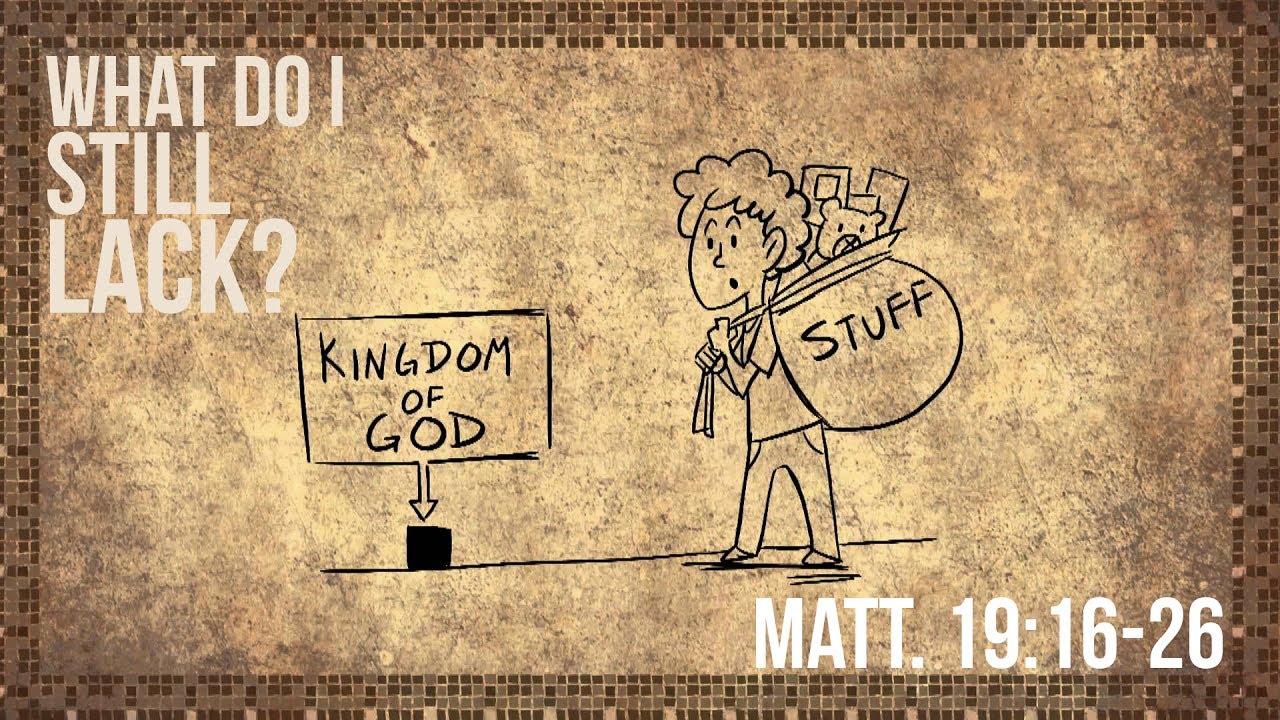
“All of these I have observed. What do I still lack?”

Today’s gospel reading (Mt 19:16-22) gives us the story of the rich young man.  He asks Jesus, “Teacher, what good must I do to gain eternal life?”  Jesus tells him to keep the commandments but the fellow persists.  Then Jesus lists some commandments as the man requests.  The man is still not satisfied and then asks the question in the headline.  This is when Jesus tells him to give what he owns to the poor and follow Him.  The man goes away sad.

https://i.ytimg.com/vi/V6kS-5dFS64/maxresdefault.jpg

The passage read today got me thinking about the rich man’s motivation.  Did he wish to justify himself to others (“I know what they’re saying — I’ll show them!”)?  Was it a pang of conscience (“Should I be doing more for others?”)?  Or had he been following Jesus, or at least listening to Him or hearing reports, and become enthusiastic (“I’m fired up– what else can I do?”)?

Although the man pushed the issue, clearly he was not expecting the answer he was given.  Possessions, generally, are neutral.  Yet clearly Jesus had insight into this man’s heart.  It was not the man who had possessions it was possessions who had the man.  Thus he went away sad.  Why sad and not angry or dismissive?  I believe it is because deep down he really wanted to follow Jesus – and knew He was right in His assessment.  He knew that his stuff was holding him back.  Yet he was not in a place where he was prepared to give up that which kept him from fully throwing in with Jesus.

While Scripture tells us no more about this man, it is interesting to wonder what became of him.  Did he eventually follow Jesus or at least become a Christian at some point in his life.  Or did he continue for the rest of his life to focus on his finances and build an even greater estate.  Maybe he lost his wealth and reconsidered his priorities.  Whatever the case, I am willing to bet that Jesus’ words stayed with him long after the two parted ways.

And so we ask ourselves the same question: “What do I still lack?”  What is it that possesses us and keeps us from a wholehearted relationship with Christ?  Whether its stuff, sin, or worldly cares and distractions, Jesus asks of us the same thing he asked the young fellow 2000 years ago: get rid of any obstacles “then come, follow me.”


“The woman herself fled into the desert where she had a place prepared by God, that there she might be taken care of for twelve hundred and sixty days.”

The passage above from today’s first reading for the Feast of the Assumption (Rev 11:19a; 12;1-6a, 10ab) has long intrigued me.  Upon hearing it again today, I thought I would look to several of my commentaries for explanation.

While it is true that some commentators, particularly those who wish to downplay the role or status of Mary, the mother of Jesus, will not see her in the beginning of Revelation 12, a good Catholic approach (here and in many other places in Revelation [and Divine Revelation]) is to see layers or levels of meaning.  To wit:

When the entire text is taken into account the woman is seen to be faithful Israel, personified as daughter Zion, who gives birth to the Messiah.  At the same [time], the woman is the literal mother of the Messiah, Mary of Nazareth.  Finally, the woman is the Church, whom God cares for during her time in the wilderness of this world and who brings forth children (12:17).  This vision illustrates Revelation’s symbolic way of communicating, the multiple levels of meaning in images, and the book’s nonlinear chronology, since the story that this vision tells begins before the birth of Christ.  (Peter S. Williamson, Revelation [Catholic Commentary on Sacred Scripture] [Grand Rapids: Baker Academic, 2015], 210)

Virgin as the Woman of the Apocalypse, Peter Paul Rubens,  1623-1624 Getty.

Matris Apocalypticae effigies, Peter Paul Rubens, c. 1625/1630

My friend, Jim Papandrea, tends more strongly to a Marian interpretation while recognizing other allusions and then ties them all together to provide historical context:

Revelation 12:6 and 12:13-16 refer to the same event, the flight of the holy family into Egypt.[…where] they were guided and protected by God, and according to verses 6 and 14, they spent about three and a half years in Egypt.[…]  It is the same amount of time as the activity of the beast, that is, the war of Rome against the people of Judea.[…]  It is also the same amount of time that is described in the book of Daniel as a great tribulation interpreted as the reign of Antiochus IV.  Connecting all these events in this way signifies that the same satanic force that was cast out of heaven also caused the oppression of historic Israel, tried to kill the infant Jesus, was behind the Roman war against the Jews with the subsequent destruction of the temple, and will be behind the continued persecution of the Church.  Just as there is a continuity to God’s activity in history, there is also a historical continuity to the activity of Satan on earth.  (James L. Papandrea, The Wedding of the Lamb [Eugene, OR: Pickwick, 2011], 111-112)

Consider the depth of meaning in just one verse that, on its face, is easy for the average reader or hearer to hurry past or dismiss entirely as of little importance.  It is imperative that we dive into scripture (with the guidance of the Church and commentaries faithful to it) so that we do not miss out on so much that God, out of His graciousness, has given to us in His Word.  Dr. Papandrea’s interpretation in particular shows that understanding the Bible is not of mere intellectual interest but also helps us understand the world in which we live.

Our Lady of the Assumption, pray for us.


“When Jesus heard of the death of John the Baptist, he withdrew in a boat to a deserted place by himself.”

When speaking of Scripture reading or more formal Scripture study, I often emphasize the  importance of not overlooking what seem to be minor or unimportant details.  The Catechism of the Catholic Church, quoting Vatican II’s document on Divine Revelation (Dei Verbum 11), tells us:

To compose the sacred books, God chose certain men who, all the while he employed them in this task, made full use of their own faculties and powers so that, though he acted in them and by them, it was as true authors that they consigned to writing whatever he wanted written, and no more. (no. 106)

So, everything in the Bible is what the Almighty wanted in its pages — no more, no less.

So who are we to overlook any words of the Word?  The first verse of today’s Gospel reading (Mt 14:13-21) is easy to bypass mentally as we move to what appears to be the “meat” of the passage.  But no so fast.  There is value in slowing down in many aspects of living, including in our reading of Holy Writ.

Consider what John meant to Jesus.

Cousin: “For at the moment the sound of your greeting reached my ears, the infant in my womb leaped for joy.” (Lk 1:44)

Forerunner and preparer:

* “He will go before him in the spirit and power of Elijah to turn the hearts of fathers toward children and the disobedient to the understanding of the righteous, to prepare a people fit for the Lord.” (Lk 1:17)

* “And you, child, will be called prophet of the Most High, for you will go before the Lord to prepare his ways, to give his people knowledge of salvation through the forgiveness of their sins. (Lk 1: 76-77)

https://thepassionists.org/uploads/post/image/1222/john_the_baptist_002.jpg

Status: “I tell you, among those born of women, no one is greater than John.” (Lk 7:28)

Is it any wonder Jesus wanted some time alone to grieve?  The cousin who greeted Him from the womb.  The one who paved the way, making Jesus’ task easier in certain ways.  A great man, the greatest to have ever lived, who never compromised on the truth, and paid dearly for it.  So, might the Lord not also have been reminded that John’s fate — death at the hands of enemies — would be His as well and for the same reason?  The thoughts and emotions must have weighed down on Him.  Yet, like His cousin, Jesus never tired of giving of Himself.  As we read on, the crowds continue to press, and Jesus, always the Good Shepherd, pities them even in the depths of His own sorrow.  No rest for the weary, but Jesus realized that He was to use His limited time in the service of others.  In this scene He truly was the Suffering Servant, setting aside His own needs for the needs of the people.

As usual, Jesus provides the example for us to focus on others rather than on our own difficulties.  In this way we make ourselves more receptive to God’s grace while opening up others to the same by exemplifying a truly Christ-like disposition.