“In life he performed wonders, and after death, marvelous deeds.”

I was struck when I heard this passage proclaimed in the first reading (Sir 48:1-14) at Mass today.  I don’t recall ever hearing it used in apologetic discussions regarding the intercession of the saints, but there it is in the Old Testament (at least the Catholic OT — maybe because it is one of the books considered “apocryphal” by Protestants that it is not used to defend Catholic teaching on the matter, at least in debates; this article will be helpful regarding the scriptures not considered canonical by Protestants).

Ostensibly, this verse is referring to 2 Kings 13:21 when a dead man was thrown into Elisha’s grave and immediately came back to life upon touching his bones.  I believe I have heard this verse used to defend the concept of relics, but it seems to me that it could be used more broadly to encourage asking the help of holy men and women who have gone before us.  If the Lord allows Elisha’s bones to have such miraculous powers, which declares him to be of special character, certainly invoking his help cannot be discouraged (St. Elisha, whose feast day was one week ago, pray for us!).

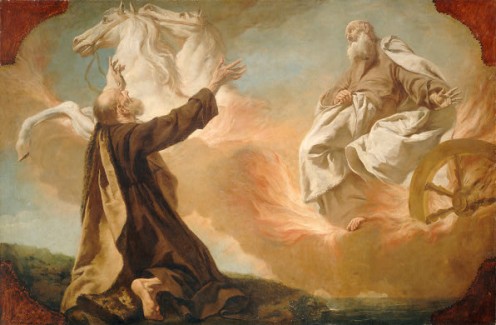
https://usercontent1.hubstatic.com/4853816_f496.jpgGiuseppe Angeli, Oil on canvas

Elisha is famously known for the scene above, in which he watches Elijah taken up to heaven in a “chariot of fire” (2 Kgs 2:11-12) after receiving the former’s mantle (taking over his work).  But, in doing a bit of research on Elisha, he is an absolutely fascinating character in his own right (it is worth reading his whole story, starting in 1 Kings 19 and continuing in 2 Kings 2-13, as well as the overview of his ministry given in this chapter of Sirach; he even gets a shout out from Jesus in Luke 4:27).  The Catholic Bible Dictionary (Scott Hahn, gen. ed., [New York: Doubleday, 2009]) points out a certain uniqueness in Elijah in his “receiv[ing] ecstatic experiences in a way that was noteworthy than for any other Old Testament prophet” but “[a]lthough immensely influential, he remains in the shadow of his mentor, Elijah” (p. 242).

Consider bringing him out of the shadows for your own edification by reading about him.


“Take care not to perform righteous deeds in order that people may see them.”

These are the first words of Jesus in today’s gospel reading (Mt 6:1-6, 16-18) and are part of the Sermon on the Mount.  He follows with particular admonitions to those who make a big show of giving alms, praying, and fasting.  But the first thing I thought of was the particularly modern trend called virtue signalling (“commonly used as a pejorative characterization by commentators to criticize what they regard as empty, or superficial support of certain political views, and also used within groups to criticize their own members for valuing outward appearance over substantive action” —  Wikipedia).

Just as it is not only proper, but a necessity, for Christians to give alms, pray, and fast (just search for these terms in the Bible or note that in this passage the Father will repay [reward] the one who does these things), we should also be not afraid to make clear our stances, rooted in Catholic teaching, on the pressing moral issues of the day.

But, if the expression of these positions consists of showing off to a large number of folks (and social media facilitates this quite well) without “substantive action,” as the definition above states, then one must look long and hard at his intentions.  The “reward” for folks such as these is “received” in the accolades and awards.  The repayment we desire is not from this world but from the next.

It seems that the appropriate place to begin to move from signalling to action is with the three meritorious deeds laid out in this reading:

  1. Give alms to support the causes that can be advocated morally and no longer contribute to organizations that militate against the good.
  2. Pray daily for the advancement of God’s kingdom on earth through the conversion of a culture that has “exchanged the truth of God for a lie and revered and worshiped the creature rather than the creator” (Rom 1:25).  The “ruler of this world” (Jn 12:31, also see Jn 14:30) seems to be gaining ground, so prayer is an absolute necessity (see Mk 9:14-29).
  3. Fasting seems to be making somewhat of a comeback these days (beyond two days year), but so many saints anticipated us in this practice (see this article for examples).  In preparing for His public ministry, Jesus “fasted for forty days” (Mt 4:2).  Should we not also take up this practice so that we are prepared for what the world throws at us?

Let us be sure to do more than signal virtue.  Supported by prayer and fasting, let us live virtuously (find an overview of the virtues in the Catechism of the Catholic Church here).

“The dogs have a mighty appetite; they never have enough.”

This passage from Isaiah 56 seems appropriate for today as we mourn the passing of the beagle matriarch of our family, “queen bee” Nellie.  We were blessed to have her joyful presence for nearly twelve years, having rescued her at about the age of three.  A faithful companion, a brave cancer battler, a voracious eater (at least until recently), and an inveterate squirrel hunter, she is already sorely missed.

IMAG0958.jpg

I am heartened by Peter Kreeft in Everything You Ever Wanted to Know About Heaven… But Never Dreamed of Asking (San Francisco: Ignatius Press, 1990, 45-46) that we will see Nellie again.  The excerpt from the book (below) is from this article.

10. Are There Animals in Heaven?

The simplest answer is: Why not? How irrational is the prejudice that would allow plants (green fields and flowers) but not animals into Heaven! [St. Thomas Aquinas, Summa Theologiae, III (Supplement), 91, 5] Much more reasonable is C.S. Lewis’ speculation that we will be “between the angels who are our elder brothers and the beasts who are our jesters, servants and playfellows” [That Hideous Strength, p. 378] Scripture seems to confirm this: “thy judgments are like the great deep; man and beast thou savest, O Lord” [Psalm 36:6]. Animals belong in the “new earth” [Revelation 21:1] as much as trees.

C.S. Lewis supposes that animals are saved “in” their masters, as part of their extended family [The Problem of Pain, pp. 138-39]. Only tamed animals would be saved in this way. It would seem more likely that wild animals are in Heaven too, since wildness, otherness, not-mine-ness, is a proper pleasure for us [C.S. Lewis, Miracles, p. 78]. The very fact that the seagull takes no notice of me when it utters its remote, lonely call is part of its glory.

Would the same animals be in Heaven as on earth? “Is my dead cat in Heaven?” Again, why not? God can raise up the very grass [Psalm 90:5-6. If we are “like grass”, and we are raised, grass can be raised, too]; why not cats? Though the blessed have better things to do than play with pets, the better does not exclude the lesser. We were meant from the beginning to have stewardship over the animals [Genesis 1:28]; we have not fulfilled that divine plan yet on earth; therefore it seems likely that the right relationship with animals will be part of Heaven: proper “petship”. And what better place to begin than with already petted pets?

“After the fire there was a tiny whispering sound.”

Today’s first reading (1 Kgs 19:9A, 11-16) tells the famous story of the persecuted and pursued prophet Elijah encountering God in a special way.  Neither in the chaos and fury of tornado force winds, nor in an earthquake, nor in fire, did he meet the Lord in his desperate need.  Rather it was the “tiny whispering sound” that alerted Elijah to the presence of Yahweh.  While the earlier events certainly got the great man’s attention, it was only to prepare him for the “still small voice” (as the Revised Standard Version and others beautifully translate it).  I wonder what God whispered?

In our “progress,” the world has become an increasingly “noisy” place, particularly starting with the introduction of radio followed by television, and in our day with the advent of the internet, smart phones, and social media.  As we see, noise is not limited to sound, but rather it inundates us in the busyness, distractions, and procrastinations of life.  But this reality should make us all the more eager for quiet time, even if it’s a few minutes each day before everyone gets up or after everyone is asleep (or ideally an occasional hour in front of the Blessed Sacrament [see Mt 26:40]).  It is in these times that we should take the opportunity to commune in a special way with our Creator, talking less (see Mt 6:8) and listening more.

Even Jesus had to get away from time to time (see this article by Fr. Mitch).  His mission was more important than any person’s in history.  If He needed to do it, what excuse can we make?

Coincidentally (and providentially, I think), I recently came across the new book Why God Hides which is next on my spiritual reading list.  I certainly have wondered at times why God seemingly hides.  I know that He is always with us, always fathering, always listening, always caring, always loving.  But it doesn’t always feel that way (so much for feelings, huh?).  Most likely because I am not taking the time or space to really listen.  I look forward to Fr. Portavella’s insights.

While there usually are not explicit links among the readings during weekday Masses, I found, with the help of the priest’s homily at morning Mass, a wonderful correspondence among the three Scripture passages proclaimed in the Liturgy of the Word.

For starters, the psalm response, I long to see your face, O Lord, captures well Elijah’s lament and ours in this life and in hope for the next life.  Psalm 27 is a wonderful meditation in times of difficulty.

Finally, the gospel warns of the sin of lust.  While the amount of information on which we can get our hands in an instant today would have been unimaginable even a few decades ago, with the good comes the bad.  The dissonant noise of explicit images and videos serves only to distance ourselves from God and neighbor, sometimes cutting us off completely from both.  Here again we must immediately seek shelter in the calm and quiet of our heavenly Father’s arms for protection so we can hear His “gentle whisper” (New International Version and others) and in the warmth our Blessed Mother’s bosom to hear the beating of her Immaculate Heart.

“This is the heir. Come, let us kill him, and the inheritance will be ours.”

I have long wondered about this line, uttered by the tenants, from the Parable of the Wicked Tenants (Mk 12:1-12).  How in the world, I have asked, could these folks, in their wildest imagination, have thought that murdering the son the landlord sent could possibly gain them the land that they worked?  Was there a practical explanation or was it something strictly spiritual that Jesus was trying to evoke in His hearers?

https://i.pinimg.com/originals/f2/c9/f8/f2c9f891ee727b3646f92a7220a287a5.jpg

Abel Grimmer, The Parable of the Wicked Tenants, c. 1590’s

That the first part of this parable reflects on the history of the Chosen People is quite obvious.  Prophets have come to Israel throughout the Old Testament, always to be ultimately forsaken.  The Son of God now comes, already experiencing rejection by many religious leaders, and anticipates His ultimate demise.  That being the case, the tenants are types of the chief priests and scribes — these words are aimed squarely at them.  So how does this work?  What is the message?

Time to consult some books!  Fortunately, I have more commentaries dedicated to the Gospel of Mark than any other book in the Bible.  Now, many did not address this at all, others touched on it unsatisfactorily, but a few were helpful.

The key to clearing up the confusion is to be disabused of the assumption that the tenants knew that the landlord was alive (remember, he was abroad so who knows what his status is — v. 1).  If they believed that the son was the only heir then killing him would allow them to claim the land, as the law at the time allowed (contrary to some commentaries’ speculation that they would take the land due to contract, confusion, or hostile seizure):

The seizure of the property is illumined by the contemporary legal situation.  The arrival of the son allowed the tenant farmers to assume that the owner had died and that his sole heir had come to claim his inheritance.  Under specified circumstances an inheritance could be regarded as “ownerless property,” which could be lawfully claimed by anyone, the prior right of ownership belonging to the claimant who comes first.  This was the case when an inheritance was not claimed within a specified period of time.  The provision of law explains why the tenants assume that if they murder the son (and presumed heir), they may take unhindered possession of the vineyard.  It would become “ownerless property” which they can claim as the actual occupants of the land.  (William L. Lane, The Gospel of Mark, The New International Commentary on the New Testament [Grand Rapids: Eerdmans, 1974], 418-19)

How does this apply to the religious leaders to whom Jesus is directing this?  They “cherished the hope that in putting Jesus to death they would remain the masters in Israel” (M. J. LaGrange, The Gospel According to Saint Mark [London: Burns, Oates & Washbourne, 1930], 125) (consider John 11:50).  And how do they lord over the people?  “The Son is the heir.  If he dies, the inheritance, that is, the authority to form and to apply the law ourselves, will be ours.” (Adrienne von Speyr, Mark: Meditations for a Community, trans. Michelle K. Borras [San Francisco: Ignatius, 2012], 544) (Jesus calls this out in the entire chapter of Matthew 23).  But the scribes and Pharisees were even worse than the tenants in the parable — they knew God, the ultimate landlord, was alive!

The sin of pride, the crux of the Original Sin, reigned in Jesus’ time as it does today.  Let us never discard the Lord Jesus Christ from our lives or our society, thinking that we don’t need Him, that He gets in the way, or that we know better than God what is right and good.  The destructive results of this attitude are all around us.

Here I have focused on one line in this allegorical story.  But there is so much more to this particular aspect of the pericope as well as the entire passage (particularly its prophetic nature — not only of Jesus’ death but also of the fate of Jerusalem).  Find a good Catholic commentary and dive into this excerpt.  The richness of the symbolism and the terrifying message the Jewish religious leaders should have taken away from it is stunning.

Crowned in prayer.

It came to me today in praying the Third Sorrowful Mystery, The Crowning with Thorns, that Jesus must have been intensely praying the entire time of His Passion, as I recalled this scene from my favorite Jesus movie:

How else could He have endured the unimaginable pain inflicted on Him with the even more pressing weight of all of the sins ever committed and ever to be committed that was placed on Him?  What started on His knees in the Garden of Gethsemane surely must not have ceased until He uttered His final breath on the cross.  In fact, Christ lives Scripture by forgiving His persecutors from the tree (Lk 23:34 and Acts 10:39) and quotes Scripture in His last moments, recognizing that what feels like a “God-forsaken” situation

My God, my God, why have you abandoned me? (Ps 22:2 and Mt 27:46)

really ends with

The generation to come will be told of the Lord,

that they may proclaim to a people yet unborn

the deliverance you have brought. (Ps 22:32)

This image and insight came to mind because of the inaudible groan that comes from Jesus in the video clip above as the thorns are pressed into His skull (scroll down to ‘Effects of the crown of thorns” here for the horrific details of what this must have done to His senses).

This reminded me of this passage from Romans:

In the same way, the Spirit too comes to the aid of our weakness; for we do not know how to pray as we ought, but the Spirit itself intercedes with inexpressible groanings.  And the one who searches hearts knows what is the intention of the Spirit, because it intercedes for the holy ones according to God’s will. (8:26-27)

Now, of course, Jesus not only knew how to pray but taught His apostles (and us) how to pray.  But He was in a time of great physical and mental strain where He must have called on His Holy Spirit for strength, even when no words came.  So He provides an example for us in our tribulations, on how to unite ourselves to His sufferings when words, or even cohesive thoughts, do not come.

Jesus, King with a crown of thorns, help us in our trials.


“Surely it is not I, Rabbi?”

The Gospel for “Spy Wednesday” (Mt 26:14-25) contains a quote (above) from the “spy,” Judas Iscariot, at the Last Supper. Matthew is the only evangelist to relate what Judas said to Jesus in response to Jesus’ speaking of His betrayer, although all four Gospels tell us some form of this episode.  Possibly Judas whispered his words or others did not hear it because of the general discussion/commotion coming from Jesus’ declaration of a betrayer at hand (see Jn 13:28), but it was a bold statement in any case.  We learned a few verses earlier that Judas had already cut a deal with the Pharisees so he knew he was the betrayer.  Was he trying to test Jesus’ to determine if He knew or discerned his intent?  Was he trying to mask his own true intentions to Christ and the others at table (although only John apparently knew at the time [see Jn 13:25-26])?  Might the question betray an internal conflict on the whole matter?  We don’t know.  But we do know that, even though Judas is not mentioned again in Matthew (or Mark or Luke) until he appears in the Garden of Gethsemane to go through with the plot (Mt 26:47-56), he does leave the Passover meal early to put his plan in motion (see Jn 13:20).

Image result for judas at the last supper

Giacomo Raffaelli (1753-1836) detail of mosaic of DaVinci’s The Last Supper

Although the thirty pieces of silver was ostensibly the reason for Judas’ betrayal of his Master, there certainly must have been discontent brewing for some time.  Likely he was disappointed in Jesus.  Somehow He did not meet his expectations.  Instead of walking out after the Bread of Life discourse when Jesus made a point of calling him out (seemingly out of the blue — see Jn 6:70-71), or at some other point, he decided, apparently, to continue to use Jesus’ ministry to line his own pockets (Jn 12:6).  Maybe he enjoyed the fame as well.  But were things getting a little too hot for his comfort?  Did he think Jesus was going down soon and he didn’t want to be caught in his net?

We must be diligent to not emulate Judas.  Jesus tells the apostles in today’s reading, “woe to that man by whom the Son of Man is betrayed; it would be better for that man if he had never been born” (v. 24).  Meaning, that to be born only to end up eternally damned, it would have been better not to have come into existence in the first place.  Let those words of Jesus never apply to us.  To stick with Jesus only when it is advantageous to us but give Him up when we grow disappointed, disenchanted, or afraid makes us no friend of Christ.  Faith, in order to be strengthened, must be tested.  Judas ultimately failed the test.  Unlike Peter, whose offense against Jesus was also grievous (and much more public), but whose remorse led to hope and forgiveness, Judas despaired of God’s mercy and died in his sins.  So, even if we have betrayed Jesus, as long as we have breath, we can return into His good graces as long as we sincerely repent.

Finally, note that Judas may have received the First Communion unworthily (see Jn 13:27, 30; Augustine and Aquinas believe He ate the consecrated bread, although others debate that assertion as they attempt to reconcile all four Gospel accounts).  If he ate, considering the mortal sin he was committing, he was condemning himself: “Therefore whoever eats the bread or drinks the cup of the Lord unworthily will have to answer for the body and blood of the Lord” (1 Cor 11:27).  We are wise to remember well this grave admonition from Paul before presenting ourselves at the altar rail.  Just like Judas, we have access to Jesus (in our case through His ministerial priest who acts in the person of Christ) in Confession so that grave sin can be expunged.  Let us not be like Judas who did not take advantage of the opportunity to repent before or after his dastardly deed.

May St. Peter and all the saintly apostles pray for us that we will fight the good fight and stay close to the Lord till the end.

Palm Sunday in History and Scripture

I thought I would share a paper I put together from which I delivered a talk to a local Catholic young adult group per its leader’s request.  Just click the link below.

Click to access palmsundaypaper.pdf

I pray it enhances your Palm Sunday and Holy Week.

Entry Into Jerusalem (Palm Sunday) "Herran Ratsastus Jerusalemiin” Hand-Painted Byzantine Icon

A Valentine from Jesus and for Jesus

One does not usually associate Valentine’s Day with penitential practice.  In fact, ideally, February 14th means quite the opposite.  A lovely card with a heartfelt sentiment perched on a nightstand.  A beautiful bouquet of roses delivered to the office.  A nice box of chocolates waiting on the dining room table.  A sumptuous dinner at a fancy restaurant.  A romantic stroll through the park.

This year, for the first time in decades, Valentine’s Day happens to fall on Ash Wednesday.  That means abstinence (no meat) and fasting (a full meal and two small meals not equaling one full meal) for Catholics.  Should this put a damper on the day, though?  Of course not!  While a big steak dinner is out, all the other items are still okay (even if, for some, the candy will have to wait to be enjoyed until after Lent).

But what we should not lose sight of is that this blessed confluence of holidays provides us a rare opportunity to contemplate in a special way the Valentine that Jesus left for us: His passion, death, and resurrection that opened up heaven to those who accept this precious gift of salvation.

Solemnly meditating on Christ’s passion also puts us in solidarity with those for whom Valentine’s Day is most painful.  The widows and widowers who recall special moments when their dearly departed was still with them.  The husbands and wives who long to be reunited with spouses away on tours of duty.  The women and men who remember happier days before a painful separation or divorce.

Even the St. Valentine who is remembered on this day was a martyr for love of the Faith in the time of Christian persecutions in the Roman Empire. When the priest at Mass wears red on this day, he is commemorating the blood the saint spilled, not a sentiment toward the holiday.  In fact, the number of canonized saints with the name Valentine reaches double figures — and most of them gave their lives as well because of their complete devotion to Jesus.

So, it seems that love and suffering are intrinsically united.  The deeper the affection, the more one is grieved when loss or separation from the beloved occurs.  Also, the deeper the affection, the more one wishes to take away the suffering of the beloved when it occurs, even taking it upon one’s own self if it were possible.

We see this in the mother whose little girl is battling an aggressive form of cancer who would gladly undergo the chemo and radiation in her child’s place.  We see this in the husband who would give anything to be the one enduring his wife’s crippling arthritis.  We see this in the young fiancée whose critically injured betrothed hangs between life and death and who wishes it were him lying there instead of her.  The examples are countless.

Our prayers for healing should be unceasing, but if the Lord does not grant our request to take away or take on physical pain, we are called to make any suffering he allows redemptive.

On the Cross, Jesus bore the full weight of evil and removed its power over us.  He provided a new meaning for suffering by giving it redemptive power.  By his grace we are able to unite our pain to his redemptive passion.  St. Paul witnessed this when he wrote, “I rejoice in my sufferings for your sake, and in my flesh I complete what is lacking in the afflictions of Christ on behalf of his body, that is, the church” (Col 1:24).

(Catholic Church, United States Catholic Catechism for Adults [Washington, D.C.: United States Conference of Catholic Bishops, 2006], 252.)

What Valentine could we ever receive that is better than this outpouring of love from the God who is Love (1 Jn 4:8)?  And what better Valentine could we give Jesus than returning that love by offering up everything to Him, including our own suffering, whether it be physical or emotional?

Let us make this Valentine’s Day the beginning of forty days of ever deepening love for the Savior who gave to us His Heart, rent open by a lance, and for His Mother who felt keenly the sword of His suffering at the foot of the Cross (see Luke 2:35).  May it be a forty-day Valentine to Jesus, becoming ever more resplendent with each sunrise.

As we prepare for the Easter Triduum may we appreciate in a most profound way the suffering of love that Christ willingly endured for our redemption.  Then our Easter joy will be that much more complete.

May this Lent be especially blessed for you.

“It is not you they reject, they are rejecting me as their king.”

Yahweh’s stern words in today’s first reading (1 Sm 8:4-7, 10-22a) must have shook Samuel to the core.  Samuel, the last of the judges (who were generally a motley lot themselves) with children that went astray, may have found it at least somewhat understandable that the elders had had enough of them all and wanted a different type of ruler.  Unfortunately, their true Ruler (and ours), the only one we can completely trust, did not reign in their hearts.  Despite Samuel’s warnings of what these kings would do to the people, and that they would not be able to fall back on the Lord in their distress, they demanded an earthly king.  What was their stated cause?  “To rule us and to lead us in warfare and fight our battles” (v. 20).  They wanted to be like every other nation, chasing earthly gain and power.  But they did not remember that as the Chosen People they were set apart to be a beacon for all peoples.  Now, rather, they would be subject to the vagaries endured by every other earthly kingdom and their pleas to God would go unheard (at least until they learned their lesson, again and again).

https://i.pinimg.com/736x/67/06/fd/6706fd02f0b572e25048b475a01ba1d7---samuel--give-up-on.jpg

More and more individuals and nations today are rejecting their true King.  Looking to politicians and celebrities (often one and the same) for often very fallible guidance, they wonder why the world is such a mess.  “Where is God in all this?”, they say.  Like with the ancient Israelites, God does not impose Himself on us.  We have the power to reject Him and put our confidence in ourselves.  And when it all goes awry?  “When this takes place, you will complain against the king whom you have chosen, but on that day the LORD will not answer you” (v. 18).

Replacing the Lord of every aspect of our lives and our world with fleeting pleasures (even in just one aspect) and with fallible humans has consequences.  Pray for the conversion of hearts to the one true God.